


MHT CET · Physics · Rotational Motion
From a uniform circular thin disc of mass \(9 \mathrm{M}\) and radius \(\mathrm{R}\), a small disc of radius \(\frac{\mathrm{R}}{3}\) is removed. The centre of the small disc is at a distance \(\frac{2 \mathrm{R}}{3}\) from the centre of original disc. The moment of inertia of the remaining disc about an axis perpendicular to the plane of the disc and passing through the centre of the disc of radius \(\mathrm{R}\) is
- A \(4 \mathrm{MR}^{2}\)
- B \(3 \mathrm{MR}^{2}\)
- C \(\frac{\mathrm{MR}^{2}}{2}\)
- D \(\mathrm{MR}^{2}\)
Answer & Solution
Correct Answer
(A) \(4 \mathrm{MR}^{2}\)
Step-by-step Solution
Detailed explanation
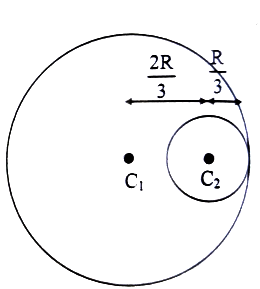
The moment of inertia of the complete disc \(\mathrm{I}_{1}=\frac{9 \mathrm{MR}^{2}}{2}\) The moment of inertia of the removed disc \(=\)
\(
\begin{aligned}
I^{\prime} &=\frac{M}{2}\left(\frac{R}{3}\right)^{2}+M\left(\frac{2 R}{3}\right)^{2}=\frac{M R^{2}}{18}+\frac{4 M R^{2}}{9} \\
&=\frac{M R^{2}}{2}
\end{aligned}
\)
[Since mass is proportional to area, it is proportional to square of the radius. Since the radius of the removed disc is \(\frac{R}{3}\), its mass will be \(M\) ]
\(\therefore\) Moment of inertia of the remaining disc will be \(I_{2}=I_{1}-I^{\prime}=\frac{9 m R^{2}}{2}-\frac{M R^{2}}{2}=4 M R^{2}\)
See the Complete Solution
Get step-by-step explanations for this and 2.5 Lakh+ more JEE, NEET & CET questions.
- Unlock all solutions
- Practice the full chapter
- Track accuracy across PYQs
4.8 rated on Google Play · 14,000+ reviews
More questions from Physics
- The mass of earth is 81 times that of the moon and the radius of the earth is \(3.5\) times that of the moon. The ratio of the escape velocity on the surface of earth to that on the surface of moon will beMHT CET 2011 Easy
- A wire length L and radius r is rigidly fixed at one end. On stretching the other end of the wire with a force F, the increase in length is . If another wire of the same material but double the length and radius is stretched with a force 2F, then increase in length isMHT CET 2019 Medium
- The ratio of magnetic fields due to a bar magnet at the two axial points P1 and P2 which are separated from each other by is . P1 Point is situated at from the centre of the magnet. (Points P1 and P2 are on the same side of magnet and distance of P1 and P2 from the centre of magnet is much greater than the distance of two ends of the magnet from the centre). Magnetic length of the bar magnet isMHT CET 2018 Hard
- A rigid body rotates about a fixed axis with variable angular velocity (\(\propto-\beta \mathrm{t}\)) at time t, where \(\propto\) and \(\beta\) are constants. The angle through which it rotates before it comes to rest isMHT CET 2025 Medium
- A body of mass 1 kg begins to move under the action of a time dependent force \(\vec{F}=\left(t \hat{i}+2 t^2 \hat{j}\right) N\), where \(\hat{i}\) and \(\hat{j}\) are unit vectors along \(x\) and \(y\) axis. The power developed by above force at time \(t=3\) second will beMHT CET 2025 Medium
- A prism having refractive index \(\sqrt{2}\) and refracting angle \(30^{\circ}\) has one of the
refracting surfaces silvered. The beam of light incident on the other refracting
surface will retrace its path, if angle of incidence is \(\left[\sin \frac{\pi}{6}=0 \cdot 5\right]\)MHT CET 2020 Medium
More PYQs from MHT CET
- What is the number of \(>\mathrm{C}=\mathrm{C} < \) bonds present in a linolenic acid molecule?MHT CET 2025 Easy
- Maximum kinetic energy of photon is ' \(E\) ' when wavelength of incident radiation is ' \(\lambda\) '. If wavelength of incident radiations is reduced to \(\frac{\lambda}{3}\) then energy of photon becomes four times. Then work function of the metal isMHT CET 2023 Medium
- Calculate the molar mass of solute in a solution prepared by dissolving 1 gram in \(0.3 \mathrm{dm}^3\) solvent having osmotic pressure 0.2 atm at 300 K.
\(\left[\mathrm{R}=0.082 \mathrm{dm}^3 \mathrm{~atm} \mathrm{~K} \mathrm{~mol}^{-1}\right]\)MHT CET 2024 Easy - Urea enters the nephron through _____.
i. thicker segment of ascending limb of Henle's loop.
ii.thinner segment of ascending limb of Henle's loop.
iii.ultrafiltration into urinary space.
iv.inner medullary segment of collecting tubule.
v.outer medullary segment of collecting tubule.
Select the correct optionMHT CET 2024 Hard - Match column I with column II and select the correct option.
Column I Column II i. Frontal lobe a. Gustato receptors ii. Parietal lobe b. Olfactory receptors iii. Temporal lobe C. Sense of vision iv. Occipital lobe d. Broca's area MHT CET 2024 Hard - When exposed to sunlight, thin films of oil on water often exhibit brilliant colours due to the phenomenon ofMHT CET 2007 Medium