


MHT CET · Physics · Rotational Motion
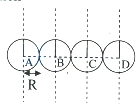
Four identical uniform solid spheres each of same mass ' \(M\) ' and radius ' \(R\) ' are placed touching each other as shown in figure with centres A, B, C, D. \(\mathrm{I}_{\mathrm{A}}, \mathrm{I}_{\mathrm{B}}, \mathrm{I}_{\mathrm{C}}, \mathrm{I}_{\mathrm{D}}\) are the moment of inertia of these spheres respectively about an axis passing through centre and perpendicular to the plane, then
- A \(\mathrm{I}_{\mathrm{A}}>\mathrm{I}_{\mathrm{B}}>\mathrm{I}_{\mathrm{C}}>\mathrm{I}_{\mathrm{D}}\)
- B \(\mathrm{I}_{\mathrm{D}}>\mathrm{I}_{\mathrm{C}}>\mathrm{I}_{\mathrm{B}}>\mathrm{I}_{\mathrm{A}}\)
- C \(\mathrm{I}_{\mathrm{A}}=\mathrm{I}_{\mathrm{D}}>\mathrm{I}_{\mathrm{B}}=\mathrm{I}_{\mathrm{C}}\)
- D \(\mathrm{I}_{\mathrm{A}}=\mathrm{I}_{\mathrm{D}} < \mathrm{I}_{\mathrm{B}}=\mathrm{I}_{\mathrm{C}}\)
Answer & Solution
Correct Answer
(C) \(\mathrm{I}_{\mathrm{A}}=\mathrm{I}_{\mathrm{D}}>\mathrm{I}_{\mathrm{B}}=\mathrm{I}_{\mathrm{C}}\)
Step-by-step Solution
Detailed explanation
\(\therefore \quad\) The moment of inertia of \(\mathrm{A}\) and \(\mathrm{D}\) will be equal as the mass, distance, and position are similar. Similarly, the moment of inertia of B and C are equal.
\(\therefore \quad\) But the moment of inertia of A and D is greater than \(\mathrm{B}\) and \(\mathrm{C}\) as they are at the ends.
\(\therefore \quad\) But the moment of inertia of A and D is greater than \(\mathrm{B}\) and \(\mathrm{C}\) as they are at the ends.
See the Complete Solution
Get step-by-step explanations for this and 2.5 Lakh+ more JEE, NEET & CET questions.
- Unlock all solutions
- Practice the full chapter
- Track accuracy across PYQs
4.8 rated on Google Play · 14,000+ reviews
More questions from Physics
- At poles, a stretched wire of a given length vibrates in unison with a tuning fork. At the equator, for same setting, to produce resonance with same fork, the vibrating length of wireMHT CET 2025 Medium
- A 2.5 V battery is connected to a potentiometer wire. A cell of e.m.f. 1.08 V is balanced by the voltage drop across 2.16 m of wire. The length of the potentiometer wire isMHT CET 2025 Medium
- If the kinetic energy of a particle is increased to 16 times its previous value, the percentage change in the de-Broglie wavelength of the particle isMHT CET 2020 Medium
- The law of electromagnetic induction have been used in the construction ofMHT CET 2012 Easy
- According to Hooke's law of elasticity, if stress is increased, then the ratio of stress to strainMHT CET 2007 Hard
- A parallel plate air capacitor, with plate separation ' d ' has a capacitance of 9 pF . The space between the plates is now filled with two dielectrics, the first having \(\mathrm{K}_1=3\) and thickness \(\mathrm{d}_1=\mathrm{d} / 3\), while the \(2^{\text {nd }}\) has \(\mathrm{K}_2=6\) and thickness \(\mathrm{d}_2=2 \mathrm{~d} / 3\). The capacitance of the new capacitor isMHT CET 2024 Medium
More PYQs from MHT CET
- If \(\int \frac{x+1}{\sqrt{2 x-1}} \mathrm{~d} x=f(x) \sqrt{2 x-1}+C\), where \(C\) is an arbitrary constant, then \(f(x)\) is equal toMHT CET 2022 Medium
- A capacitor of capacity ' \(\mathrm{C}\) ' is charged to a potential ' \(\mathrm{V}\) '. It is connected in parallel to an inductor of inductance ' \(L\) '. The maximum current that will flow in the circuit isMHT CET 2021 Easy
- When the conductivity of a semiconductor is only due to the breaking of the covalent bonds, the semiconductor is calledMHT CET 2023 Easy
- Which carbon atom of ribose sugar is joined to nitrogen base to form nucleoside?MHT CET 2021 Medium
- If the matrix \(\mathrm{A}=\left[\begin{array}{cc}1 & 2 \\ -5 & 1\end{array}\right]\) and \(\mathrm{A}^{-1}=x \mathrm{~A}+y \mathrm{I}\), when \(I\) is a unit matrix of order 2 , then the value of \(2 x+3 y\) isMHT CET 2023 Medium
- Identify the mismatch out of the following.MHT CET 2023 Easy