


MHT CET · Physics · Gravitation
For a satellite moving in an orbit around the earth at height ' \(h\) ' the ratio of kinetic energy to potential energy is
- A \(2: 1\)
- B \(1: 2\)
- C \(1: \sqrt{2}\)
- D \(\sqrt{2}: 1\)
Answer & Solution
Correct Answer
(B) \(1: 2\)
Step-by-step Solution
Detailed explanation
Let \(\mathrm{M}_{\mathrm{e}}=\) Mass of earth
\(\mathrm{m}=\) Mass of satellite
\(\mathrm{R}_{\mathrm{e}}=\) Radius of earth
\(\mathrm{G}=\) Gravitational constant
\(\therefore \quad\) Potential Energy,
\(\mathrm{U}=\frac{\mathrm{GM}_{\mathrm{e}} \mathrm{~m}}{\mathrm{R}_{\mathrm{c}}}\)
Kinetic Energy,
\(\begin{aligned}
& \mathrm{K}=\frac{1}{2} \frac{\mathrm{GM}_{\mathrm{e}} \mathrm{~m}}{\mathrm{R}_{\mathrm{e}}} \\
& \frac{\mathrm{~K}}{\mathrm{U}}=\frac{\frac{1 \cdot \mathrm{GM}_{\mathrm{e}} \mathrm{~m}}{2}}{\frac{\mathrm{R}_{\mathrm{e}}}{\mathrm{GM}_{\mathrm{e}} \mathrm{~m}}} \\
& \mathrm{U} = 2 \mathrm{K}
\end{aligned}\)
\(\mathrm{m}=\) Mass of satellite
\(\mathrm{R}_{\mathrm{e}}=\) Radius of earth
\(\mathrm{G}=\) Gravitational constant
\(\therefore \quad\) Potential Energy,
\(\mathrm{U}=\frac{\mathrm{GM}_{\mathrm{e}} \mathrm{~m}}{\mathrm{R}_{\mathrm{c}}}\)
Kinetic Energy,
\(\begin{aligned}
& \mathrm{K}=\frac{1}{2} \frac{\mathrm{GM}_{\mathrm{e}} \mathrm{~m}}{\mathrm{R}_{\mathrm{e}}} \\
& \frac{\mathrm{~K}}{\mathrm{U}}=\frac{\frac{1 \cdot \mathrm{GM}_{\mathrm{e}} \mathrm{~m}}{2}}{\frac{\mathrm{R}_{\mathrm{e}}}{\mathrm{GM}_{\mathrm{e}} \mathrm{~m}}} \\
& \mathrm{U} = 2 \mathrm{K}
\end{aligned}\)
See the Complete Solution
Get step-by-step explanations for this and 2.5 Lakh+ more JEE, NEET & CET questions.
- Unlock all solutions
- Practice the full chapter
- Track accuracy across PYQs
4.8 rated on Google Play · 14,000+ reviews
More questions from Physics
- A piece of metal weighing \(100 \mathrm{~g}\) is heated to \(80^{\circ} \mathrm{C}\) and dropped into \(1 \mathrm{~kg}\) of cold water in an insulated container at \(15^{\circ} \mathrm{C}\). If the final temperature of the water in the container is \(15.69^{\circ} \mathrm{C}\), the specific heat of the metal in \(\mathrm{J} / \mathrm{g}^{\circ} \cdot \mathrm{C}\) is:MHT CET 2023 Medium
- For occurring total internal reflection, which one of the following is correct statement?
\(\text { (i = angle incidence, } \mathrm{i}_{\mathrm{C}}=\text { critical angle). }\)MHT CET 2022 Easy - Which of the following comes under the category of random errors?MHT CET 2025 Easy
- In a diffraction pattern due to single slit of width ' \(a\) ', the first minimum is observed at an angle \(30^{\circ}\) when light of wavelength \(5000 Å\) is incident on the slit. The first secondary maximum is observed at an angle \(\left[\sin 30=\frac{1}{2}\right]\)MHT CET 2024 Easy
- A wavefront is a surfaceMHT CET 2024 Easy
- A mass ' \(M\) ' is suspended from a light spring. An additional mass \(\mathrm{M}_1\) added extends the spring further by a distance ' \(\mathrm{x}\) '. Now the combined mass will oscillate on the spring with period \(\mathrm{T}=\)MHT CET 2023 Hard
More PYQs from MHT CET
- Find the value of spin only magnetic moment for chromium cation in +2 state.MHT CET 2023 Medium
- Following combination of gates is equivalent to
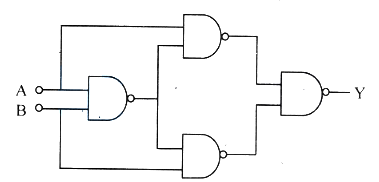 MHT CET 2024 Easy
 - Which of the following is used as antiseptic?MHT CET 2017 Easy
- Identify the mismatch out of the following.MHT CET 2023 Easy
- For the simple statements \(p, q\), and \(r, p \rightarrow(q \vee r)\) is logically equivalent toMHT CET 2022 Easy
- If
\(\int(7 x-2) \sqrt{3 x+2} \mathrm{~d} x=\mathrm{A}(3 x+2)^{\frac{5}{2}}+\mathrm{B}(3 x+2)^{\frac{3}{2}}+\mathrm{c}\)
(where c is a constant of integration), then the values of \(A\) and \(B\) are respectivelyMHT CET 2024 Easy