


MHT CET · Physics · Oscillations
For a particle performing S.H.M. the equation \(\left(\frac{\mathrm{d}^2 \mathrm{x}}{\mathrm{dt}^2}\right)+\alpha \mathrm{x}=0\). Then the time period of the motion will be
- A \(\frac{2 \pi}{\alpha}\)
- B \(2 \pi \alpha\)
- C \(2 \pi \sqrt{\alpha}\)
- D \(\frac{2 \pi}{\sqrt{\alpha}}\)
Answer & Solution
Correct Answer
(D) \(\frac{2 \pi}{\sqrt{\alpha}}\)
Step-by-step Solution
Detailed explanation
The correct option is (D).
Concept: For SHM \(\frac{\mathrm{d}^2 \mathrm{x}}{\mathrm{dt}^2}=-\left(\omega^2\right) \mathrm{x}\) is the necessary condition, where \(\omega\) is the angular frequency.
On comparing with the given equation \(\omega=\sqrt{\alpha}\)
Therefore, the time period of the SHM is:
\(\mathrm{T}=\frac{2 \pi}{\omega}=\frac{2 \pi}{\sqrt{\alpha}}\)
Concept: For SHM \(\frac{\mathrm{d}^2 \mathrm{x}}{\mathrm{dt}^2}=-\left(\omega^2\right) \mathrm{x}\) is the necessary condition, where \(\omega\) is the angular frequency.
On comparing with the given equation \(\omega=\sqrt{\alpha}\)
Therefore, the time period of the SHM is:
\(\mathrm{T}=\frac{2 \pi}{\omega}=\frac{2 \pi}{\sqrt{\alpha}}\)
See the Complete Solution
Get step-by-step explanations for this and 2.5 Lakh+ more JEE, NEET & CET questions.
- Unlock all solutions
- Practice the full chapter
- Track accuracy across PYQs
4.8 rated on Google Play · 14,000+ reviews
More questions from Physics
- The kinetic energy of an electron is increased by 2 times, then the de-Broglie wavelength associated with it changes by a factor.MHT CET 2024 Hard
- A vessel completely filled with water has two holes 'P' and 'Q' at depths ' 2 h ' and ' 8 h ' from the top respectively. Hole ' P ' is square of side ' a ' and hole ' \(Q\) ' is a circle of radius ' \(r\) '. The water flowing out per second from both the holes is same, then side ' \(a\) ' of hole ' \(P\) ' isMHT CET 2025 Medium
- An alternating voltage is given by . The voltage will be maximum for the first time when is (T = periodic time)MHT CET 2019 Medium
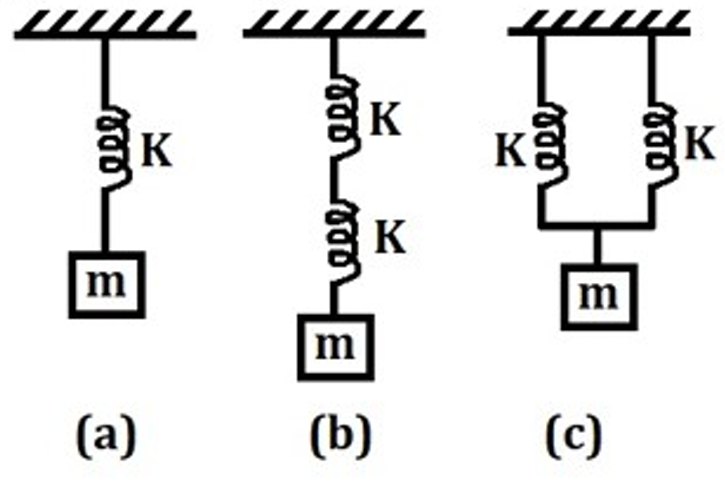
- All the springs in fig. (a), (b) and (c) are identical, each having force constant \(K\) each. Mass \(m\) is attached to each system. If \(T_a, T_b\) and \(T_c\) are the time periods of oscillations of the three systems in fig. (a), (b) and (c) respectively, then
 MHT CET 2025 Medium
 - Three liquids of densities \(\rho_1, \rho_2\) and \(\rho_3\) (with \(\rho_1\gt\rho_2\gt\rho_3\) ) having same value of surface tension T , rise to the same height in three identical capillaries. Angle of contact \(\theta_1, \theta_2\) and \(\theta_3\) respectively obeyMHT CET 2024 Hard
- If ' \(\Delta Q^{\prime}\) is the amount of heat supplied to 'n' moles of a diatonic gas at constant pressure, ' \(\triangle \mathrm{U}^{\prime}\) is the change in internal energy and ' \(\triangle \mathrm{W}^{\prime}\) is the work done, then \(\Delta \mathrm{W}: \Delta \mathrm{U}: \Delta \mathrm{Q}\) isMHT CET 2020 Medium
More PYQs from MHT CET
- \(\mathrm{f}(x)=\left\{\begin{array}{ll}\frac{1-\cos k x}{x^2}, & \text { if } x \leq 0 \ \frac{\sqrt{x}}{\sqrt{16+\sqrt{x}}-4}, & \text { if } x>0\end{array}\right.\) is continuous at \(x=0\), then the value of \(\mathrm{k}\) isMHT CET 2023 Medium
- Which one of the following is NOT a function of cytokinins?MHT CET 2021 Medium
- Which among the following is benzylic halide?MHT CET 2025 Easy
- In case of free expansion, which one of the following statements is \(\underline{WRONG}\)?MHT CET 2025 Easy
- If \(\mathrm{f}(\mathrm{x})=\left\{\begin{array}{ll}\mathrm{x}, & \text { for } \mathrm{x} \leq 0 \ 0, & \text { for } \mathrm{x}>0\end{array}\right.\), then the function \(\mathrm{f}(\mathrm{x})\) at \(\mathrm{x}=0\) isMHT CET 2021 Medium
- A pipe closed at one end has lengh \(0 \cdot 8 \mathrm{~cm}\). At its open end a \(0.5 \mathrm{~m}\) long uniform string is vibrating in its second harmonic and it resonates with the fundamental frequency of the pipe. If the tension in the wire is \(50 \mathrm{~N}\) and the speed of sound is \(320 \mathrm{~m} / \mathrm{s}\), the mass of the string isMHT CET 2020 Hard