


MHT CET · Physics · Oscillations
For a particle executing S.H.M., its potential energy is 8 times its kinetic energy at certain displacement ' \(\mathrm{x}\) ' from the mean position. If ' \(\mathrm{A}\) ' is the amplitude of S.H.M the value of ' \(x\) ' is
- A \(\frac{\mathrm{A} \sqrt{2}}{3}\)
- B \(\mathrm{A} \sqrt{3}\)
- C \(\frac{2 \sqrt{2} \mathrm{~A}}{3}\)
- D \(\frac{\mathrm{A}}{\sqrt{2}}\)
Answer & Solution
Correct Answer
(C) \(\frac{2 \sqrt{2} \mathrm{~A}}{3}\)
Step-by-step Solution
Detailed explanation
Potential energy: \(U=\frac{1}{2} m \omega^2 x^2\) and Kinetic energy: \(K=\frac{1}{2} m \omega^2\left(A^2-x^2\right)\)
Given: Potential energy \(=8 \times\) Kinetic energy
\(
\begin{aligned}
& \mathrm{U}=8 \mathrm{~K} \\
& \frac{1}{2} \mathrm{~m} \omega^2 \mathrm{x}^2=8 \times \frac{1}{2} \mathrm{~m} \omega^2\left(\mathrm{~A}^2-\mathrm{x}^2\right) \\
& \mathrm{x}^2=8 \mathrm{~A}^2-8 \mathrm{x}^2 \\
& 9 \mathrm{x}^2=8 \mathrm{~A}^2 \\
& \mathrm{x}^2=\frac{8 \mathrm{~A}^2}{9} \\
& \mathrm{x}=\frac{2 \sqrt{2} \mathrm{~A}}{3}
\end{aligned}
\)
Given: Potential energy \(=8 \times\) Kinetic energy
\(
\begin{aligned}
& \mathrm{U}=8 \mathrm{~K} \\
& \frac{1}{2} \mathrm{~m} \omega^2 \mathrm{x}^2=8 \times \frac{1}{2} \mathrm{~m} \omega^2\left(\mathrm{~A}^2-\mathrm{x}^2\right) \\
& \mathrm{x}^2=8 \mathrm{~A}^2-8 \mathrm{x}^2 \\
& 9 \mathrm{x}^2=8 \mathrm{~A}^2 \\
& \mathrm{x}^2=\frac{8 \mathrm{~A}^2}{9} \\
& \mathrm{x}=\frac{2 \sqrt{2} \mathrm{~A}}{3}
\end{aligned}
\)
See the Complete Solution
Get step-by-step explanations for this and 2.5 Lakh+ more JEE, NEET & CET questions.
- Unlock all solutions
- Practice the full chapter
- Track accuracy across PYQs
4.8 rated on Google Play · 14,000+ reviews
More questions from Physics
- The frequency for which a \(5 \mu \mathrm{F}\) capacitor has a reactance of \(\frac{1}{1000} \Omega\) is given byMHT CET 2022 Medium
- A spherical surface of radius of curvature ' \(R\) ' separates air from glass of refractive index 1.5. The centre of curvature is in the glass. A point object \(P\) placed in air forms a real image \(Q\) in the glass. The line \(P Q\) cuts the surface at point ' \(O\) ' and \(\mathrm{PO}=\mathrm{OQ}=\mathrm{x}\). Hence the distance ' \(\mathrm{x}\) ' is equal toMHT CET 2023 Hard
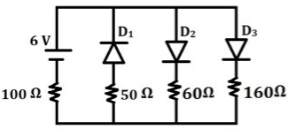
- In the following circuit shown in figure, three diodes are connected each with forward resistance \(40 \Omega\) and infinite backward resistance. The current through \(100 \Omega\) resistance is
 MHT CET 2025 Medium
 - The thermal conductivity of a rod is \(2 .\) What is its thermal resistivity?MHT CET 2007 Hard
- The electric field intensity on the surface of a solid charged sphere of radius \(r\) and volume charge density \(\sigma\) is ( \(\epsilon_0=\) permittivity of free space)MHT CET 2025 Medium
- The magnetic energy in an inductor changes from maximum value to minimum value in 5 ms . When connected to an a.c. source, the frequency of the source isMHT CET 2024 Easy
More PYQs from MHT CET
- ….MHT CET 2019 Easy
- The centroid of tetrahedron with vertices \(\mathrm{A}(3,-5, x), \mathrm{B}(5,4,2)\), \(\mathrm{C}(7,-7, \mathrm{y}), \mathrm{D}(1,0, \mathrm{z})\) is \(\mathrm{G}(4,-2,2)\), then \(x+\mathrm{y}+\mathrm{z}=\)MHT CET 2025 Easy
- Which of the following is true for the compound \(\mathrm{AB}\), if it is formed by transfer of an electron from \(A\) to \(B\) ?MHT CET 2020 Easy
- If \(\tan u=\sqrt{\frac{1-x}{1+x}}, \cos v=4 x^{3}-3 x\), then \(\frac{d u}{d v}=\)MHT CET 2020 Medium
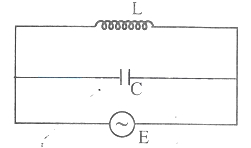
- In the circuit given below, the current through inductor is \(0.9 \mathrm{~A}\) and through the capacitor is \(0.6 \mathrm{~A}\). The current drawn from the a.c. source is
 MHT CET 2023 Medium
 - Which of the following reactions represents Wolf-Kishner reduction?MHT CET 2025 Easy