


MHT CET · Physics · Semiconductors
For a common-emitter amplifier, the voltage gain is 40 . Its input and output impedances are \(100 \Omega\) and \(400 \Omega\), respectively. The power gain of the \(\mathrm{CE}\) amplifier will be
- A 450
- B 400
- C 300
- D 500
Answer & Solution
Correct Answer
(B) 400
Step-by-step Solution
Detailed explanation
Power gain \(=(\) voltage gain \() \times(\) current gain \()\)
\(
\begin{aligned}
& \text {Current gain }=\frac{\text {output current }}{\text {Input current }}=\frac{\frac{\mathrm{V}_0}{\mathrm{z}_0}}{\frac{\mathrm{V}_{\mathrm{i}}}{\mathrm{z}_{\mathrm{i}}}} \\
& =\frac{\mathrm{V}_0}{\mathrm{~V}_{\mathrm{i}}} \cdot \frac{\mathrm{z}_{\mathrm{i}}}{\mathrm{z}_0}=\frac{40 \times 100}{400}=10
\end{aligned}
\)
Power gain \(=40 \times 10=400\)
\(
\begin{aligned}
& \text {Current gain }=\frac{\text {output current }}{\text {Input current }}=\frac{\frac{\mathrm{V}_0}{\mathrm{z}_0}}{\frac{\mathrm{V}_{\mathrm{i}}}{\mathrm{z}_{\mathrm{i}}}} \\
& =\frac{\mathrm{V}_0}{\mathrm{~V}_{\mathrm{i}}} \cdot \frac{\mathrm{z}_{\mathrm{i}}}{\mathrm{z}_0}=\frac{40 \times 100}{400}=10
\end{aligned}
\)
Power gain \(=40 \times 10=400\)
See the Complete Solution
Get step-by-step explanations for this and 2.5 Lakh+ more JEE, NEET & CET questions.
- Unlock all solutions
- Practice the full chapter
- Track accuracy across PYQs
4.8 rated on Google Play · 14,000+ reviews
More questions from Physics
- A pipe closed at one end has lengh \(0 \cdot 8 \mathrm{~cm}\). At its open end a \(0.5 \mathrm{~m}\) long uniform string is vibrating in its second harmonic and it resonates with the fundamental frequency of the pipe. If the tension in the wire is \(50 \mathrm{~N}\) and the speed of sound is \(320 \mathrm{~m} / \mathrm{s}\), the mass of the string isMHT CET 2020 Hard
- A weightless string can support a tension up to \(30 \mathrm{~N}\). A stone of mass \(0.5 \mathrm{~kg}\) is tied to its one end and is revolved in a circular path of radius \(2 \mathrm{~m}\) in a vertical plane. Then the maximum angular velocity of the stone will be (acceleration due to gravity \(g=10 \mathrm{~m} / \mathrm{s}^2\) )MHT CET 2022 Medium
- A wire of length \(1 \mathrm{~m}\) is moving at a speed of \(2 \mathrm{~m} / \mathrm{s}\) perpendicular homogenous magnetic field of \(0.5 \mathrm{~T}\). The ends of the wire are joined to resistance \(6 \Omega\). The rate at which work is being done to keep the wire moving at that speed isMHT CET 2021 Easy
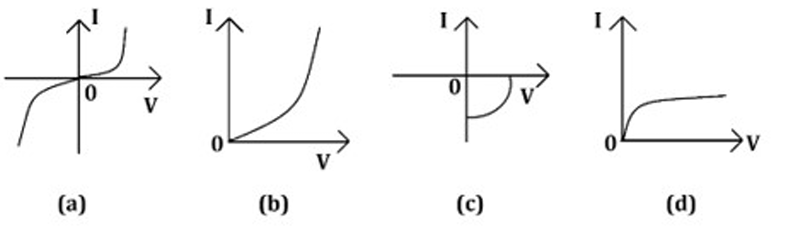
- I-V characteristics of LED is shown correctly by graph
 MHT CET 2025 Medium
 - The temperature of a black body is increased by \(50 \%\), then the percentage increase in the rate of radiation by the body is approximatedMHT CET 2021 Medium
- An elevator of mass is connected to a rope which pulls the elevator up with a maximum acceleration equal to . If the maximum bearable tension in the rope is , then for a safe journey the minimum diameter of the rope is [ = acceleration due to gravity]MHT CET 2017 Medium
More PYQs from MHT CET
- Which among the following pairs of halogen forms the interhalogen compound of the type \(\mathrm{XX}_{7}^{\prime}\) ?MHT CET 2020 Easy
- The graph between the time period and the length of a simple pendulum isMHT CET 2008 Easy
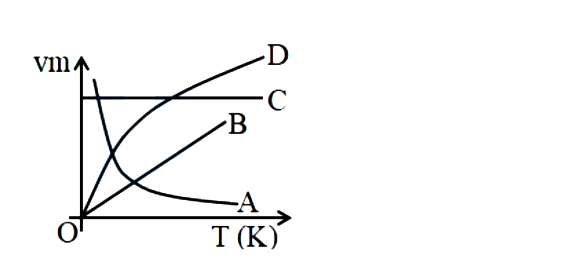
- For a perfectly black body, the graph is plotted between the frequency of radiation with maximum intensity \(\left(v_{\mathrm{m}}\right)\) and the absolute temperature ' \(\mathrm{T}\) '. Out of the following which is the correct graph?
 MHT CET 2022 Easy
 - What is standard reduction potential of \(\mathrm{Cu}^{2+} \mid \mathrm{Cu}_{(\mathrm{s})}\) if \(\mathrm{E}^{\circ}\) of following cell is 0.46 ?
\(\mathrm{Cu}_{(\mathrm{s})}\left|\mathrm{cu}_{(\mathrm{aq})}^{2+} \| \mathrm{Ag}_{(\mathrm{aq})}^{+}\right| \mathrm{Ag}_{(\mathrm{s})} ; \mathrm{E}_{\mathrm{Ag}^{+} / \mathrm{Ag}}^{\circ}=0.80 \mathrm{v} \mid\)MHT CET 2022 Medium - German silver does not containMHT CET 2010 Easy
- Rate of reaction \(\mathrm{x}+\mathrm{y} \rightarrow\) product is \(5.4 \times 10^{-2} \mathrm{~mol} \mathrm{dm}^{-3} \mathrm{sec}^{-1}\). When \([\mathrm{x}]=0.2 \mathrm{~mol} \mathrm{dm}^{-3}\) and \([\mathrm{y}]=0.1 \mathrm{~mol} \mathrm{dm}^{-3}\), calculate rate constant of reaction if it is first order in \(\mathrm{X}\) and second order in \(\mathrm{Y}\)MHT CET 2022 Easy