


MHT CET · Physics · Mathematics in Physics
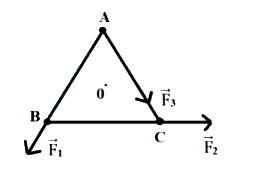
Figure shows three forces \(\overrightarrow{\mathrm{F}}_{1}, \overrightarrow{\mathrm{F}}_{2}\) and \(\overrightarrow{\mathrm{F}}_{3}\) acting along the sides of an equilateral
triangle. If the total torque acting at point ' 0 ' (centre of the triangle) is zero then the
magnitude of \(\overrightarrow{\mathrm{F}}_{3}\) is
- A \(\frac{\mathrm{F}_{1}-\mathrm{F}_{2}}{2}\)
- B \(\mathrm{~F}_{1}-\mathrm{F}_{2}\)
- C \(\mathrm{~F}_{1}+\mathrm{F}_{2}\)
- D \(\frac{\mathrm{F}_{1}}{\mathrm{~F}_{2}}\)
Answer & Solution
Correct Answer
(C) \(\mathrm{~F}_{1}+\mathrm{F}_{2}\)
Step-by-step Solution
Detailed explanation
The perpendicular distance of point \(\mathrm{O}\) from the sides \(\mathrm{AB}\) or \(\mathrm{BC}\) or \(\mathrm{AC}\) will be same (say r). Torque will be zero if total moment of force about point \(\mathrm{O}\) is zero Hence
\(\mathrm{rF}_{1}+\mathrm{rF}_{2}-\mathrm{rF}_{3}=0\)
\(\mathrm{F}_{3}=\mathrm{F}_{1}+\mathrm{F}_{2}=(4+2) \mathrm{N}-6 \mathrm{~N}\)
\(\mathrm{rF}_{1}+\mathrm{rF}_{2}-\mathrm{rF}_{3}=0\)
\(\mathrm{F}_{3}=\mathrm{F}_{1}+\mathrm{F}_{2}=(4+2) \mathrm{N}-6 \mathrm{~N}\)
See the Complete Solution
Get step-by-step explanations for this and 2.5 Lakh+ more JEE, NEET & CET questions.
- Unlock all solutions
- Practice the full chapter
- Track accuracy across PYQs
4.8 rated on Google Play · 14,000+ reviews
More questions from Physics
- In a meter bridge experiment, the balance point is obtained if the gaps are closed by \(2 \Omega\) and \(3 \Omega\). A shunt of \(X \Omega\) is added to \(3 \Omega\) resistor to shift the null point by 22.5 cm . The value of ' \(x\) ' isMHT CET 2024 Medium
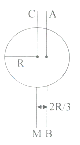
- \(\mathrm{I}_1\) is the moment of inertia of a circular disc about an axis passing through its centre and perpendicular to the plane of disc. \(I_2\) is its moment of inertia about an axis AB perpendicular to plane and parallel to axis \(\mathrm{CM}\) at a distance \(\frac{2 R}{3}\) from centre. The ratio of \(I_2\) and \(I_1\) is \(x= 9\). The value of ' \(x\) ' is ( \(\mathrm{R}=\) radius of the disc)
 MHT CET 2023 Hard
 - A body initially at rest is acted upon by a constant force (F) for time (t). The kinetic energy at time \(\mathrm{t}\) isMHT CET 2020 Easy
- A simple pendulum of length 'L' is suspended from a roof of a trolley. A trolley moves in horizontal direction with an acceleration 'a'. What would be the period of
oscillation of a simple pendulum? [ \(\mathrm{g}\) is acceleration due to gravity]MHT CET 2020 Medium - A tuning fork of frequency ' \(n\) ' is held near the open end of tube which is closed at the other end and the length are adjusted until resonance occurs. The first resonance occurs at length \(\mathrm{L}_1\) and immediate next resonance occurs at length \(\mathrm{L}_2\). The speed of sound in air isMHT CET 2021 Medium
- A black rectangular surface of area emits energy per second at . If length and breadth are reduced to of initial value and temperature is raised to , then energy emitted per second becomesMHT CET 2016 Easy
More PYQs from MHT CET
- Let \(f\) be twice differentiable function such that \(\mathrm{f}^{\prime \prime}(x)=-\mathrm{f}(x), \mathrm{f}^{\prime}(x)=\mathrm{g}(x)\) and \(\mathrm{h}(x)=(\mathrm{f}(x))^2+(\mathrm{g}(x))^2\). If \(\mathrm{h}(5)=1\), then the value of \(h(10)\) isMHT CET 2024 Medium
- A block of mass 'M' is moving on rough horizontal surface with momentum 'P'. The coefficient of friction between the block and surface is ' \(\mu\) '. The distance covered by block before it stops is \([\mathrm{g}=\) acceleration due to gravity \(]\)MHT CET 2020 Medium
- In an \(L-R\) circuit, the inductive reactance is equal to \(\sqrt{3}\) times the resistance ' \(R\) ' of the circuit. An e.m.f. \(E=E_0 \sin (\omega t)\) is applied to the circuit. The power consumed in the circuit isMHT CET 2025 Medium
- In a face centred cubic unit cell, what is the volume occupied?MHT CET 2016 Easy
- What is the value of standard enthalpy of formation of dihydrogen?MHT CET 2024 Easy
- Which is NOT an example of macro molecular colloid?MHT CET 2022 Easy