


MHT CET · Physics · Wave Optics
Consider the following statements about interference of light
A. The interference fringes are equally bright and equally spaced
B. At the centre of a bright fringe, the intensity is four times the intensity of the incident wave
C. For constructive interference of two waves, the crest of one wave coincides with trough of another wave.
Which of the above statements are correct?
- A A and B only
- B A and C only
- C All A, B and C
- D B and C only
Answer & Solution
Correct Answer
(A) A and B only
Step-by-step Solution
Detailed explanation
In interference, the fringes are equally bright and equally spaced and intensity of the bright fringe is four times the intensity of each incident wave.
Resultant intensity at a point is given by
\(I=I_1+I_2+2 \sqrt{I_1} \sqrt{I_2} \cos \delta\)
where, \(I_1\) is the intensity of the wave from source \(1, I_2\) is the intensity of the wave from source 2 . No two sources in nature can be coherent. So, sources are made from one source by either splitting the amplitude or the wave fronts, by means of double-slit or Fresnel's prism or Lloyd's mirror etc. Further, to get a high contrast \(I_1=I_2=I\).
So, for constructive interference and at the central maxima \(\delta=0\),
\(I_{\max }=2 I+2 I \cos \delta=2 I(1+\cos \delta)=4 I \cos ^2\left(\frac{\delta}{2}\right)=4 I\)
So at central maxima intensity is four times the incident wave.
Resultant intensity at a point is given by
\(I=I_1+I_2+2 \sqrt{I_1} \sqrt{I_2} \cos \delta\)
where, \(I_1\) is the intensity of the wave from source \(1, I_2\) is the intensity of the wave from source 2 . No two sources in nature can be coherent. So, sources are made from one source by either splitting the amplitude or the wave fronts, by means of double-slit or Fresnel's prism or Lloyd's mirror etc. Further, to get a high contrast \(I_1=I_2=I\).
So, for constructive interference and at the central maxima \(\delta=0\),
\(I_{\max }=2 I+2 I \cos \delta=2 I(1+\cos \delta)=4 I \cos ^2\left(\frac{\delta}{2}\right)=4 I\)
So at central maxima intensity is four times the incident wave.
See the Complete Solution
Get step-by-step explanations for this and 2.5 Lakh+ more JEE, NEET & CET questions.
- Unlock all solutions
- Practice the full chapter
- Track accuracy across PYQs
4.8 rated on Google Play · 14,000+ reviews
More questions from Physics
- Force is applied to a body of mass 3 kg at rest on a frictionless horizontal surface as shown in the force against time (F - t) graph. The speed of the body after 1 s is
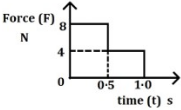 MHT CET 2025 Medium
 - Three long straight and parallel wires carrying currents are arranged as shown
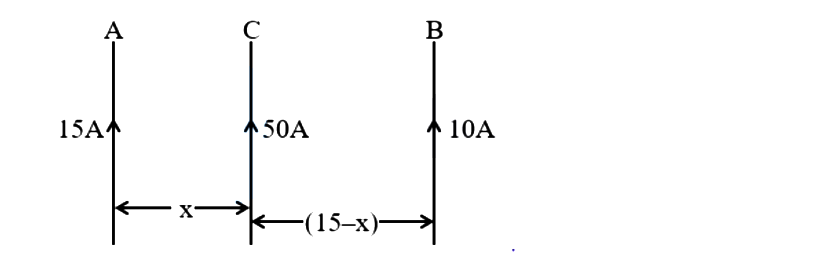
The wire \(\mathrm{C}\) which carries a current of \(50 \mathrm{~A}\) is so placed that it experiences no force. The distance of wire \(\mathrm{C}\) from wire \(\mathrm{A}\) isMHT CET 2022 Hard - In non - uniform circular motion, the ratio of tangential to radial acceleration is \((\mathrm{r}=\) radius, \(\propto=\) angular acceleration, \(\mathrm{V}=\) linear velocity)MHT CET 2020 Easy
- A magnetic field \(4 \times 10^{-2} \mathrm{~T}\) acts at right angles to a coil of area \(100 \mathrm{~cm}^2\) with 50 turns. The average e.m.f. induced in the coil is 0.1 V , when it is removed from the field in time ' \(t\) '. The value of ' \(t\) ' isMHT CET 2025 Easy
- In Young's double slit experiment, intensity at a point is \(\left(\frac{1}{4}\right)\) of the maximum intensity. The angular position of this point isMHT CET 2024 Hard
- The ratio of energies of photons produced due to transition of electron of hydrogen atom from its (i) second to first energy level and (ii) highest energy level to \(2^{\text {nd }}\) level is respectivelyMHT CET 2020 Easy
More PYQs from MHT CET
- \(\int \frac{x}{1+x^4} \mathrm{~d} x=\)MHT CET 2025 Easy
- If \(\mathrm{f}(x)=\frac{1+\cos \pi x}{\pi(1-x)^2}\), for \(x \neq 1\) is continuous at \(x=1\), then \(\mathrm{f}(1)\) is equal toMHT CET 2024 Easy
- What is the range of number of carbon atoms in alkanes found in paraffin wax?MHT CET 2020 Easy
- Identify an antiseptic compound from following.MHT CET 2025 Easy
- Which of the following statements is correct for boiling point of a liquid?MHT CET 2021 Medium
- Three vectors \(\vec{A}, \vec{B}\) and \(\vec{C}\) are such that \(\vec{A} \cdot \vec{B}=\vec{A} \cdot \vec{C}=0\), then \(\vec{A}\) is parallel to
\(\left[\cos 90^{\circ}=0\right]\)MHT CET 2020 Easy