


MHT CET · Physics · Waves and Sound
Consider the Doppler effect in two cases. In the first case, an observer moves towards a stationary source of sound with a speed of \(50 \mathrm{~m} / \mathrm{s}\). In the second case, the observer is at rest and the source moves towards the observer with the same speed of \(50 \mathrm{~m} / \mathrm{s}\). Then the frequency heard by the observer will be [velocity of sound in air \(=330 \mathrm{~m} / \mathrm{s}\).]
- A same in both the cases.
- B more in the second case than in the first case.
- C less in the second case than in the first case.
- D less than the actual frequency in both the cases.
Answer & Solution
Correct Answer
(B) more in the second case than in the first case.
Step-by-step Solution
Detailed explanation
For observer moving towards a stationary source,
\(\mathrm{n}_1=\mathrm{n}_0\left[\frac{\mathrm{v}+\mathrm{v}_{\mathrm{L}}}{\mathrm{v}}\right]\)
For source moving towards a stationary observer,
\(\mathrm{n}_2=\mathrm{n}_0\left[\frac{\mathrm{v}}{\mathrm{v}-\mathrm{v}_{\mathrm{s}}}\right]\)
Substituting the values for \(v, v_L\) and \(v_S\) in the equations above
\(\begin{aligned}
& \mathrm{n}_1=\mathrm{n}_0\left[\frac{330+50}{330}\right]=1.15 \mathrm{n}_0 \\
& \mathrm{n}_2=\mathrm{n}_0\left[\frac{330}{330-50}\right]=1.17 \mathrm{n}_0 \\
& \Rightarrow \mathrm{n}_2>\mathrm{n}_1
\end{aligned}\)
\(\therefore \quad\) The frequency heard will be more in the second case than in the first case.
\(\mathrm{n}_1=\mathrm{n}_0\left[\frac{\mathrm{v}+\mathrm{v}_{\mathrm{L}}}{\mathrm{v}}\right]\)
For source moving towards a stationary observer,
\(\mathrm{n}_2=\mathrm{n}_0\left[\frac{\mathrm{v}}{\mathrm{v}-\mathrm{v}_{\mathrm{s}}}\right]\)
Substituting the values for \(v, v_L\) and \(v_S\) in the equations above
\(\begin{aligned}
& \mathrm{n}_1=\mathrm{n}_0\left[\frac{330+50}{330}\right]=1.15 \mathrm{n}_0 \\
& \mathrm{n}_2=\mathrm{n}_0\left[\frac{330}{330-50}\right]=1.17 \mathrm{n}_0 \\
& \Rightarrow \mathrm{n}_2>\mathrm{n}_1
\end{aligned}\)
\(\therefore \quad\) The frequency heard will be more in the second case than in the first case.
See the Complete Solution
Get step-by-step explanations for this and 2.5 Lakh+ more JEE, NEET & CET questions.
- Unlock all solutions
- Practice the full chapter
- Track accuracy across PYQs
4.8 rated on Google Play · 14,000+ reviews
More questions from Physics
- To get the truth table shown, from the following logic circuit, the Gate \(\mathrm{G}\) should be
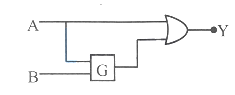
\(\begin{array}{|c|c|c|}\hline\mathrm{A} & \mathrm{B} & \mathrm{Y} 0 & 0 & 0 0 & 1 & 0 1 & 0 & 1 1 & 1 & 1\\\hline\end{array}\)MHT CET 2023 Medium - In the following circuit, the current \(I_3\) is
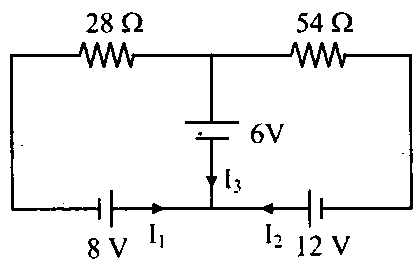 MHT CET 2024 Medium
 - The electron in hydrogen atom is initially in the third excited state. When it finally moves to ground state, the maximum number of spectral lines emitted areMHT CET 2021 Easy
- A uniform metal wire has length 'L', mass 'M' and density ' \(\mathrm{Q}\) '. It is under tension 'T"
and ' \(v^{\prime}\) is the speed of transverse wave along the wire. The area of cross-section of
the wire isMHT CET 2020 Medium - If a gas is compressed isothermally then the r.m.s. velocity of its moleculesMHT CET 2025 Easy
- In an equilateral prism the ray undergoes minimum deviation when it is incident at an angle of \(50^{\circ}\). The angle of minimum deviation isMHT CET 2024 Easy
More PYQs from MHT CET
- If \(20 \mathrm{~mL}\) of an acidic solution of \(\mathrm{pH} 3\) is diluted to \(100 \mathrm{~mL}\), the \(\mathrm{H}^{+}\) ion concentration will beMHT CET 2009 Hard
- If \(\bar{a}=2 \hat{i}+3 \hat{j}+4 \hat{k}, \overline{\mathrm{~b}}=\hat{i}-2 \hat{j}-2 \hat{\mathrm{k}}, \overline{\mathrm{c}}=-\hat{i}+4 \hat{j}+3 \hat{\mathrm{k}}\) and if \(\overline{\mathrm{d}}\) is vector perpendicular to both \(\overline{\mathrm{b}}\) and \(\overline{\mathrm{c}}, \overline{\mathrm{a}} \cdot \overline{\mathrm{d}}=18\), then \(|\overline{\mathrm{a}} \times \overline{\mathrm{d}}|^2=\)MHT CET 2025 Medium
- What is the unit of density?MHT CET 2018 Easy
- Using Einstein's photoelectric equation, the graph between kinetic energy of emitted photoelectrons and the frequency of incident radiation is shown correctly by graph
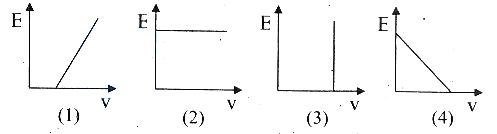 MHT CET 2024 Easy
 - Name the catalyst used in the commercial preparation of phenol.MHT CET 2016 Medium
- Identify the major product when anisole is treated with \(\mathrm{Br}_2\) in presence of acetic acid.MHT CET 2021 Hard