


MHT CET · Physics · Gravitation
Consider earth to be a sphere of radius \(R_e\) rotating about its own axis with angular speed \(\omega\). If \(g_{\mathrm{E}}\) and \(g_{\mathrm{P}}\) are the accelerations due to gravity at the equator and the poles respectively, then \(\left(g_{\mathrm{P}}-g_{\mathrm{E}}\right)\) is given by
\(\left[\cos \left(0^{\circ}\right)=\sin \left(\frac{\pi}{2}\right)=1, \sin \left(0^{\circ}\right)=\cos \left(\frac{\pi}{2}\right)=0\right]\)
- A \(\frac{R_{\mathrm{E}}}{\omega^2}\)
- B \(R_{\mathrm{E}} \omega^2\)
- C \(R_{\mathrm{E}} \omega\)
- D \(R_{\mathrm{E}}^2 \omega^2\)
Answer & Solution
Correct Answer
(B) \(R_{\mathrm{E}} \omega^2\)
Step-by-step Solution
Detailed explanation
Acceleration due to gravity at a place of latitude \(\lambda\) due to the rotation of earth is
\(g^{\prime}=g-\mathrm{R}_{\mathrm{E}} \omega^2\left(\cos ^2 \lambda\right)\)
At equator, \(\lambda=0^{\circ}, \cos 0^{\circ}=1\)
\(\Rightarrow g_E=g-\mathrm{R}_{\mathrm{E}} \omega^2\)
At poles, \(\lambda=90^{\circ}, \cos (\lambda)=0\)
\(\begin{aligned} & \therefore g^{\prime}=g_{\mathrm{P}}=g \\ & \therefore g_{\mathrm{P}}-g_{\mathrm{E}}=g-\left(g-R_E \omega^2\right)=R_E \omega^2\end{aligned}\)
\(g^{\prime}=g-\mathrm{R}_{\mathrm{E}} \omega^2\left(\cos ^2 \lambda\right)\)
At equator, \(\lambda=0^{\circ}, \cos 0^{\circ}=1\)
\(\Rightarrow g_E=g-\mathrm{R}_{\mathrm{E}} \omega^2\)
At poles, \(\lambda=90^{\circ}, \cos (\lambda)=0\)
\(\begin{aligned} & \therefore g^{\prime}=g_{\mathrm{P}}=g \\ & \therefore g_{\mathrm{P}}-g_{\mathrm{E}}=g-\left(g-R_E \omega^2\right)=R_E \omega^2\end{aligned}\)
See the Complete Solution
Get step-by-step explanations for this and 2.5 Lakh+ more JEE, NEET & CET questions.
- Unlock all solutions
- Practice the full chapter
- Track accuracy across PYQs
4.8 rated on Google Play · 14,000+ reviews
More questions from Physics
- The magnetic induction along the axis of a toroidal solenoid is independent ofMHT CET 2024 Easy
- Two parallel plate air capacitors of same capacity 'C' are connected in parallel to a battery of e.m.f. ' \(E\) '. Then one of the capacitors is completely filled with dielectric material of constant ' \(K\) '. The change in the effective capacity of the parallel combination isMHT CET 2025 Medium
- When a d.c voltage of \(200 \mathrm{~V}\) is applied to a coil of self-inductance \(\left(\frac{2 \sqrt{3}}{\pi}\right) \mathrm{H}\), a current of 1A flows through it. But by replacing d.c. source with a.c. source of \(200 \mathrm{~V}\), the current in the coil is reduced to \(0.5 \mathrm{~A}\). Then the frequency of a.c. supply isMHT CET 2021 Hard
- If only \(2 \%\) of the total current passes through an ammeter having coil of resistance \({ }^{\prime} \mathrm{R}^{\prime}\) then the resistance of the shunt of an ammeter isMHT CET 2020 Medium
- A convex lens of focal length ' \(f\) ' \(m\) forms a real, inverted image twice in size of the object. The object distance from the lens in metre isMHT CET 2024 Easy
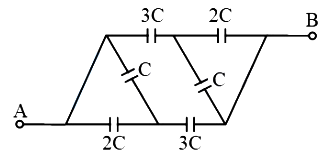
- The network of six capacitors is as shown in figure. The equivalent capacitance between \(\mathrm{A}\) and \(\mathrm{B}\) is
 MHT CET 2022 Medium
More PYQs from MHT CET
- If \([\bar{a} \quad \bar{b} \quad \bar{c}]=4\), then volume of parallelopiped with coterminus edges \(\bar{a}+2 \bar{b}\),
\(\bar{b}+2 \bar{c}, \quad \bar{c}+2 \bar{a}\) isMHT CET 2020 Medium - Which one of the following is the correct sequence of cytochromes in the order of their participation in respiratory chain?MHT CET 2020 Hard
- Conductivity of a solution is \(1.26 \times 10^{-2} \Omega^{-1} \mathrm{~cm}^{-1}\). Calculate molar conductivity for \(0.01 \mathrm{M}\) solution.MHT CET 2023 Medium
- If \(x=a(t+\sin t), y=a(1-\cos t)\), then \(\frac{d y}{d x}=\)MHT CET 2021 Hard
- Which of the following molecules shows intramolecular hydrogen bonding?MHT CET 2023 Easy
- What is the SI unit of rate of diffusion for a gas?MHT CET 2025 Easy