


MHT CET · Physics · Ray Optics
Concave and convex lenses are placed touching each other. The ratio of magnitudes of their power is \(2: 3\). The focal length of the system is 30 cm . The focal lengths of individual lens are
- A \(5 \mathrm{~cm},-10 \mathrm{~cm}\)
- B \(10 \mathrm{~cm},-15 \mathrm{~cm}\)
- C \(10 \mathrm{~cm},-20 \mathrm{~cm}\)
- D \(20 \mathrm{~cm},-30 \mathrm{~cm}\)
Answer & Solution
Correct Answer
(B) \(10 \mathrm{~cm},-15 \mathrm{~cm}\)
Step-by-step Solution
Detailed explanation
Power \((P)=\frac{1}{f}...(i)\)
Given, \(\frac{\mathrm{P}_{\text {concave }}}{\mathrm{P}_{\text {convex }}}=\frac{2}{3}...(ii)\)
Let the focal length of the convex lens be \(\mathrm{f}_{\text {convex }}=\mathrm{f}\)
From (i) and (ii),
\(\mathrm{f}_{\text {concave }}=-\frac{3}{2} \mathrm{f} \cdot(-\mathrm{ve}\) as lens is concave \()\)
Using the equivalent focal length for two lenses in contact, we get
\(\frac{1}{f_{e q}} =\frac{1}{f}+\frac{1}{-\frac{3}{2} f} \)
\( \Rightarrow \frac{1}{30} =\frac{1}{f}-\frac{2}{3 f} \)
\( =\frac{3 f-2 f}{3 f^2}\)
\(\Rightarrow \frac{1}{30}=\frac{1}{3 \mathrm{f}} \)
\( \therefore \quad, \mathrm{f}=10 \mathrm{~cm} \)
\( \therefore \mathrm{f}_{\text {convex }}=10 \mathrm{~cm} \text { and } \mathrm{f}_{\text {concave }}=\frac{-3}{2} \times 10\) \(=-15 \mathrm{~cm}\)
Given, \(\frac{\mathrm{P}_{\text {concave }}}{\mathrm{P}_{\text {convex }}}=\frac{2}{3}...(ii)\)
Let the focal length of the convex lens be \(\mathrm{f}_{\text {convex }}=\mathrm{f}\)
From (i) and (ii),
\(\mathrm{f}_{\text {concave }}=-\frac{3}{2} \mathrm{f} \cdot(-\mathrm{ve}\) as lens is concave \()\)
Using the equivalent focal length for two lenses in contact, we get
\(\frac{1}{f_{e q}} =\frac{1}{f}+\frac{1}{-\frac{3}{2} f} \)
\( \Rightarrow \frac{1}{30} =\frac{1}{f}-\frac{2}{3 f} \)
\( =\frac{3 f-2 f}{3 f^2}\)
\(\Rightarrow \frac{1}{30}=\frac{1}{3 \mathrm{f}} \)
\( \therefore \quad, \mathrm{f}=10 \mathrm{~cm} \)
\( \therefore \mathrm{f}_{\text {convex }}=10 \mathrm{~cm} \text { and } \mathrm{f}_{\text {concave }}=\frac{-3}{2} \times 10\) \(=-15 \mathrm{~cm}\)
See the Complete Solution
Get step-by-step explanations for this and 2.5 Lakh+ more JEE, NEET & CET questions.
- Unlock all solutions
- Practice the full chapter
- Track accuracy across PYQs
4.8 rated on Google Play · 14,000+ reviews
More questions from Physics
- A current ' \(I\) ' produces a magnetic flux ' \(\phi\) ' per turn in a coil of ' \(n\) ' turns. Self-inductance of the coil is ' \(L\) '. The relation between them isMHT CET 2021 Easy
- The light of wavelength ' \(\lambda\) ' is incident on the surface of metal of work function \(\phi\) and emits the electron, The maximum velocity of electron emitted is [ \(\mathrm{m}=\) mass of electron and \(\mathrm{h}=\) Planck's constant, \(c=\) velocity of light]MHT CET 2021 Medium
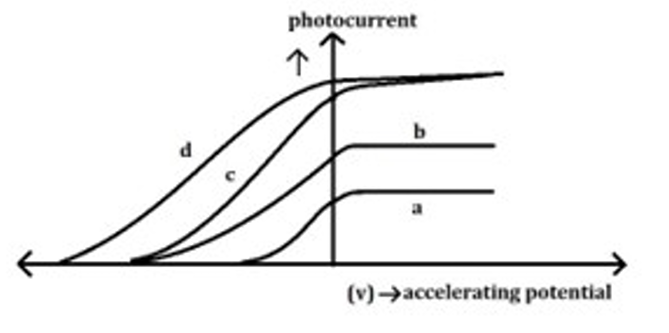
- The graph shows the variation of photocurrent with anode potential for four different radiations. Let \(I_a, I_b, I_c\) and \(I_d\) are intensities and \(f_a, f_b, f_c\) and \(f_d\) be the frequencies for the curves \(a, b, c\) and \(d\) respectively, then
 MHT CET 2025 Medium
 - The length of a potentiometer wire is 'L'. A cell of e.m.f. 'E' is balanced at a length \(\frac{\mathrm{L}^{\prime}}{5}\) from the positive end of the wire. If the length of the wire is increased by \(\frac{\mathrm{L}}{2}\),
at what distance will the same cell give a balance point? 'MHT CET 2020 Medium - Two trains, each \(30 \mathrm{~m}\) long are travelling in opposite directions with velocities \(5 \mathrm{~m} / \mathrm{s}\) and \(10 \mathrm{~m} / \mathrm{s}\). They will cross afterMHT CET 2023 Easy
- The ratio of momenta of an electron and an \(\alpha\) -particle which are accelerated from rest by a potential difference of \(100 \mathrm{~V}\) isMHT CET 2011 Medium
More PYQs from MHT CET
- A magnetizing field of \(100 \mathrm{~A} / \mathrm{m}\) produces a magnetic flux of \(2.4 \times 10^{-5} \mathrm{~Wb}\) in an iron bar of cross-sectional area \(0.3 \mathrm{~cm}^2\). The magnetic permeability of the iron bar in the SI unit isMHT CET 2022 Medium
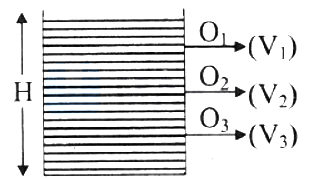
- A cylinder contains water upto a height 'H'. It has three orifices \(\mathrm{O}_1, \mathrm{O}_2, \mathrm{O}_3\) as shown in the figure. Let \(V_1, V_2, V_3\) be the speed of efflux of water from the three orifices. Then
 MHT CET 2024 Easy
 - An electron (e) moves in circular orbit of radius ' \(r\) ' with uniform speed ' \(\mathrm{V}\) '. It produces magnetic field ' \(\mathrm{B}\) ' at the center of circle. The magnetic field \(B\) is ( \(\mu_0=\) permeability of free space)MHT CET 2021 Medium
- Three condensers of capacities ' \(\mathrm{C}_1\) ', ' \(\mathrm{C}_2\) ', ' \(\mathrm{C}_3\) ' are connected in series with a source of e.m.f. ' \(V\) '. The potentials across the three condensers are in the ratioMHT CET 2024 Easy
- The population of towns \(A\) and \(B\) increase at the rate proportional to their population present at that time. At the end of the year 1984, the population of both the towns was 20,000 . At the end of the year 1989, the population of town A was 25,000 and that of town B was 28,000. The difference of populations of towns A and B at the end of 1994 wasMHT CET 2025 Medium
- Calculate van't Hoff factor (i) of 0.2 m aqueous solution of an electrolyte if it freezes at \(-0.660 \mathrm{~K} .\left(\mathrm{K}_{\mathrm{f}}=1.84 \mathrm{~K} \mathrm{~kg} \mathrm{~mol}^{-1}\right)\)MHT CET 2024 Easy