


MHT CET · Physics · Electrostatics
Charges \(3 \mathrm{Q}, \mathrm{q}\) and Q are placed along x -axis at positions \(\mathrm{x}=0, \mathrm{x}=\frac{1}{3}\) and \(\mathrm{x}=1\) respectively. When the force on charge Q is zero, the value of \(q\) is
- A \(\frac{\mathrm{Q}}{3}\)
- B \(-\frac{\mathrm{Q}}{3}\).
- C \(\frac{4}{3} \mathrm{Q}\)
- D \(-\frac{4}{3} \mathrm{Q}\)
Answer & Solution
Correct Answer
(D) \(-\frac{4}{3} \mathrm{Q}\)
Step-by-step Solution
Detailed explanation
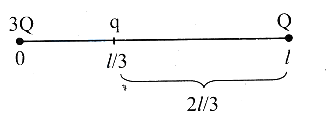
Force \(F_1\) due to charge \(3 Q\) on \(Q\) will be,
\(\mathrm{F}_1=\frac{1}{4 \pi \varepsilon_0} \frac{3 \mathrm{Q}^2}{l^2}\)
Force \(F_2\) due to charge \(q\) on charge \(Q\) will be,
\(\begin{aligned}
& \mathrm{F}_2=\frac{1}{4 \pi \varepsilon_0} \frac{\mathrm{Qq}}{\left(\frac{2 l}{3}\right)^2} \\
\therefore \quad & \mathrm{~F}_2=\frac{1}{4 \pi \varepsilon_0} \frac{9 \mathrm{Qq}}{4 l^2}
\end{aligned}\)
For the force on charge Q to be zero,
\(\begin{array}{ll}
& \mathrm{F}_1+\mathrm{F}_2=0 \text { or } \mathrm{F}_1=-\mathrm{F}_2 \\
\therefore & \cdot \frac{3 \mathrm{Q}^2}{l^2}=-\frac{9 \mathrm{Qq}}{4 l^2} \\
\therefore & \mathrm{Q}=-\frac{3 \mathrm{q}}{4} \\
\therefore \quad & \mathrm{q}=-\frac{4}{3} \mathrm{Q}
\end{array}\)
See the Complete Solution
Get step-by-step explanations for this and 2.5 Lakh+ more JEE, NEET & CET questions.
- Unlock all solutions
- Practice the full chapter
- Track accuracy across PYQs
4.8 rated on Google Play · 14,000+ reviews
More questions from Physics
- Threshold frequency for a metal is \(15 \times 10^{14} \mathrm{~Hz}\). The light of wavelength \(6000 Å\) falls on the metal surface. Which one of the following statements is correct? [velocity of light, \(\left.\mathrm{c}=3 \times 10^{8} \mathrm{~m} / \mathrm{s}\right]\)MHT CET 2020 Medium
- In a conical pendulum the bob of mass ' \(\mathrm{m}\) ' moves in a horizontal circle of radius ' \(r\) ' with uniform speed ' \(V\) '. The string of length ' \(L\) ' describes a cone of semi vertical angle ' \(\theta\) '. The centripetal force acting on the bob is ( \(\mathrm{g}=\) acceleration due to gravity)MHT CET 2023 Hard
- The magnetic field at the centre of a current carrying circular coil of area ' \(\mathrm{A}\) ' is ' \(\mathrm{B}\) '. The magnetic moment of the coil is ( \(\mu_0=\) permeability of free space)MHT CET 2021 Easy
- The equation of sound wave is
\(
y=0.0015 \sin (62.4 x+316 t) . \text { Find the }
\)
wavelength of this waveMHT CET 2011 Medium - Two small drops of mercury each of radius ‘ ’ coalesce to form a large single drop. The ratio of the total surface energies before and after the change isMHT CET 2019 Medium
- A mass 'M' is suspended from a spring of negligible mass. The spring is pulled a little
and then released so that the mass executes S.H.M. of period \(\mathrm{T}\). If the mass is increased by 'm', the time period becomes \(\frac{5 \mathrm{~T}^{\prime}}{3}\). What is the ratio \(\left(\frac{\mathrm{M}}{\mathrm{m}}\right)\) ?MHT CET 2020 Easy
More PYQs from MHT CET
- A random variable X has the following probability distribution :
\(\begin{array}{|c|c|c|c|c|} \hline \mathrm{X}=x & 1 & 2 & 3 & 4 \\ \hline \mathrm{P}(\mathrm{X}=x) & 0 \cdot 1 & 0 \cdot 2 & 0 \cdot 3 & 0 \cdot 4 \\ \hline \end{array}\)
The mean and standard deviation of X are respectivelyMHT CET 2025 Medium - In a cross performed between parents considering two contrasting characters yellow round and green wrinkled seed. In the \(F _2\) generation progeny, the ratio of yellow and green will be __________ .MHT CET 2019 Hard
- The first law of thermodynamics for isothermal process isMHT CET 2017 Easy
- In the logic circuit diagram, A, B and C are the inputs, \(\mathrm{Y}\) is the output. The output \(\mathrm{Y}\) is ' \(\mathrm{HIGH}\) '
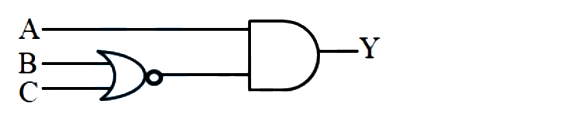 MHT CET 2022 Easy
 - If \(A=\left[a_{i j}\right]_{3 \times 3}=\left[\begin{array}{lll}3 & 2 & 4 \\ 1 & 4 & 1 \\ 2 & 6 & 3\end{array}\right]\) and \(A_{i j}\) is a cofactor of \(a_{i j}\), then the value of \(a_{21} A_{21}+a_{22} A_{22}+a_{23} A_{23}\) is equal toMHT CET 2022 Easy
- ….MHT CET 2019 Medium