


MHT CET · Physics · Thermal Properties of Matter
At certain temperature, rod A and \(\operatorname{rod} \mathrm{B}\) of different materials have lengths \(L_A\) and \(L_B\) respectively. Their co-efficients of linear expansion are \(\alpha_A\) and \(\alpha_B\) respectively. It is observed that the difference between their lengths remain constant at all temperatures. The ratio \(L_A / L_B\) is given by
- A \(\frac{\alpha_A}{\alpha_B}\)
- B \(\frac{\alpha_B}{\alpha_A}\)
- C \(\frac{\alpha_A+\alpha_B}{\alpha_A}\)
- D \(\frac{\alpha_A+\alpha_B}{\alpha_B}\)
Answer & Solution
Correct Answer
(B) \(\frac{\alpha_B}{\alpha_A}\)
Step-by-step Solution
Detailed explanation
\(L_B^{\prime}=L_B\left(1+\alpha_B \Delta \theta\right)\) and \(L_A^{\prime}=L_A\left(1+\alpha_B \Delta \theta\right)\). So that
\(L_B^{\prime}-L_A^{\prime}=L_B-L_S+\left(L_B \alpha_B-L_A \alpha_A\right) \Delta \theta\)
So \(\left(L_B^{\prime}-L_A^{\prime}\right)\) will be equal to \(\left(L_B-L_A\right)\) at all temperature if, \(L_B \alpha_B-L_A \alpha_A=0\)
\([\operatorname{as} \Delta \theta \neq 0] \text { or } \frac{L_B}{L_A}=\frac{\alpha_{A}}{\alpha_B}\)
i.e., the difference in the lengths of the two rods will be independent of temperature if the lengths are in the inverse ratio of their coefficients of linear expansion.
\(L_B^{\prime}-L_A^{\prime}=L_B-L_S+\left(L_B \alpha_B-L_A \alpha_A\right) \Delta \theta\)
So \(\left(L_B^{\prime}-L_A^{\prime}\right)\) will be equal to \(\left(L_B-L_A\right)\) at all temperature if, \(L_B \alpha_B-L_A \alpha_A=0\)
\([\operatorname{as} \Delta \theta \neq 0] \text { or } \frac{L_B}{L_A}=\frac{\alpha_{A}}{\alpha_B}\)
i.e., the difference in the lengths of the two rods will be independent of temperature if the lengths are in the inverse ratio of their coefficients of linear expansion.
See the Complete Solution
Get step-by-step explanations for this and 2.5 Lakh+ more JEE, NEET & CET questions.
- Unlock all solutions
- Practice the full chapter
- Track accuracy across PYQs
4.8 rated on Google Play · 14,000+ reviews
More questions from Physics
- A straight wire carrying current 'I' is bent into a semi-circular arc of radius \({ }^{\prime} \mathrm{r}^{\prime}\), as shown. The magnitude of magnetic field at point '0' due to semi-circular arc is \(\left(\mu_{0}=\right.\) Permeability of free space)
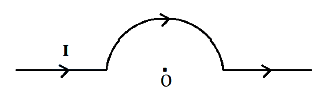 MHT CET 2020 Medium
 - The temperature of a gas is measure ofMHT CET 2023 Easy
- The length of the seconds pendulum is \(1 \mathrm{~m}\) on earth. If the mass and diameter of the planet is 1.5 times that of the earth, the length of the seconds pendulum on the planet will be nearlyMHT CET 2021 Hard
- The magnetic flux through a coil is \(4 \times 10^{-4} \mathrm{~Wb}\) at time \(\mathrm{t}=0\). It reduces to \(30 \%\) of its original value in time \(t\) second. If e.m.f. induced in the coil is 0.56 mV then the value of \(t\) isMHT CET 2025 Medium
- In a potentiometer experiment, the null point is obtained on \(7^{\text {th }}\) wire for given cell. To shift the null point on \(9^{\text {th }}\) wire for the same cell what should we do?MHT CET 2022 Medium
- A point source of light is used in a photoelectric effect. If the source is removed farther from the emitting metal, then the stopping potential willMHT CET 2024 Easy
More PYQs from MHT CET
- Which of the following polymers is prepared by using phenol?MHT CET 2020 Easy
- Out of the fundamental forces in nature, maximum and minimum range is respectively forMHT CET 2020 Easy
- Which among the following statements about ozone depletion is NOT true?MHT CET 2021 Easy
- Which of the following polymers is used in electrophoresis in the form of gel?MHT CET 2021 Medium
- Which of the following groups increases the basic strength of substituted aniline?MHT CET 2020 Medium
- The materials suitable for making electromagnets should haveMHT CET 2023 Easy