


MHT CET · Physics · Nuclear Physics
An ' \(\alpha\) ' particle of energy \(10 \mathrm{eV}\) is moving in a circular path in uniform magnetic field. The energy of proton moving in the same path and same magnetic field will be [mass of ' \(\alpha\) ' particle \(=4\) times mass of proton \(]\)
- A \(4 \mathrm{eV}\)
- B \(8 \mathrm{eV}\)
- C \(16 \mathrm{eV}\)
- D \(10 \mathrm{eV}\)
Answer & Solution
Correct Answer
(D) \(10 \mathrm{eV}\)
Step-by-step Solution
Detailed explanation
(C)
From the formula mentioned above, momentum of particle moving in a magnetic field \(\mathrm{mv}=\mathrm{p}=\mathrm{qBr}\)
Therefore, Kinetic Energy of that particle can be written as \(\mathrm{KE}=\frac{\mathrm{p}^{2}}{2 \mathrm{~m}}=\) \(\frac{q^{2} B^{2} r^{2}}{2 m}\)
In the same magnetic field for the same path, \(\mathrm{KE} \propto \frac{\mathrm{q}^{2}}{\mathrm{~m}}\)
This ratio is same for the alpha particle and the proton. \(\left(\frac{(2 \mathrm{e})^{2}}{4 \mathrm{amu}}=\frac{4 \mathrm{e}^{2}}{4 \mathrm{amu}}=\right.\) \(\frac{\mathrm{e}^{2}}{\mathrm{amu}}\); Here amu is the atomic mass unit)
So, in such conditions, both will have the same energy. Hence, energy of the alpha particle will be \(8 \mathrm{eV}\) too.
From the formula mentioned above, momentum of particle moving in a magnetic field \(\mathrm{mv}=\mathrm{p}=\mathrm{qBr}\)
Therefore, Kinetic Energy of that particle can be written as \(\mathrm{KE}=\frac{\mathrm{p}^{2}}{2 \mathrm{~m}}=\) \(\frac{q^{2} B^{2} r^{2}}{2 m}\)
In the same magnetic field for the same path, \(\mathrm{KE} \propto \frac{\mathrm{q}^{2}}{\mathrm{~m}}\)
This ratio is same for the alpha particle and the proton. \(\left(\frac{(2 \mathrm{e})^{2}}{4 \mathrm{amu}}=\frac{4 \mathrm{e}^{2}}{4 \mathrm{amu}}=\right.\) \(\frac{\mathrm{e}^{2}}{\mathrm{amu}}\); Here amu is the atomic mass unit)
So, in such conditions, both will have the same energy. Hence, energy of the alpha particle will be \(8 \mathrm{eV}\) too.
See the Complete Solution
Get step-by-step explanations for this and 2.5 Lakh+ more JEE, NEET & CET questions.
- Unlock all solutions
- Practice the full chapter
- Track accuracy across PYQs
4.8 rated on Google Play · 14,000+ reviews
More questions from Physics
- In a potentiometer experiment, the null point is obtained on \(7^{\text {th }}\) wire for given cell. To shift the null point on \(9^{\text {th }}\) wire for the same cell what should we do?MHT CET 2022 Medium
- The gyromagnetic ratio and Bohr magneton are given respectively by [Given \(\rightarrow \mathrm{e}=\) charge on electron, \(\mathrm{m}=\) mass of electron, \(\mathrm{h}=\) Planck's constant].MHT CET 2024 Easy
- An alternating current is given by \(I=100 \sin (50 \pi t)\). How many times will the current become zero in one second?MHT CET 2024 Medium
- At any time ' \(t\) ', the co-ordinates of moving particle are \(x=a t^2\) and \(\mathrm{y}=\mathrm{bt}^2\). The speed of the particle isMHT CET 2025 Medium
- A mass \(2 \sqrt{3} \mathrm{~kg}\) is acted upon by two forces which are inclined to each other at \(60^{\circ}\) and each of magnitude \(1 \mathrm{~N}\). The acceleration of that mass in SI system is \(\left[\sin 30^{\circ}=\cos 60^{\circ}=0.5\right]\)MHT CET 2020 Easy
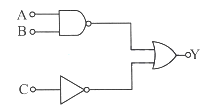
- In the digital circuit the inputs are as shown in figure. The Boolean expression for output \(\mathrm{Y}\) is
 MHT CET 2023 Easy
More PYQs from MHT CET
- The differential equation whose solution represents the family \(x^2 y=4 e^x+c\), where \(c\) is an arbitrary constant, isMHT CET 2025 Medium
- For a suitable chosen real constant a, let a function \(\mathrm{f}: \mathbb{R}-\{-\mathrm{a}\} \rightarrow \mathbb{R}\) be defined by \(\mathrm{f}(x)=\frac{\mathrm{a}-x}{\mathrm{a}+x}\). Further suppose that for any real number \(x \neq-\mathrm{a}\) and \(\mathrm{f}(x) \neq-\mathrm{a}\), (fof) \((x)=x\). Then \(\mathrm{f}\left(-\frac{1}{5}\right)\) is equal toMHT CET 2024 Hard
- Following are various symptoms of marasmus EXCEPT,MHT CET 2018 Hard
- With reference to the principal values, if \(\sin ^{-1} x+\sin ^{-1} y+\sin ^{-1} z=\frac{3 \pi}{2}\), then \(x^{100}+y^{100}+z^{100}=\)MHT CET 2022 Easy
- How many of the following statements are correct about niche?
i. It denotes the functional role played by an organism.
ii. It deals with the flow of energy from one organism to another.
iii. As soon as niche is left vacant other organisms fill that position.
iv. The same niche is shared by two or more species.
v. Organisms living in the same habitat differ in their niches.MHT CET 2023 Hard - A particle starting from rest moves atong the circumference of a circle of radius ' \(r\) ' with angular acceleration ' \(\alpha\) '. The magnitude of the average velocity in time it completes the small angular displacement ' \(\theta\) ' isMHT CET 2024 Easy