


MHT CET · Physics · Alternating Current
An inductor coil takes current \(8 \mathrm{~A}\) when connected to a \(100 \mathrm{~V}\) and \(50 \mathrm{~Hz} \mathrm{AC}\) source. A pure resistor under the same condition takes current of \(10 \mathrm{~A}\). If inductor coil and resistor are connected in series to a \(100 \mathrm{~V}\) and \(40 \mathrm{~Hz}\) AC supply, then the current in the series combination of above resistor and inductor is
- A \(\frac{10}{\sqrt{3}} \mathrm{~A}\)
- B \(\frac{5}{\sqrt{2}} \mathrm{~A}\)
- C \(10 \sqrt{2} \mathrm{~A}\)
- D \(5 \sqrt{2} \mathrm{~A}\)
Answer & Solution
Correct Answer
(D) \(5 \sqrt{2} \mathrm{~A}\)
Step-by-step Solution
Detailed explanation
Inductive reactance when \(100 \mathrm{~V}, 50 \mathrm{~Hz}\) source is connected is given by
\(
\mathrm{X}_{\mathrm{L}}=\frac{\mathrm{V}}{\mathrm{I}}=\frac{100}{8}=12.5 \Omega
\)
Resistance \(\mathrm{R}=\frac{\mathrm{V}}{1}=\frac{100}{10}=10 \Omega\)
Inductive reactance at new frequency of \(40 \mathrm{~Hz}\)
\(
\begin{aligned}
& \frac{\mathrm{X}_{\mathrm{L}}^{\prime}}{\mathrm{X}_{\mathrm{L}}}=\frac{2 \pi \mathrm{f}^{\prime} \mathrm{L}}{2 \pi \mathrm{fL}}=\frac{40}{50}=\frac{4}{5} \\
& \mathrm{X}_{\mathrm{L}}^{\prime}=\frac{4}{5} \mathrm{X}_{\mathrm{L}}=\frac{4}{5} \times 12.5=10 \Omega
\end{aligned}
\)
When they are connected in series the impedance will be given by
\(
\begin{aligned}
& Z=\sqrt{R^2+X_L^{\prime 2}}=\sqrt{(10)^2+(10)^2}=10 \sqrt{2} A \\
& I=\frac{V}{Z}=\frac{100}{10 \sqrt{2}}=5 \sqrt{2} \mathrm{~A}
\end{aligned}
\)
\(
\mathrm{X}_{\mathrm{L}}=\frac{\mathrm{V}}{\mathrm{I}}=\frac{100}{8}=12.5 \Omega
\)
Resistance \(\mathrm{R}=\frac{\mathrm{V}}{1}=\frac{100}{10}=10 \Omega\)
Inductive reactance at new frequency of \(40 \mathrm{~Hz}\)
\(
\begin{aligned}
& \frac{\mathrm{X}_{\mathrm{L}}^{\prime}}{\mathrm{X}_{\mathrm{L}}}=\frac{2 \pi \mathrm{f}^{\prime} \mathrm{L}}{2 \pi \mathrm{fL}}=\frac{40}{50}=\frac{4}{5} \\
& \mathrm{X}_{\mathrm{L}}^{\prime}=\frac{4}{5} \mathrm{X}_{\mathrm{L}}=\frac{4}{5} \times 12.5=10 \Omega
\end{aligned}
\)
When they are connected in series the impedance will be given by
\(
\begin{aligned}
& Z=\sqrt{R^2+X_L^{\prime 2}}=\sqrt{(10)^2+(10)^2}=10 \sqrt{2} A \\
& I=\frac{V}{Z}=\frac{100}{10 \sqrt{2}}=5 \sqrt{2} \mathrm{~A}
\end{aligned}
\)
See the Complete Solution
Get step-by-step explanations for this and 2.5 Lakh+ more JEE, NEET & CET questions.
- Unlock all solutions
- Practice the full chapter
- Track accuracy across PYQs
4.8 rated on Google Play · 14,000+ reviews
More questions from Physics
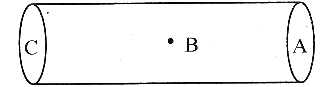
- A hollow cylinder has charge ' \(q\) ' \(C\) within it. If ' \(\phi\) ' is the electric flux associated with the curved surface B , the flux linked with the plane surface A will be
 MHT CET 2024 Medium
 - For a photosensitive material, work function is ' \(\mathrm{W}_0\) ' and stopping potential is ' V '. The wavelength of incident radiation is (\(\mathrm{h}=\) Planck's constant, \(c=\) velocity of light, \(e=\) electronic charge)MHT CET 2024 Easy
- The magnitude of magnetic induction at a point on the axis at a large distance from the centre of circular coil of ‘ ’ turns and area ‘ ’ carrying current is given byMHT CET 2019 Hard
- The thermodynamic process in which the work done on or by the gas is zeroMHT CET 2022 Easy
- When light of wavelength ' \(\lambda\) ' is incident on photosensitive surface, photons of power
'P' are emitted. The number of photons (n) emitted in 't' second is
(h= Planck's constant, \(\mathrm{c}=\) velocity of light in vacuum)MHT CET 2020 Easy - An 80 W lamp is connected to the secondary of a step-down transformer, where primary is connected to ac mains of 220 V . Assuming the transformer to be ideal, the current in the primary winding is nearlyMHT CET 2025 Easy
More PYQs from MHT CET
- The absolute natality is _________ realised natality.MHT CET 2022 Easy
- Which of the following is NOT a basic amino acid?MHT CET 2023 Easy
- The work done in splitting a water drop of radius \(R\) in to 64 droplets is ( \(\mathrm{T}=\) surface tension of water)MHT CET 2025 Medium
- Two particles of equal mass ' m ' move in a circle of radius ' r ' under the action of their mutual gravitational attraction. The speed of each particle will be ( \(\mathrm{G}=\) Universal gravitational constant)MHT CET 2025 Medium
- Considering four sub-intervals, the value of \(\int_{0}^{1} \frac{1}{1+x} d x\) by Trapezoidal rule, isMHT CET 2008 Easy
- If \(x^{3}+y^{3}-3 a x y=0\), then \(\frac{d y}{d x}\) equalsMHT CET 2008 Medium