


MHT CET · Physics · Thermodynamics
An ideal gas with pressure \(\mathrm{P}\), volume \(\mathrm{V}\) and temperature \(\mathrm{T}\) is expanded isothermally to a volume \(2 \mathrm{~V}\) and a final pressure \(\mathrm{P}_{\mathrm{i}}\). The same gas is expanded adiabatically to a volume \(2 \mathrm{~V}\), the final pressure is \(\mathrm{P}_{\mathrm{a}}\). In terms of the ratio of the two specific heats for the gas ' \(\gamma\) ', the ratio \(\frac{\mathrm{P}_i}{\mathrm{P}_{\mathrm{a}}}\) is
- A \(2^{\gamma+1}\)
- B \(2^{\gamma-1}\)
- C \(2^{1-\gamma}\)
- D \(2^\gamma\)
Answer & Solution
Correct Answer
(B) \(2^{\gamma-1}\)
Step-by-step Solution
Detailed explanation
For isothermal expansion we have
\(
\begin{aligned}
& \mathrm{P}_1 \mathrm{~V}_1=\mathrm{P}_2 \mathrm{~V}_2 \\
& \therefore \mathrm{P}_2=\mathrm{P}_1 \frac{\mathrm{V}_1}{\mathrm{~V}_2}=\mathrm{P}_1 \times \frac{1}{2}=\frac{\mathrm{P}}{2} \\
& \therefore \mathrm{P}_{\mathrm{i}}=\frac{\mathrm{P}}{2}
\end{aligned}
\)
For adiabatic process:
\(
\begin{aligned}
& \mathrm{P}_1 \mathrm{~V}_1^\gamma=\mathrm{P}_2 \mathrm{~V}_2^\gamma \\
& \therefore \mathrm{P}_2=\mathrm{P}_1\left(\frac{\mathrm{V}_1}{\mathrm{~V}_2}\right)^\gamma=\mathrm{P}_1\left(\frac{1}{2}\right)^\gamma=\frac{\mathrm{P}}{2^\gamma} \\
& \therefore \mathrm{P}_{\mathrm{a}}=\frac{\mathrm{P}}{2^\gamma} \\
& \therefore \frac{\mathrm{P}_{\mathrm{i}}}{\mathrm{P}_{\mathrm{a}}}=\frac{2^\gamma}{2}=2^{\gamma-1}
\end{aligned}
\)
\(
\begin{aligned}
& \mathrm{P}_1 \mathrm{~V}_1=\mathrm{P}_2 \mathrm{~V}_2 \\
& \therefore \mathrm{P}_2=\mathrm{P}_1 \frac{\mathrm{V}_1}{\mathrm{~V}_2}=\mathrm{P}_1 \times \frac{1}{2}=\frac{\mathrm{P}}{2} \\
& \therefore \mathrm{P}_{\mathrm{i}}=\frac{\mathrm{P}}{2}
\end{aligned}
\)
For adiabatic process:
\(
\begin{aligned}
& \mathrm{P}_1 \mathrm{~V}_1^\gamma=\mathrm{P}_2 \mathrm{~V}_2^\gamma \\
& \therefore \mathrm{P}_2=\mathrm{P}_1\left(\frac{\mathrm{V}_1}{\mathrm{~V}_2}\right)^\gamma=\mathrm{P}_1\left(\frac{1}{2}\right)^\gamma=\frac{\mathrm{P}}{2^\gamma} \\
& \therefore \mathrm{P}_{\mathrm{a}}=\frac{\mathrm{P}}{2^\gamma} \\
& \therefore \frac{\mathrm{P}_{\mathrm{i}}}{\mathrm{P}_{\mathrm{a}}}=\frac{2^\gamma}{2}=2^{\gamma-1}
\end{aligned}
\)
See the Complete Solution
Get step-by-step explanations for this and 2.5 Lakh+ more JEE, NEET & CET questions.
- Unlock all solutions
- Practice the full chapter
- Track accuracy across PYQs
4.8 rated on Google Play · 14,000+ reviews
More questions from Physics
- In the circuit shown in the following figure, the potential difference cross \(3 \mu \mathrm{~F}\) capacitor is
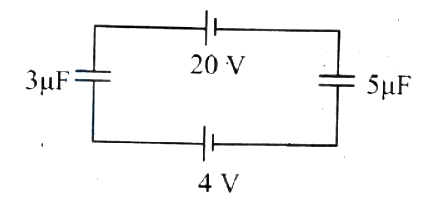 MHT CET 2024 Easy
 - The radius and mean density of the planet are four times as that of the earth. The ratio of escape velocity at the earth to the escape velocity at a planet isMHT CET 2024 Hard
- A disc of paper of radius ' \(R\) ' has a hole of radius ' \(r\) '. It is floating on a liquid of surface tension ' T '. The force of surface tension on the disc isMHT CET 2025 Easy
- A long straight wire of radius 'r' carries a steady current 'I'. The current is uniformly distributed over its cross-section. The ratio \(\left(\frac{B}{B^1}\right)\) of the magnetic field ' \(B\) ' and ' \(B^1\) ' it radial distances \(\frac{r}{2}\) ' and ' \(3 r\) ' respectively, from the axis of the wire isMHT CET 2025 Medium
- A fluid of density ' \(\rho\) ' is flowing through a uniform tube of diameter ' \(\mathrm{d}\) '. The coefficient of viscosity of the fluid is ' \(\eta\) ', then critical velocity of the fluid isMHT CET 2023 Easy
- Moment of inertia of a rod of mass \(M\) and length \(L\) about an axis passing through a point midway between centre and end isMHT CET 2009 Medium
More PYQs from MHT CET
- Process of expelling urine out of body is called ________.MHT CET 2025 Easy
- In unbiased p-n junction diodeMHT CET 2025 Easy
- In the reverse biasing of a p-n junction diodeMHT CET 2023 Easy
- The contrapositive of \((\sim \mathrm{p} \wedge \mathrm{q}) \rightarrow(\mathrm{q} \wedge \sim \mathrm{r})\) isMHT CET 2022 Easy
- For a reaction \(\mathrm{A}+\mathrm{B} \rightarrow\) products \(\Delta \mathrm{H}\) is \(-84.2 \mathrm{~kJ}\) and \(\Delta \mathrm{S}\) is \(-200 \mathrm{~J} \mathrm{~K}^{-1}\). Calculate the highest value of temperature so that the reaction will proceed in forward direction.MHT CET 2023 Medium
- The angle between the lines \(y^{2} \sin ^{2} \theta-x y \sin ^{2} \theta+x^{2}\left(\cos ^{2} \theta-1\right)=0\) isMHT CET 2020 Medium