


MHT CET · Physics · Atomic Physics
An electron in the ground state of hydrogen atom is revolving in a circular orbit of
radius \(\mathrm{R}\). The orbital magnetic moment of the electron is
\((\mathrm{m}=\) mass of electron, \(\mathrm{h}=\) Planck's constant, \(\mathrm{e}=\) electronic charge \()\)
- A \(\frac{-\mathrm{eh}}{\pi \mathrm{m}}\)
- B \(\frac{\mathrm{eh}}{2 \pi \mathrm{m}}\)
- C \(\frac{2 \mathrm{eh}}{\pi \mathrm{m}}\)
- D \(\frac{\mathrm{eh}}{4 \pi \mathrm{m}}\)
Answer & Solution
Correct Answer
(D) \(\frac{\mathrm{eh}}{4 \pi \mathrm{m}}\)
Step-by-step Solution
Detailed explanation
(A)
In ground state \((\mathrm{n}=1)\) according to Bohr's theory:
\(\mathrm{mvR}=\frac{\mathrm{h}}{2 \pi}\) or \(\mathrm{v}=\frac{\mathrm{h}}{2 \pi \mathrm{mR}}\)
Now time period, \(\mathrm{T}=\frac{2 \pi \mathrm{R}}{\mathrm{v}}=\frac{2 \pi \mathrm{R}}{\mathrm{h} / 2 \pi \mathrm{mR}}=\frac{4 \pi^{2} \mathrm{mR}^{2}}{\mathrm{~h}}\)
Magnetic moment, \(\mathrm{M}=\mathrm{iA}\)
Where, \(\mathrm{I}=\frac{\text { charge }}{\text { time period }}=\frac{\mathrm{e}}{\frac{4 \pi^{2} \mathrm{mR}^{2}}{\mathrm{~h}}}=\frac{\mathrm{eh}}{4 \pi^{2} \mathrm{mR}^{2}}\)
and \(\mathrm{A}=\pi \mathrm{R}^{2}\)
\(\therefore \mathrm{M}=\left(\pi \mathrm{R}^{2}\right)\left(\frac{\text { eh }}{4 \pi^{2} \mathrm{mR}^{2}}\right)\) or \(\mathrm{M}=\frac{\text { eh }}{4 \pi \mathrm{m}}\)
Direction of magnetic moment \(\vec{M}\) is perpendicular to the plane of orbit.
In ground state \((\mathrm{n}=1)\) according to Bohr's theory:
\(\mathrm{mvR}=\frac{\mathrm{h}}{2 \pi}\) or \(\mathrm{v}=\frac{\mathrm{h}}{2 \pi \mathrm{mR}}\)
Now time period, \(\mathrm{T}=\frac{2 \pi \mathrm{R}}{\mathrm{v}}=\frac{2 \pi \mathrm{R}}{\mathrm{h} / 2 \pi \mathrm{mR}}=\frac{4 \pi^{2} \mathrm{mR}^{2}}{\mathrm{~h}}\)
Magnetic moment, \(\mathrm{M}=\mathrm{iA}\)
Where, \(\mathrm{I}=\frac{\text { charge }}{\text { time period }}=\frac{\mathrm{e}}{\frac{4 \pi^{2} \mathrm{mR}^{2}}{\mathrm{~h}}}=\frac{\mathrm{eh}}{4 \pi^{2} \mathrm{mR}^{2}}\)
and \(\mathrm{A}=\pi \mathrm{R}^{2}\)
\(\therefore \mathrm{M}=\left(\pi \mathrm{R}^{2}\right)\left(\frac{\text { eh }}{4 \pi^{2} \mathrm{mR}^{2}}\right)\) or \(\mathrm{M}=\frac{\text { eh }}{4 \pi \mathrm{m}}\)
Direction of magnetic moment \(\vec{M}\) is perpendicular to the plane of orbit.
See the Complete Solution
Get step-by-step explanations for this and 2.5 Lakh+ more JEE, NEET & CET questions.
- Unlock all solutions
- Practice the full chapter
- Track accuracy across PYQs
4.8 rated on Google Play · 14,000+ reviews
More questions from Physics
- The frequency of a tuning fork is 256 Hz. It will not resonate with the tuning fork of frequencyMHT CET 2025 Easy
- 'Circle of least confusion' refers to which one of the following defects occurring in images formed by mirrors or lenses?MHT CET 2021 Easy
- A pipe open at both ends and a pipe closed at one end have same length. The ratio of frequencies of their overtone isMHT CET 2019 Medium
- A couple producesMHT CET 2007 Easy
- In photoelectric effect, the photocurrentMHT CET 2021 Easy
- Two identical metal spheres are kept in contact with each other, each having radius ' \(R\) ' cm and ' \(\rho\) ' is the density of material of metal spheres. The gravitational force ' \(F\) ' of attraction between them is proportional toMHT CET 2024 Hard
More PYQs from MHT CET
- A body initially at rest is acted upon by a constant force (F) for time (t). The kinetic energy at time \(\mathrm{t}\) isMHT CET 2020 Easy
- Identify the reactant, reagent and condition of Kolbe's reaction from following.MHT CET 2021 Medium
- Given below are two statements:
Statement I: In suspension culture and callus culture technique, subculturing is necessary.
Statement II: Subculturing is needed only in suspension culture technique.
In the light of above statements, select the correct option given below:MHT CET 2024 Easy - Calculate the volume of unit cell of an element having molar mass \(63.5 \mathrm{~g} \mathrm{~mol}^{-1}\). that forms fce structure \(\left[\varrho \times \mathrm{N}_{\mathrm{A}}=5.5 \times 10^{24} \mathrm{~g} \mathrm{~cm}^{-3} \mathrm{~mol}^{-1}\right]\)MHT CET 2024 Easy
- Which among the following does not from polyhalide ion?MHT CET 2019 Easy
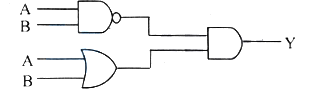
- The logic gate represented by following logic circuit is
 MHT CET 2024 Easy