


MHT CET · Physics · Magnetic Effects of Current
An electron accelerated through potential difference \(V\) passes through a uniform transverse magnetic field and experiences a force \(F\). If the accelerating potential is increased to \(2 \mathrm{~V}\), the electron in the same magnetic field will experience a force
- A \(\frac{F}{2}\)
- B \(3 F\)
- C F
- D \(\sqrt{2} F\)
Answer & Solution
Correct Answer
(D) \(\sqrt{2} F\)
Step-by-step Solution
Detailed explanation
The magnetic force on charged particle \((m, q)\) passing through a uniform transverse magnetic field. \(B\) is given by,
\(F=B q v\)
The kinetic energy gained during acceleration through a potential difference \(V\) is,
\(\begin{aligned} & \frac{1}{2} m v^2=e V \\ & \Rightarrow v=\sqrt{\frac{2 e V}{m}}\end{aligned}\)
Therefore, the magnetic force on the charged particle is directly proportional to the square-root of the potential difference applied during acceleration phase:
\(F \propto \sqrt{V}\)
Now, if the potential difference used to accelerate the electron is doubled:
\(F^{\prime} \propto \sqrt{2 V}\)
\(\therefore \frac{F^{\prime}}{F}=\sqrt{2}\)
\(F=B q v\)
The kinetic energy gained during acceleration through a potential difference \(V\) is,
\(\begin{aligned} & \frac{1}{2} m v^2=e V \\ & \Rightarrow v=\sqrt{\frac{2 e V}{m}}\end{aligned}\)
Therefore, the magnetic force on the charged particle is directly proportional to the square-root of the potential difference applied during acceleration phase:
\(F \propto \sqrt{V}\)
Now, if the potential difference used to accelerate the electron is doubled:
\(F^{\prime} \propto \sqrt{2 V}\)
\(\therefore \frac{F^{\prime}}{F}=\sqrt{2}\)
See the Complete Solution
Get step-by-step explanations for this and 2.5 Lakh+ more JEE, NEET & CET questions.
- Unlock all solutions
- Practice the full chapter
- Track accuracy across PYQs
4.8 rated on Google Play · 14,000+ reviews
More questions from Physics
- One of the slits in Young's double slit experiment is covered with a transparent sheet of thickness \(2.9 \times 10^{-3} \mathrm{~cm}\). The central fringe shifts to a position originally occupied by the \(25^{\text {th }}\) bright fringe. If \(\lambda=5800 Å\), the refractive index of the sheet isMHT CET 2023 Medium
- Out of the following gates, identify the gates which will give an output as '0' (zero) for the given inputs.
 MHT CET 2025 Easy
 - Consider the following statements about interference of light.
A-When crest of one wave coincides with crest of another wave at point, this point is a point of destructive interference.
B-Two coherent sources emit wave of same frequency with constant phase difference.
Choose the correct option from the following.MHT CET 2022 Medium - When a system is taken from state ' \(a\) ' to state ' c ' along a path abc , it is found that \(\mathrm{Q}=80 \mathrm{cal}\) and \(\mathrm{W}=35 \mathrm{cal}\). Along path adc, \(\mathrm{Q}=65 \mathrm{cal}\) the work done W along path adc is
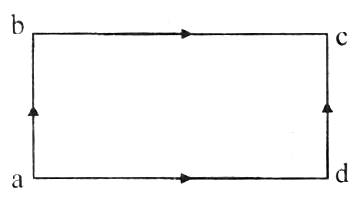 MHT CET 2024 Easy
 - A magnetizing field of \(100 \mathrm{~A} / \mathrm{m}\) produces a magnetic flux of \(2.4 \times 10^{-5} \mathrm{~Wb}\) in an iron bar of cross-sectional area \(0.3 \mathrm{~cm}^2\). The magnetic permeability of the iron bar in the SI unit isMHT CET 2022 Medium
- If a ship of mass \(4 \times 10^{7} \mathrm{~kg}\) initially at rest is pulled by a force of \(5 \times 10^{4} \mathrm{~N}\) through a distance of \(4 \mathrm{~m}\), then the speed of the ship will be (resistance due to water is negligible)MHT CET 2012 Medium
More PYQs from MHT CET
- Calculate the quantity of electricity required to liberate \(0.224 \mathrm{dm}^3\) of chlorine at STP during the electrolysis of fused sodium chloride?MHT CET 2025 Medium
- If \(A=\left[\begin{array}{cc}2 & -1 \\ -1 & 2\end{array}\right]\) such that \(A^2-4 A+3 I=0\), where \(\mathrm{I}\) is a unit matrix of order 2 , then \(A^{-1}\) isMHT CET 2022 Medium
- Which from following ligands has highest field strength?MHT CET 2024 Easy
- Match the ecological hierarchy given in Column-I with their explanation in Column-II. Choose the correct answer from options given below.
Column-I Column - II a. Organism i. Flora and fauna of a specific climatic zone. b. Population ii. Populations of different species of an area. c. Community iii. Organisms of same kind inhabiting an area. d. Biome iv. Basic unit of hierarchy. MHT CET 2022 Medium - If the potential difference used to accelerate electrons is doubled, by what factor does the de-Broglie wavelength associated with the electrons change?MHT CET 2022 Easy
- \(\int \cos ^3 x \cdot e^{\log (\sin x)} d x=\)MHT CET 2021 Hard