


MHT CET · Physics · Current Electricity
An ammeter of resistance ' \(R\) ' gives a full scale deflection when a current of 2 A passes through it. If it is to be converted into an ammeter to measure maximum current of \(10 \mathrm{~A}\), the required shunt is
- A \(\frac{\mathrm{R}}{2}\)
- B \(\frac{\mathrm{R}}{4}\)
- C \(2 \mathrm{R}\)
- D R
Answer & Solution
Correct Answer
(B) \(\frac{\mathrm{R}}{4}\)
Step-by-step Solution
Detailed explanation
Consider the diagram below:
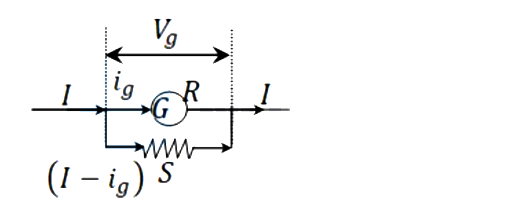
Given, \(\mathrm{i}_{\mathrm{g}}=2 \mathrm{~A}\) is current for maximum deflection, \(\mathrm{R}=\mathrm{R}_{\mathrm{g}}\) is the resistance of galvanometer, \(\mathrm{I}=10 \mathrm{~A}\) is the maximum current to be measured by the ammeter.
On considering same potential drop across the galvanometer and the shunt resistance:
\(\Rightarrow\left(I-i_g\right) S=i_g R\).
On plugging in the given values,
\((10 A-2 A) S=(2 A) R\)
The shunt resistance \(S\) can be written as: \(S=\frac{R}{4}\)
Given, \(\mathrm{i}_{\mathrm{g}}=2 \mathrm{~A}\) is current for maximum deflection, \(\mathrm{R}=\mathrm{R}_{\mathrm{g}}\) is the resistance of galvanometer, \(\mathrm{I}=10 \mathrm{~A}\) is the maximum current to be measured by the ammeter.
On considering same potential drop across the galvanometer and the shunt resistance:
\(\Rightarrow\left(I-i_g\right) S=i_g R\).
On plugging in the given values,
\((10 A-2 A) S=(2 A) R\)
The shunt resistance \(S\) can be written as: \(S=\frac{R}{4}\)
See the Complete Solution
Get step-by-step explanations for this and 2.5 Lakh+ more JEE, NEET & CET questions.
- Unlock all solutions
- Practice the full chapter
- Track accuracy across PYQs
4.8 rated on Google Play · 14,000+ reviews
More questions from Physics
- A gas expands in such a way that its pressure and volume satisfy the condition \(\mathrm{PV}^2=\) constant. Then the temperature of the gasMHT CET 2024 Easy
- A particle of mass ' \(\mathrm{m}\) ' is rotating along a circular path of radius ' \(r\) ' having angular momentum ' \(L\) '. The centripetal force acting on the particle is given byMHT CET 2023 Medium
- In an intrinsic semiconductor, at an ordinary temperature, the correct relation
between the number of electrons 'ne' and number of holes 'nn' isMHT CET 2020 Easy - The instantaneous value of current in an a.c. circuit is \(I=3 \sin\) \(\left(50 \pi t+\frac{\pi}{4}\right) \mathrm{A}\). The current will be maximum for the first time atMHT CET 2025 Easy
- Internal energy of \(\mathrm{n}_1\) moles of hydrogen at temperature ' \(\mathrm{T}\) ' is equal to internal energy of ' \(n_2\) ' moles of helium at temperature \(2 T\), then the ratio \(n_1: n_2\) is [Degree of freedom of \(\mathrm{He}=3\), Degree of freedom of \(\mathrm{H}_2=5\) ]MHT CET 2021 Easy
- A monoatomic gas of presuure 'P' having volume 'V' expands isothermally to a volume '2V' and then adiabatically to a volume '16V'. The final pressure of the gas is (ratio of specific heats \(=\frac{5}{3}\))MHT CET 2020 Medium
More PYQs from MHT CET
- Identify polyamide polymer from following.MHT CET 2025 Easy
- If the sum of the squares of the distance of the point \(\mathrm{P}(\mathrm{x}, \mathrm{y}, \mathrm{z})\) from the co-ordinate axes is 242 , then the distance of the point \(P\) from the origin is _______ units.MHT CET 2025 Easy
- Which of the following metals is refined by vapour phase refining in Mond process?MHT CET 2020 Easy
- An engine operating between temperatures \(T_1\) and \(T_2\) has efficiency \(\frac{1}{5}\). When \(\mathrm{T}_2\) is lowered by 45 K , its efficiency becomes \(\frac{1}{2}\). Temperatures \(\mathrm{T}_1\) and \(\mathrm{T}_2\) are respectivelyMHT CET 2025 Medium
- The differential equation of all parabolas whose axis is isMHT CET 2017 Medium
- The sum to infinite terms of the series
\(\tan ^{-1}\left(\frac{1}{3}\right)+\tan ^{-1}\left(\frac{2}{9}\right)+\ldots \ldots \ldots \ldots+\tan ^{-1}\left(\frac{2^{\mathrm{n}-1}}{1+2^{2 \mathrm{n}-1}}\right)+\ldots \ldots \ldots \text { is }\)MHT CET 2025 Medium