


MHT CET · Physics · Alternating Current
An a.c. voltage source \(\mathrm{V}=\mathrm{V}_0 \sin \omega \mathrm{t}\). is connected across resistance ' R ' and capacitance ' \(C\) ' in series. It is given that \(R=\frac{1}{\omega \mathrm{c}}\) and the peak current is \(\mathrm{I}_0\). If the angular frequency of the voltage source is changed to \(\left(\frac{\omega}{\sqrt{3}}\right)\), then the new peak current in the circuit is
- A \(\frac{\mathrm{I}_0}{2}\)
- B \(\frac{\mathrm{I}_0}{\sqrt{2}}\)
- C \(\sqrt{2} \mathrm{I}_0\)
- D \(\sqrt{3} \mathrm{I}_0\)
Answer & Solution
Correct Answer
(B) \(\frac{\mathrm{I}_0}{\sqrt{2}}\)
Step-by-step Solution
Detailed explanation
Given: \(R=\frac{1}{\omega \mathrm{C}}=\mathrm{X}_{\mathrm{c}}\).
\(\begin{aligned}
\therefore \quad Z & =\sqrt{R^2+X_C^2}=\sqrt{2} R \\
I_0 & =\frac{V_0}{Z}=\frac{V_0}{\sqrt{2} R} \\
& \Rightarrow \frac{I_0}{\sqrt{2}}=\frac{V_0}{2 R}...(i)
\end{aligned}\)
When \(\omega\) becomes \(\frac{1}{\sqrt{3}}\) times, \(X_C\) will become \(\sqrt{3}\) times, i.e., \(\sqrt{3} R\).
\(\begin{array}{ll}
\therefore & Z^{\prime}=\sqrt{R^2+(\sqrt{3} R)^2}=2 R \\
\therefore & I_0^{\prime}=\frac{V_0}{Z^{\prime}}=\frac{V_0}{2 R}=\frac{I_0}{\sqrt{2}}...[From(i)]
\end{array}\)
\(\begin{aligned}
\therefore \quad Z & =\sqrt{R^2+X_C^2}=\sqrt{2} R \\
I_0 & =\frac{V_0}{Z}=\frac{V_0}{\sqrt{2} R} \\
& \Rightarrow \frac{I_0}{\sqrt{2}}=\frac{V_0}{2 R}...(i)
\end{aligned}\)
When \(\omega\) becomes \(\frac{1}{\sqrt{3}}\) times, \(X_C\) will become \(\sqrt{3}\) times, i.e., \(\sqrt{3} R\).
\(\begin{array}{ll}
\therefore & Z^{\prime}=\sqrt{R^2+(\sqrt{3} R)^2}=2 R \\
\therefore & I_0^{\prime}=\frac{V_0}{Z^{\prime}}=\frac{V_0}{2 R}=\frac{I_0}{\sqrt{2}}...[From(i)]
\end{array}\)
See the Complete Solution
Get step-by-step explanations for this and 2.5 Lakh+ more JEE, NEET & CET questions.
- Unlock all solutions
- Practice the full chapter
- Track accuracy across PYQs
4.8 rated on Google Play · 14,000+ reviews
More questions from Physics
- A coil has inductance \(H\). The ratio of its reactance when it is connected first to an a.c. source and then to d.c. source isMHT CET 2024 Easy
- In two separate setups for Biprism experiment using same wavelength, fringes of equal width are obtained. If ratio of slit separation is \(2: 3\) then the ratio of the distance between the slit and screen in the two setups isMHT CET 2023 Medium
- A pendulum performs S.H.M. with period \(\sqrt{3}\) second in a stationery lift. If lift moves up with acceleration \(\frac{\mathrm{g}}{3}\), the period of pendulum is \([\mathrm{g}=\) acceleration due to gravity \(]\)MHT CET 2020 Medium
- The electrostatic potential inside a charged spherical ball is given by \(V=a r^2+\mathrm{b}\) where ' r ' is the distance from its centre and ' \(a\) ' and ' \(b\) ' are constants. The volume charge density of the ball is \(\left[\varepsilon_0=\right.\) permittivity of free space]MHT CET 2024 Hard
- A wave is given by \(Y=3 \sin 2 \pi\left(\frac{t}{0.04}-\frac{x}{0.01}\right)\) where \(Y\) is in cm . Frequency of the wave and maximum acceleration will be \(\left(\pi^2=10\right)\)MHT CET 2024 Medium
- A body is projected vertically upwards from earth's surface. If its K.E. of projection is
equal to half of its minimum value required to escape from the gravitational
influence, then the height upto which it rises is \((\mathrm{R}=\) radius of the earth \()\)MHT CET 2020 Medium
More PYQs from MHT CET
- Two identical long parallel wires carry currents \(I_1\) and \(I_2\) such that \(I_1>I_2\). When the currents are in the same direction, the magnetic field at a point midway between the wires is \(6 \times 10^{-6} \mathrm{~T}\). If the direction of \(I_2\) is reversed, the field becomes \(3 \times 10^{-5} \mathrm{~T}\). The ratio \(\left(\frac{I_1}{I_2}\right)\) is-MHT CET 2022 Hard
- Tangent galvanometer measuresMHT CET 2007 Easy
- The magnetic dipole moment of a short magnetic dipole at a distant point along the equator of magnet has a magnitude of ‘X’ in SI units. If the distance between point and the magnet is halved then the magnitude of dipole moment will beMHT CET 2019 Hard
- The variation of magnetic susceptibility \((\chi)\) with temperature for a diamagnetic substance is shown correctly by graph
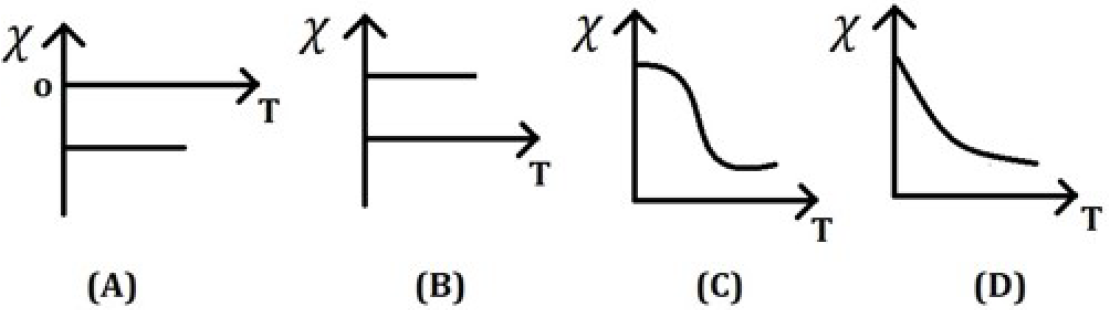 MHT CET 2025 Easy
 - A spherical iron ball of \(10 \mathrm{~cm}\) radius is coated with a layer of ice of uniform thickness that melts at the rate of \(50 \mathrm{~cm}^3 / \mathrm{min}\). If the thickness of ice is \(5 \mathrm{~cm}\), then the rate at which the thickness of ice decrease isMHT CET 2022 Easy
- In LCR resonant circuit, the current and voltage have phase differenceMHT CET 2024 Easy