


MHT CET · Physics · Dual Nature of Matter
According to de-Broglie hypothesis if an electron of mass ' \(\mathrm{m}\) ' is accelerated by potential difference ' \(\mathrm{V}\) ' then associated wavelength is ' \(\lambda\) '. When a proton of mass ' \(M\) ' is accelerated through potential difference ' \(9 \mathrm{~V}\) ' then the wavelength associated with it is
- A \(\frac{\lambda}{3} \sqrt{\frac{M}{m}}\)
- B \(\frac{\lambda}{3} \sqrt{\frac{\mathrm{m}}{\mathrm{M}}}\)
- C \(\frac{\lambda}{6} \sqrt{\frac{m}{M}}\)
- D \(\frac{\lambda}{6} \sqrt{\frac{M}{m}}\)
Answer & Solution
Correct Answer
(B) \(\frac{\lambda}{3} \sqrt{\frac{\mathrm{m}}{\mathrm{M}}}\)
Step-by-step Solution
Detailed explanation
Do Broglie relation
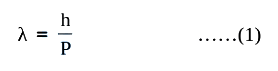
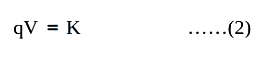
Energy conservation,
Energy vs momentum relation
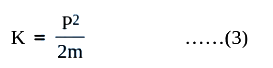
Using equation (1), (2) and (3)
\(\begin{aligned}
& \lambda=\frac{h}{p}=\frac{h}{\sqrt{2 K m}} \\
& \lambda=\frac{h}{\sqrt{2 q V m}}
\end{aligned}\)
Now, for proton of mass \(M\) that is accelerated through \(9 \mathrm{~V}\), the de-broglie wavelength can be written as,
\(\begin{aligned}
& \lambda_p=\frac{h}{\sqrt{2 q(9 V) M}} \\
& \therefore \frac{\lambda}{\lambda_p}=3 \sqrt{\frac{M}{m}} \\
& \Rightarrow \lambda_p=\frac{\lambda}{3} \sqrt{\frac{m}{M}}
\end{aligned}\)
Energy conservation,
Energy vs momentum relation
Using equation (1), (2) and (3)
\(\begin{aligned}
& \lambda=\frac{h}{p}=\frac{h}{\sqrt{2 K m}} \\
& \lambda=\frac{h}{\sqrt{2 q V m}}
\end{aligned}\)
Now, for proton of mass \(M\) that is accelerated through \(9 \mathrm{~V}\), the de-broglie wavelength can be written as,
\(\begin{aligned}
& \lambda_p=\frac{h}{\sqrt{2 q(9 V) M}} \\
& \therefore \frac{\lambda}{\lambda_p}=3 \sqrt{\frac{M}{m}} \\
& \Rightarrow \lambda_p=\frac{\lambda}{3} \sqrt{\frac{m}{M}}
\end{aligned}\)
See the Complete Solution
Get step-by-step explanations for this and 2.5 Lakh+ more JEE, NEET & CET questions.
- Unlock all solutions
- Practice the full chapter
- Track accuracy across PYQs
4.8 rated on Google Play · 14,000+ reviews
More questions from Physics
- A source of sound emits sound wave of frequency ' \(f\) ' and moves towards an observer with a velocity \(\frac{\mathrm{V}}{3}\) where V is the velocity of sound. If the observer moves away from the source with a velocity \(\frac{\mathrm{V}}{5}\) the apparent frequency heard by him will beMHT CET 2025 Medium
- A source of sound is moving towards a stationary observer with \(\left(\frac{1}{10}\right)^{\text {th }}\) the of the speed of sound. The ratio of apparent to real frequency isMHT CET 2023 Hard
- In a resonance tube the first resonance with a tunning fork occurs at \(16 \mathrm{~cm}\) and second at \(49 \mathrm{~cm} .\) If the velocity of sound is \(330 \mathrm{~m} / \mathrm{s}\), the frequency of tunning fork isMHT CET 2011 Hard
- The energy band gap (distance between the conduction band and valence band) in conductor isMHT CET 2009 Easy
- For a body of mas ' \(\mathrm{m}\) ', the acceleration due to gravity at a distance ' \(R\) ' from the surface of the earth is \(\left(\frac{g}{4}\right)\). Its value at a distance \(\left(\frac{R}{2}\right)\) from the surface of the earth is \((R=\) radius of the earth, \(g\) = acceleration due to gravity)MHT CET 2021 Medium
- For a gas, \(\frac{\mathrm{R}}{\mathrm{C}_{\mathrm{V}}}=0 \cdot 4\) where 'R' is universal gas constant and \(\mathrm{C}_{\mathrm{V}}\) is the molar specific heat at constant volume. The gas is made up of molecules which areMHT CET 2020 Medium
More PYQs from MHT CET
- \(
\int_{-1}^{1}\left[\sqrt{1+x+x^{2}}-\sqrt{1-x+x^{2}}\right] d x=
\)MHT CET 2020 Easy - Two bodies 'A' an 'B' start from the same point at the same instant and move along a straight line. Body 'A' moves with uniform acceleration ' \(a\) ' and body ' \(B\) ' moves with uniform velocity ' \(V\) '. They meet after time ' \(t\) '. The value of ' \(t\) ' isMHT CET 2023 Easy
- A coin is tossed and a die is thrown. The probability that the outcome will be head or a number greater than 4 or both, isMHT CET 2021 Easy
- The following figures show the variation of displacement with time of a particular object.
(a)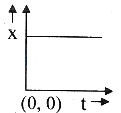
(b)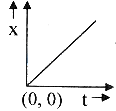
(c)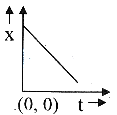
(d)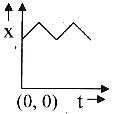 MHT CET 2024 Medium
 - Which of the following correctly represents the process of reduction?MHT CET 2022 Easy
- If \(3 \sin ^{2} x-8 \sin x+4=0, x \in\left(\frac{\pi}{2}, \pi\right)\), then \(\tan x=\)MHT CET 2020 Easy