


MHT CET · Physics · Motion In One Dimension
A vehicle of mass 'M' is moving with momentum 'P' on a rough horizontal road. The coefficient of friction between the tyres and the horizontal road is '\(\mu\)'. The stopping distance is (g \(=\) acceleration due to gravity)
- A \(\frac{\mathrm{P}^{2}}{2 \mu \mathrm{g}}\)
- B \(\frac{\mathrm{P}^{2}}{2 \mu \mathrm{gM}^{2}}\)
- C \(\frac{\mathrm{P}^{2}}{\mu \mathrm{gM}^{2}}\)
- D \(\frac{\mathrm{P}^{2}}{2 \mu \mathrm{m}^{2}}\)
Answer & Solution
Correct Answer
(B) \(\frac{\mathrm{P}^{2}}{2 \mu \mathrm{gM}^{2}}\)
Step-by-step Solution
Detailed explanation
Initial velocity \(\mathrm{u}=\frac{\mathrm{p}}{\mathrm{m}}\)
Final velocity \(\mathrm{v}=0\) (as the vehicle must stop)
Force of friction \(=\mu \mathrm{mg}\)
(where \(\mathrm{g}\) is acceleration due to gravity)
Acceleration due to friction \(=-\frac{\mu \mathrm{mg}}{\mathrm{m}}=-\mu \mathrm{g}\)
(-ve sign shows that it is retardation )
Using the kinematic expression
\(\mathrm{v}^{2}=\mathrm{u}^{2}=2 \mathrm{as}\)
and inserting various values we get stopping distance \(s\)
\(\begin{array}{l}(0)^{2}-\frac{\mathrm{p}^{2}}{\mathrm{~m}^{2}}=2(-\mu \mathrm{g}) \mathrm{s} \\\Rightarrow \mathrm{s}=\frac{\mathrm{p}^{2}}{2 \mu^{2} \mu \mathrm{g}}\end{array}\)
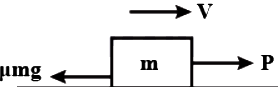
Final velocity \(\mathrm{v}=0\) (as the vehicle must stop)
Force of friction \(=\mu \mathrm{mg}\)
(where \(\mathrm{g}\) is acceleration due to gravity)
Acceleration due to friction \(=-\frac{\mu \mathrm{mg}}{\mathrm{m}}=-\mu \mathrm{g}\)
(-ve sign shows that it is retardation )
Using the kinematic expression
\(\mathrm{v}^{2}=\mathrm{u}^{2}=2 \mathrm{as}\)
and inserting various values we get stopping distance \(s\)
\(\begin{array}{l}(0)^{2}-\frac{\mathrm{p}^{2}}{\mathrm{~m}^{2}}=2(-\mu \mathrm{g}) \mathrm{s} \\\Rightarrow \mathrm{s}=\frac{\mathrm{p}^{2}}{2 \mu^{2} \mu \mathrm{g}}\end{array}\)
See the Complete Solution
Get step-by-step explanations for this and 2.5 Lakh+ more JEE, NEET & CET questions.
- Unlock all solutions
- Practice the full chapter
- Track accuracy across PYQs
4.8 rated on Google Play · 14,000+ reviews
More questions from Physics
- The string of pendulum of length ' \(L\) ' is displaced through \(90^{\circ}\) from the vertical and released. Then the maximum strength of the string in order to withstand the tension, as the pendulum passes through the mean position is ( \(\mathrm{m}=\) mass of pendulum, \(\mathrm{g}=\) acceleration due to gravity)MHT CET 2024 Easy
- Electromagnetic waves of wavelength ranging from \(100 Å\) A to \(400 Å\) comes underMHT CET 2012 Easy
- The magnetic field at the centre of a circular coil of radius ' \(R\) ', carrying current \(2 \mathrm{~A}\) is ' \(\mathrm{B}_1\) '. The magnetic field at the centre of another coil of radius ' \(3 R\) ' carrying current \(4 A\) is ' \(B_2\) '. The ratio \(B_1: B_2\) isMHT CET 2023 Medium
- An open U-tube contains mercury. When \(11.2 \mathrm{~cm}\) of water is poured into one of the arms of the tube, how high does the mercury rise in the other arm from its initial unit?MHT CET 2007 Easy
- A simple pendulum of length \(L\) has mass \(m\) and it oscillates freely with amplitude A. At extreme position, its potential energy is ( \(\mathrm{g}=\) acceleration due to gravity)MHT CET 2024 Easy
- When a photosensitive surface is irradiated by light of wavelength ' \(\lambda_1\) ' and ' \(\lambda_2\) ', maximum kinetic energies of emitted photoelectrons are ' \(E_1\) ' and ' \(E_2\) ' respectively. The work function of photosensitive surface isMHT CET 2021 Medium
More PYQs from MHT CET
- A proton and alpha particle are accelerated through the same potential difference. The ratio of the de-Broglie wavelength of proton to that of alpha will be (mass of alpha particle is four times mass of proton.)MHT CET 2021 Medium
- Which among the following carbocation is most reactive?MHT CET 2020 Medium
- A body is executing a linear S.H.M. Its potential energies at the displacement ' \(x\) ' and ' \(y\) ' are ' \(E_1\) ' and ' \(\mathrm{E}_2\) ' respectively. Its potential energy at displacement \((\mathrm{x}+\mathrm{y})\) will beMHT CET 2023 Medium
- The equations of two waves are given as
\(\begin{aligned}
& \mathrm{y}_1=\mathrm{asin}\left(\omega \mathrm{t}+\phi_1\right) \
& \mathrm{y}_2=\operatorname{asin}\left(\omega \mathrm{t}+\phi_2\right)
\end{aligned}\)
If amplitude and time period of resultant wave is same as the individual waves, then \(\left(\phi_1-\phi_2\right)\) isMHT CET 2024 Medium - If
\(\begin{aligned} f(x) &=6 \beta-3 \propto x, \text { if }-4 \leq x < -2 \ \end{aligned}\) \(=4 x+1, \text { if }-2 \leq x \leq 2 \)
is continuous on \([-4,2]\), then \(\propto+\beta=\)MHT CET 2020 Easy - If \(\tan ^{-1} x+\tan ^{-1} y+\tan ^{-1} z=\frac{\pi}{2},x, y, z>0, x y < 1\), then the value of
\(x y+y z+z x=\)MHT CET 2020 Hard