


MHT CET · Physics · Rotational Motion
A thin wire of length ' \(L\) ' and uniform linear mass density ' \(\mathrm{m}\) ' is bent into a circular coil. The moment of inertia of this coil about tangential axis and in plane of the coil is
- A \(\frac{3 \mathrm{~mL}^2}{5 \pi^2}\)
- B \(\frac{3 m L^3}{8 \pi^2}\)
- C \(\frac{3 \mathrm{~mL}^3}{4 \pi^2}\)
- D \(\frac{3 \mathrm{~mL}^2}{7 \pi^2}\)
Answer & Solution
Correct Answer
(B) \(\frac{3 m L^3}{8 \pi^2}\)
Step-by-step Solution
Detailed explanation
\(\therefore\) Moment of inertia of thin wire:
\(\mathrm{I} =\frac{\mathrm{MR}^2}{2} \)
\( \mathrm{M} =\mathrm{V} \times \mathrm{m} \text { and } \mathrm{L}=2 \pi \mathrm{R} \)
\( \mathrm{R} =\frac{\mathrm{L}}{2 \pi} \)
\( \therefore \mathrm{I} =\frac{\mathrm{Lm}}{2}\left(\frac{\mathrm{L}}{2 \pi}\right)^2 \)
\( \mathrm{I} =\frac{\mathrm{mL}^3}{8 \pi^2}\)
\(\therefore\) Using Parallel axis theorem:
\(\begin{aligned}& I^{\prime}=I+M R^2 \\& I=\frac{m L^3}{8 \pi^2}+L m\left(\frac{L}{2 \pi}\right)^2 \\& I=\frac{3 m L^3}{8 \pi^2}
\end{aligned}\)
\(\mathrm{I} =\frac{\mathrm{MR}^2}{2} \)
\( \mathrm{M} =\mathrm{V} \times \mathrm{m} \text { and } \mathrm{L}=2 \pi \mathrm{R} \)
\( \mathrm{R} =\frac{\mathrm{L}}{2 \pi} \)
\( \therefore \mathrm{I} =\frac{\mathrm{Lm}}{2}\left(\frac{\mathrm{L}}{2 \pi}\right)^2 \)
\( \mathrm{I} =\frac{\mathrm{mL}^3}{8 \pi^2}\)
\(\therefore\) Using Parallel axis theorem:
\(\begin{aligned}& I^{\prime}=I+M R^2 \\& I=\frac{m L^3}{8 \pi^2}+L m\left(\frac{L}{2 \pi}\right)^2 \\& I=\frac{3 m L^3}{8 \pi^2}
\end{aligned}\)
See the Complete Solution
Get step-by-step explanations for this and 2.5 Lakh+ more JEE, NEET & CET questions.
- Unlock all solutions
- Practice the full chapter
- Track accuracy across PYQs
4.8 rated on Google Play · 14,000+ reviews
More questions from Physics
- Self-induction of a solenoid cannot be increased byMHT CET 2022 Easy
- A ring and a disc roll on the horizontal surface without slipping with same linear velocity. If both have same mass and total kinetic energy of the ring is 4 J then total kinetic energy of the disc isMHT CET 2016 Medium
- To what temperature should the hydrogen at \(327^{\circ} \mathrm{C}\) be cooled at constant pressure, so that the root mean square velocity of its molecules becomes half of its previous value?MHT CET 2009 Easy
- Light is incident at an angle \(i\) on a glass slab. The reflected ray is completely polarised. The angle of refraction isMHT CET 2010 Hard
- Two point charges +8 q and -2 q are located at \(\mathrm{X}=0\) (origin) and \(\mathrm{X}=\mathrm{L}\) respectively. The net electric field due to these two charges is zero at point P on X -axis. The location of point P from the origin isMHT CET 2024 Easy
- Three charges each of value \(+q\) are placed at the corners of an isosceles triangle \(\mathrm{ABC}\) of sides \(\mathrm{AB}\) and \(\mathrm{AC}\) each equal to \(2 \mathrm{a}\). The mid points of \(A B\) and \(A C\) are \(D\) and \(E\) respectively. The work done in taking a charge \(\mathrm{Q}\) from \(\mathrm{D}\) to \(\mathrm{E}\) is \(\left(\varepsilon_0=\right.\) permittivity of free space)MHT CET 2023 Hard
More PYQs from MHT CET
- If decomposition of hydrogen peroxide is a first order reaction, it's rate law equation can be represented asMHT CET 2021 Easy
- A coil of resistance \(400 \Omega\) is placed in a magnetic field. If the magnetic flux ' \(\phi\) ' (Wb) linked with the coil varies with time ' \(t\) ' (s) as \(\phi=50 t^2+4\), the current in the coil at \(t=2 \mathrm{~s}\) will beMHT CET 2025 Medium
- When light of wavelength ' \(\lambda\) ' is incident on photosensitive surface, photons of power
'P' are emitted. The number of photons (n) emitted in 't' second is
(h= Planck's constant, \(\mathrm{c}=\) velocity of light in vacuum)MHT CET 2020 Easy - A body is projected vertically upwards from earth's surface. If velocity of projection is \(\left(\frac{1}{3}\right)^{\text {rd }}\) of escape velocity, then the height upto which a body rises is
\((\mathrm{R}=\) radius of earth \()\)MHT CET 2020 Medium - What is IUPAC name of following compound?
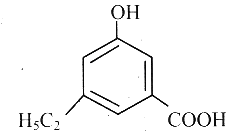 MHT CET 2024 Hard
 - If \(x^{\mathrm{y}}+\mathrm{y}^x=\mathrm{a}^{\mathrm{b}}\), then \(\frac{\mathrm{dy}}{\mathrm{d} x}\) at \(x=1, \mathrm{y}=2\) isMHT CET 2025 Medium