


MHT CET · Physics · Rotational Motion
A thin uniform rod of length ' \(L\) ' and mass ' \(M\) ', is swinging freely along a horizontal axis passing through its centre. Its maximum angular speed is ' \(\omega\) '. Its centre of mass rises to a maximum height of [g= gravitational acceleration]
- A \(\frac{\omega^2 \mathrm{~L}^2}{12 \mathrm{~g}^2}\)
- B \(\frac{\omega^2 L^2 g}{6}\)
- C \(\frac{\omega^2 g}{12 \mathrm{~L}^2}\)
- D \(\frac{\omega^2 \mathrm{~L}^2}{24 \mathrm{~g}}\)
Answer & Solution
Correct Answer
(D) \(\frac{\omega^2 \mathrm{~L}^2}{24 \mathrm{~g}}\)
Step-by-step Solution
Detailed explanation
The moment of inertia of rod about its centre is \(\frac{\mathrm{ML}^2}{12}\).
Its kinetic energy K.E. \(=\frac{1}{2} \mathrm{I} \omega^2=\frac{1}{2} \times \frac{\mathrm{ML}^2}{12} \times \omega^2\)
\(=\frac{M L^2 \omega^2}{24}\)
If its centre of mass rises by h, then it will gain potential energy.
\(\therefore \quad\) Potential energy, \(\mathrm{Mgh}=\frac{\mathrm{ML}^2 \omega^2}{24}\)
\(\therefore \quad \mathrm{h}=\frac{\mathrm{L}^2 \omega^2}{24 \mathrm{~g}}\).
Its kinetic energy K.E. \(=\frac{1}{2} \mathrm{I} \omega^2=\frac{1}{2} \times \frac{\mathrm{ML}^2}{12} \times \omega^2\)
\(=\frac{M L^2 \omega^2}{24}\)
If its centre of mass rises by h, then it will gain potential energy.
\(\therefore \quad\) Potential energy, \(\mathrm{Mgh}=\frac{\mathrm{ML}^2 \omega^2}{24}\)
\(\therefore \quad \mathrm{h}=\frac{\mathrm{L}^2 \omega^2}{24 \mathrm{~g}}\).
See the Complete Solution
Get step-by-step explanations for this and 2.5 Lakh+ more JEE, NEET & CET questions.
- Unlock all solutions
- Practice the full chapter
- Track accuracy across PYQs
4.8 rated on Google Play · 14,000+ reviews
More questions from Physics
- The moments of inertia of two freely rotating bodies \(A\) and \(B\) are \(I_{A}\) and \(I_{B}\) respectively. \(I_{A}>I_{B}\) and their angular momenta are equal. If \(K_{A}\) and \(K_{B}\) are their kinetic energies, thenMHT CET 2009 Medium
- A glass slab of thickness \(4 \mathrm{~cm}\) contains the same numbers of waves as \(5 \mathrm{~cm}\) of water when both are traversed by the same monochromatic ray of light. The refractive index of water is \(4 / 3\), what is that for glass?MHT CET 2011 Medium
- In a parallel plate capacitor with air between the plates, the distance ' \(\mathrm{d}\) ' between the plates is changed and the space is filled with dielectric constant 8 . The capacity of the capacitor is increased 16 times, the distance between the plates isMHT CET 2023 Medium
- The alternating e.m.f. induced in the secondary coil of a transformer is mainly due toMHT CET 2023 Easy
- The maximum velocity of the photoelectrons emitted by a metal surface is \(9 \times 10^5 \mathrm{~m} / \mathrm{s}\). The value of ratio of charge (e) to mass (m) of the photoelectron is \(1.8 \times 10^{11} \mathrm{C} / \mathrm{kg}\). The value of stopping potential in volt isMHT CET 2025 Easy
- Which of the following figure represents forward bias diode?
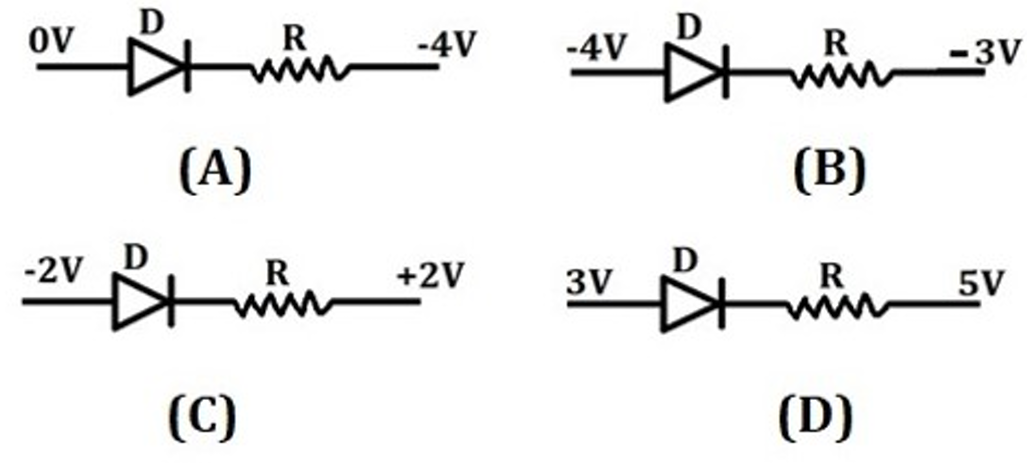 MHT CET 2025 Easy
More PYQs from MHT CET
- A heavy mass is attached at one end of a thin wire and whirled in a vertical circle. The chances of breaking the wire are maximum whenMHT CET 2020 Medium
- Two spheres \(\mathrm{S}_1\) and \(\mathrm{S}_2\) have same radii but temperatures \(T_1\) and \(T_2\) respectively. Their emissive power is same and emissivity in the ratio 1:4. Then the ratio \(T_1: T_2\) isMHT CET 2024 Medium
- The moment of inertia of thin square plate PQRS of uniform thickness, about an axis passing through centre ' O ' and perpendicular to the plane of the plate is \(\left(\mathrm{I}_1, \mathrm{I}_2, \mathrm{I}_3, \mathrm{I}_4\right.\) are respectively the moments of inertia about axis \(1,2,3,4\) which are in the plane of the plate as shown in figure)
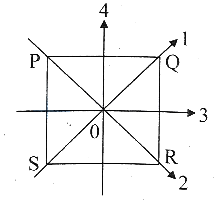 MHT CET 2024 Medium
 - On the surface of the liquid in equilibrium, molecules of the liquid possessMHT CET 2010 Easy
- Identify the formula of pentaaquaisothiocyanatoiron(III) ion from following.MHT CET 2024 Easy
- Which of the following statements is NOT true about Rutherford atomic model?MHT CET 2023 Easy