


MHT CET · Physics · Rotational Motion
A thin uniform circular disc of mass ' \(\mathrm{M}\) ' and radius ' \(R\) ' is rotating with angular velocity ' \(\omega\) ', in a horizontal plane about an axis passing through its centre and perpendicular to its plane. Another disc of same radius but of mass \(\left(\frac{M}{2}\right)\) is placed gently on the first disc co-axially. The new angular velocity will be
- A \(\frac{2}{3} \omega\)
- B \(\frac{4}{5} \omega\)
- C \(\frac{5}{4} \omega\)
- D \(\frac{3}{2} \omega\)
Answer & Solution
Correct Answer
(A) \(\frac{2}{3} \omega\)
Step-by-step Solution
Detailed explanation
Angular momentum \(=\mathrm{I} \omega\) By conservation of angular momentum, \(\mathrm{I}_1 \omega_1=\mathrm{I}_2 \omega_2\)
Here, \(I_1=\frac{M^2}{2}, I_2=\frac{(M+M / 2)}{2} R^2=\frac{3 M^2}{4}\)
\(\therefore \frac{\mathrm{MR}^2}{2} \omega_1=\frac{3 \mathrm{MR}^2}{4} \omega_2\)
\(\therefore \omega_2=\frac{2}{3} \omega_1\)
Here, \(I_1=\frac{M^2}{2}, I_2=\frac{(M+M / 2)}{2} R^2=\frac{3 M^2}{4}\)
\(\therefore \frac{\mathrm{MR}^2}{2} \omega_1=\frac{3 \mathrm{MR}^2}{4} \omega_2\)
\(\therefore \omega_2=\frac{2}{3} \omega_1\)
See the Complete Solution
Get step-by-step explanations for this and 2.5 Lakh+ more JEE, NEET & CET questions.
- Unlock all solutions
- Practice the full chapter
- Track accuracy across PYQs
4.8 rated on Google Play · 14,000+ reviews
More questions from Physics
- The function of dielectric in a capacitor isMHT CET 2024 Medium
- A body is executing S.H.M. under the action of force having maximum magnitude \(50 \mathrm{~N}\). When its energy is half kinetic and half potential, the magnitude of the force acting on the particle isMHT CET 2021 Medium
- Three bodies each of mass \(1 \mathrm{~kg}\) are situated at the vertices of an equilateral triangle of side \(1 \mathrm{~m}\). The \(x y\)-coordinates of centre of mass of the system are.MHT CET 2022 Medium
- A metal sphere cools at the rate of \(1.5^{\circ} \mathrm{C} / \mathrm{min}\) when its temperature is \(80^{\circ} \mathrm{C}\). At what rate will it cool when its temperature falls to \(50^{\circ} \mathrm{C}\). [Temperature of surrounding is \(30^{\circ} \mathrm{C}\) ]MHT CET 2021 Medium
- The moment of inertia of a uniform circular disc of radius \(R\) and mass \(M\) about an axis touching the disc at its diameter and normal to the disc isMHT CET 2007 Easy
- The frequency ' \(v_m\) ' corresponding to which the energy emitted by a black body is maximum may vary with the temperature ' \(T\) ' of the body as shown by the curves ' \(A\) ', ' \(B\) ', ' \(C\) ' and ' \(D\) ' in the figure. Which one of these represents the correct variation?
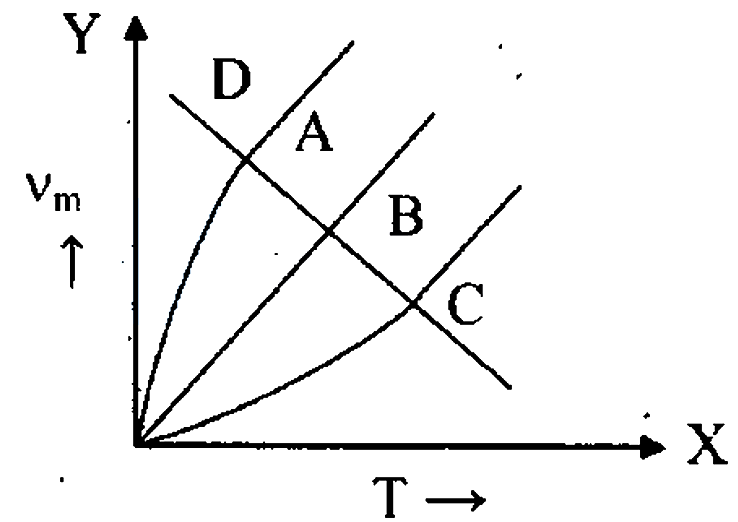 MHT CET 2024 Medium
More PYQs from MHT CET
- The equations of a line passing through \((3,-1,2)\) and perpendicular to the lines \(\overline{\mathrm{r}}=(\hat{\mathrm{i}}+\hat{\mathrm{j}}-\hat{\mathrm{k}})+\lambda(2 \hat{\mathrm{i}}-2 \hat{\mathrm{j}}+\hat{\mathrm{k}})\) and \(\bar{r}=(2 \hat{i}+\hat{j}-3 \hat{k})+\mu(\hat{i}-2 \hat{j}+2 \hat{k})\) isMHT CET 2021 Medium
- Calculate the new volume of a gas at constant pressure when temperature is increased to \(546 \mathrm{~K}\) [Initial volume of a gas at \(273 \mathrm{~K}\) is \(4 \mathrm{dm}^3\) ]MHT CET 2022 Medium
- Seven capacitors each of capacitance \(2 \mu F\) are to be connected to obtain equivalent
capacitance of \(\left(\frac{10}{11}\right) \mu \mathrm{F}\). Which of the following combination is possible?MHT CET 2020 Medium - The equation of line equally inclined with the positivie co-ordinate axes and passing through isMHT CET 2017 Medium
- The minimum value of the function \(f(x)=x \log x\) isMHT CET 2021 Easy
- If \(A=\left[\begin{array}{cc}1 & \tan x \\ -\tan x & 1\end{array}\right]\), then \(A^T \cdot A^{-1}=\)MHT CET 2023 Medium