


MHT CET · Physics · Rotational Motion
A thin circular ring of mass ' \(\mathrm{M}^{\prime}\) and radius ' \(\mathrm{R}^{\prime}\) is rotating about a transverse axis
passing through its centre with constant angular velocity ' \(\omega\) '. Two objects each of
mass 'm' are attached gently to the opposite ends of a diameter of the ring. What is the new angular velocity?
- A \(\frac{M \omega}{M+2 m}\)
- B \(\frac{M(\omega)}{M+m}\)
- C \(\frac{(M+2 m) \omega}{M}\)
- D \(\frac{(\mathrm{M}-2 \mathrm{~m}) \omega}{\mathrm{M}+2 \mathrm{~m}}\)
Answer & Solution
Correct Answer
(A) \(\frac{M \omega}{M+2 m}\)
Step-by-step Solution
Detailed explanation
Initial angular momentum of the ring \(\quad=I \omega=M R^{2} \omega\)
If the new angular velocity is \(\omega^{\prime}\) then the final angular momentum \(=I^{\prime} \omega^{\prime}\) where \(I^{\prime}=M R^{2}+2 m R^{2}=(M+2 m) R^{2}\).
By law of conservation of momentum
\(\begin{array}{c}
\mathrm{I}^{\prime} \omega^{\prime}=\mathrm{I} \omega \\
(\mathrm{M}+2 \mathrm{~m}) \mathrm{R}^{2} \omega^{\prime} \\
\therefore \omega^{\prime}=\frac{\mathrm{M} \omega}{\mathrm{M}+2 \mathrm{~m}}
\end{array}=\mathrm{MR}^{2} \omega\)
If the new angular velocity is \(\omega^{\prime}\) then the final angular momentum \(=I^{\prime} \omega^{\prime}\) where \(I^{\prime}=M R^{2}+2 m R^{2}=(M+2 m) R^{2}\).
By law of conservation of momentum
\(\begin{array}{c}
\mathrm{I}^{\prime} \omega^{\prime}=\mathrm{I} \omega \\
(\mathrm{M}+2 \mathrm{~m}) \mathrm{R}^{2} \omega^{\prime} \\
\therefore \omega^{\prime}=\frac{\mathrm{M} \omega}{\mathrm{M}+2 \mathrm{~m}}
\end{array}=\mathrm{MR}^{2} \omega\)
See the Complete Solution
Get step-by-step explanations for this and 2.5 Lakh+ more JEE, NEET & CET questions.
- Unlock all solutions
- Practice the full chapter
- Track accuracy across PYQs
4.8 rated on Google Play · 14,000+ reviews
More questions from Physics
- Which one of the following graph represents forward bias characteristic of a diode?
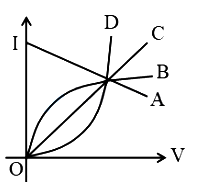 MHT CET 2022 Hard
 - A network of 4 capacitors is connected to a battery as shown. The ratio of the charges on capacitors \(\mathrm{C}_{2}\) and \(\mathrm{C}_{4}\) is
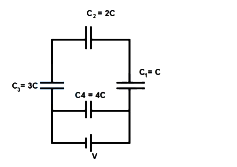 MHT CET 2020 Easy
 - A circuit has self-inductance ' \(L\) ' and carries a current ' \(\mathrm{I}\) '. To prevent sparking when the circuit is switched off, a capacitor which can withstand potential difference ' \(\mathrm{V}\) ' is used. The least capacitance isMHT CET 2021 Medium
- In conversion of moving coil galvanometer into an ammeter of required range, the resistance of ammeter so formed is
\([\mathrm{s}=\) shunt and \(\mathrm{G}=\) resistance of galvanometer \(]\)MHT CET 2020 Easy - A sphere is suspended by a thread of length \(l\) What minimum horizontal velocity has to be imparted the ball for it to reach the height of the suspension?MHT CET 2011 Medium
- A long metal rod of length 'L' completes the circuit as shown. The area of the circuit is perpendicular to magnetic field ' \(B^{\prime}\). Total resistance of the circuit is ' \(\mathrm{R}\) '. The force needed to move the rod in the direction as shown with constant speed ' \(V\) ' is
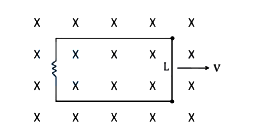 MHT CET 2020 Easy
More PYQs from MHT CET
- Calculate the number of unit cells in 0.79 g metal if product of density and volume of unit cell is \(1.58 \times 10^{-22} \mathrm{~g}\)MHT CET 2025 Medium
- The vector sum of two forces \(\overrightarrow{\mathrm{A}}\) and \(\overrightarrow{\mathrm{B}}\) is perpendicular to their vector difference. Hence forces \(\vec{A}\) and \(\vec{B}\) areMHT CET 2025 Medium
- An organ pipe has fundamental frequency 80 Hz . If its one end is closed, the frequencies produced will be (in Hz ) (Neglect end correction)MHT CET 2025 Medium
- When the pressure of the gas contained in a closed vessel is increased by \(2.5 \%\), the temperature of the gas increases by 4 K . The initial temperature of the gas isMHT CET 2025 Medium
- General solution of the differential equation \(\frac{d y}{d x}=\frac{x+y+1}{x+y-1}\) is given byMHT CET 2009 Medium
- The weight of a man in a lift moving upwards with an acceleration ' \(a\) ' is \(620 \mathrm{~N}\). When the lift moves downwards with the same acceleration, his weight is found to be \(340 \mathrm{~N}\). The real weight of the man isMHT CET 2021 Medium