


MHT CET · Physics · Center of Mass Momentum and Collision
A stationary body explodes into two parts of masses ' \(\mathrm{M}_{1}\) ' and \({ }^{\prime} \mathrm{M}_{2}{ }^{\prime}\). They move in opposite directions with velocities ' \(v_{1}\) ' and ' \(v_{2}\) '. The ratio of their kinetic energies is
- A \(\left[\frac{\mathrm{M}_{2}}{\mathrm{M}_{1}}\right]\)
- B \(\left[\frac{\mathrm{M}_{2}}{\mathrm{M}_{1}}\right]^{\frac{1}{2}}\)
- C \(\left[\frac{\mathrm{M}_{1}}{\mathrm{M}_{2}}\right]^{2}\)
- D \(\left[\frac{\mathrm{M}_{2}}{\mathrm{M}_{1}}\right]^{2}\)
Answer & Solution
Correct Answer
(A) \(\left[\frac{\mathrm{M}_{2}}{\mathrm{M}_{1}}\right]\)
Step-by-step Solution
Detailed explanation
To solve this problem, a diagram of the problem will be helpiul. Alorig with that, the corservation of linear mornentum, which is giver by. \(P_{i}=p_{f} \mathrm{~ . ~ A s ~ p e r ~ N e w t a n ' s ~ s e c a n d ~ l a}\) ther montentum is conserved. The explosion occurs purely due to internal forces.
Step ty step salution:
Let's sart by making a diagram of the problem.
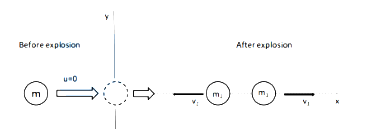
As per the problem, a stationary ball of mass (m) arnd initial velocity cercolu-0) after an explosion breaks into two masses \(m_{1}\) and \(m_{2}\) - These twò masses move in apposite directions with velocities \(v_{1}\) and \(v_{2}\) respectively.
We will use the conservation of linear momentum now, given by, \(p_{i}=p_{f}\). The initial and linal mormenta will be equal. This means that, \(p_{i}=p_{f} \Rightarrow m_{i}(0)=m_{1}\left(-v_{1}\right)+m_{2}\left(v_{2}\right) \Rightarrow m_{1}\left(v_{1}\right)=\) \(m_{2}\left(v_{2}\right)\). Hence, the ratio of the velocities will be equal to, \(\frac{v_{1}}{v_{2}}=\frac{m_{2}}{m_{1}}\).
The Final kinetic energy of the system after the explosion is the sum of the kinetic energies of the two bodies \(E_{1}\) arnd \(B_{2}\).
Finding the ratio of these two kinetic entergies becomes, \(\frac{E_{1}}{E_{2}}=\frac{\frac{1}{2} m_{1}\left(v_{1}\right)^{2}}{\frac{1}{2} m_{2}\left(v_{2}\right)^{2}}=\frac{m_{1}\left(v_{1}\right)^{2}}{m_{2}\left(v_{2}\right)^{2}}\). Naw, substituting in the ratio of velocites that we found out earlier, the ratio of kinetic energies becomes, \(\frac{E_{1}}{E_{2}}=\left(\frac{m_{1}}{m_{2}}\right)\left(\frac{v_{1}}{v_{2}}\right)^{2}=\left(\frac{m_{1}}{m_{2}}\right)\left(\frac{m_{2}}{m_{1}}\right)^{2}=\frac{m_{2}}{m_{1}} .\) Hence it is equal to the ratio of the irnerse of the masses. Sa, the correct answer is option A.
Note:
Another way of solving this problem is by only using the moenemtums of the masses. From the corservation of momentum belore and after the explosion become,
\(p_{i}=p_{f} \Rightarrow m(0)=p_{1}+p_{2} \Rightarrow p_{1}=-p_{2}\), where \(p_{1}\) and \(p_{2}\) are the momencum of the masses m \(_{1}\) and TR2respectively.
We also know that kinetic energy is given try \(E=\frac{p^{2}}{2 m}\) - Again, we will remowe the negative sign as it anly states the direclion, therefore \(\frac{E_{1}}{B_{2}}=\frac{\frac{p_{1}^{2}}{2 m_{1}}}{\frac{p_{2}^{2}}{2 m_{2}}}=\frac{\frac{\left(-p_{2}\right)^{2}}{m_{1}}}{\frac{p_{2}^{2}}{m_{2}}}=\frac{\frac{p_{2}^{2}}{m_{1}}}{\frac{p_{2}^{2}}{m_{2}}}=\frac{m_{2}}{m_{1}}\)
Step ty step salution:
Let's sart by making a diagram of the problem.
As per the problem, a stationary ball of mass (m) arnd initial velocity cercolu-0) after an explosion breaks into two masses \(m_{1}\) and \(m_{2}\) - These twò masses move in apposite directions with velocities \(v_{1}\) and \(v_{2}\) respectively.
We will use the conservation of linear momentum now, given by, \(p_{i}=p_{f}\). The initial and linal mormenta will be equal. This means that, \(p_{i}=p_{f} \Rightarrow m_{i}(0)=m_{1}\left(-v_{1}\right)+m_{2}\left(v_{2}\right) \Rightarrow m_{1}\left(v_{1}\right)=\) \(m_{2}\left(v_{2}\right)\). Hence, the ratio of the velocities will be equal to, \(\frac{v_{1}}{v_{2}}=\frac{m_{2}}{m_{1}}\).
The Final kinetic energy of the system after the explosion is the sum of the kinetic energies of the two bodies \(E_{1}\) arnd \(B_{2}\).
Finding the ratio of these two kinetic entergies becomes, \(\frac{E_{1}}{E_{2}}=\frac{\frac{1}{2} m_{1}\left(v_{1}\right)^{2}}{\frac{1}{2} m_{2}\left(v_{2}\right)^{2}}=\frac{m_{1}\left(v_{1}\right)^{2}}{m_{2}\left(v_{2}\right)^{2}}\). Naw, substituting in the ratio of velocites that we found out earlier, the ratio of kinetic energies becomes, \(\frac{E_{1}}{E_{2}}=\left(\frac{m_{1}}{m_{2}}\right)\left(\frac{v_{1}}{v_{2}}\right)^{2}=\left(\frac{m_{1}}{m_{2}}\right)\left(\frac{m_{2}}{m_{1}}\right)^{2}=\frac{m_{2}}{m_{1}} .\) Hence it is equal to the ratio of the irnerse of the masses. Sa, the correct answer is option A.
Note:
Another way of solving this problem is by only using the moenemtums of the masses. From the corservation of momentum belore and after the explosion become,
\(p_{i}=p_{f} \Rightarrow m(0)=p_{1}+p_{2} \Rightarrow p_{1}=-p_{2}\), where \(p_{1}\) and \(p_{2}\) are the momencum of the masses m \(_{1}\) and TR2respectively.
We also know that kinetic energy is given try \(E=\frac{p^{2}}{2 m}\) - Again, we will remowe the negative sign as it anly states the direclion, therefore \(\frac{E_{1}}{B_{2}}=\frac{\frac{p_{1}^{2}}{2 m_{1}}}{\frac{p_{2}^{2}}{2 m_{2}}}=\frac{\frac{\left(-p_{2}\right)^{2}}{m_{1}}}{\frac{p_{2}^{2}}{m_{2}}}=\frac{\frac{p_{2}^{2}}{m_{1}}}{\frac{p_{2}^{2}}{m_{2}}}=\frac{m_{2}}{m_{1}}\)
See the Complete Solution
Get step-by-step explanations for this and 2.5 Lakh+ more JEE, NEET & CET questions.
- Unlock all solutions
- Practice the full chapter
- Track accuracy across PYQs
4.8 rated on Google Play · 14,000+ reviews
More questions from Physics
- A glass slab of thickness \(4 \mathrm{~cm}\) contains the same number of waves as in 'x' cm of water column when both are transversed by the same monochromatic light. If the
refractive indices of glass and water for that light are \(\frac{5}{3}\) and \(\frac{4}{3}\) respectively, the
value of \(\mathrm{x}\) will beMHT CET 2020 Medium - If ' \(T\) ' is the half life of a radioactive substancethen its instantaneous rate of change of activity is proportional toMHT CET 2024 Medium
- If \(\mathrm{R}\) is universal gas constant the amount of heat needed to raise the temperature of 2 moles of an ideal monoatomic gas from \(273 \mathrm{~K}\) to \(373 \mathrm{~K}\) when no work is done isMHT CET 2022 Easy
- A convex lens of focal length 'F' produces a real image 'n' times the size of the object. The image distance isMHT CET 2020 Medium
- When a d.c voltage of \(200 \mathrm{~V}\) is applied to a coil of self-inductance \(\left(\frac{2 \sqrt{3}}{\pi}\right) \mathrm{H}\), a current of 1A flows through it. But by replacing d.c. source with a.c. source of \(200 \mathrm{~V}\), the current in the coil is reduced to \(0.5 \mathrm{~A}\). Then the frequency of a.c. supply isMHT CET 2021 Hard
- The pressure exerted by an ideal gas on the walls of a container isMHT CET 2016 Easy
More PYQs from MHT CET
- The curve \(y=a x^3+b x^2+c x+5\) touches X-axis at \(P(-2,0)\) and cuts \(\mathrm{Y}\)-axis at a point \(\mathrm{Q}\), where its gradient is 3 , thenMHT CET 2021 Medium
- If the truth value of the statement pattern \([\mathrm{p} \wedge \sim \mathrm{r}] \rightarrow \sim \mathrm{r} \wedge \mathrm{q}\) is False, then which of the following has truth value False?MHT CET 2025 Medium
- The probability that three cards drawn from a pack of 52 cards, all are red isMHT CET 2019 Medium
- Three charges ' +3 q ' , ' Q ' and ' +q ' are placed in a straight line of length ' \(\ell\) ' at points at distances \(0, \frac{\ell}{2}\) and \(\ell\) respectively. The value of \(Q\) in order to have the net force on \(+q\) to be zero, \(Q=x q\). The value of \(x\) isMHT CET 2025 Medium
- Which from following polymers is obtained from \(\mathrm{C}_2 \mathrm{~F}_4\) ?MHT CET 2023 Easy
- If \(f: R \rightarrow R\) is given by \(f(x)=7 x+8\) and \(f^{-1}(12)=\frac{k}{7}\), then the value of \(k\) isMHT CET 2020 Easy