


MHT CET · Physics · Rotational Motion
A solid cylinder of mass \(M\) and radius \(R\) is rotating about its geometrical axis. A solid sphere of the same mass and same radius is also rotating about its diameter with an angular speed half that of the cylinder. The ratio of the kinetic energy of rotation of the sphere to that of the cylinder will be
- A \(1: 4\)
- B \(1: 5\)
- C \(2: 3\)
- D \(3: 2\)
Answer & Solution
Correct Answer
(B) \(1: 5\)
Step-by-step Solution
Detailed explanation
\(I_{\text {sphere }}=I_S=\frac{2}{5} m R^2 \text { and } I_{\text {cylinder }}=I_c=\frac{1}{2} m R^2\)
Let \(\omega_{\mathrm{S}}=\) Angular speed of sphere,
\(\omega_c=\) Angular speed of cylinder.
It is given that, \(\omega_{\mathrm{s}}=\frac{\omega_{\mathrm{c}}}{2}\)
\(\begin{aligned}
\therefore \quad & \frac{K \cdot E_{\text {sphere }}}{K \cdot E_{\text {cylinder }}}=\frac{I_s \omega_s^2}{I_c^2 \omega_c^2}=\frac{\frac{2}{5} m R^2 \times\left(\frac{\omega_c}{2}\right)^2}{\frac{1}{2} m R^2 \times \omega_c{ }^2} \\
& \frac{K \cdot E_{\text {sphere }}}{K \cdot E_{\text {cylinder }}}=\frac{1}{5}
\end{aligned}\)
Let \(\omega_{\mathrm{S}}=\) Angular speed of sphere,
\(\omega_c=\) Angular speed of cylinder.
It is given that, \(\omega_{\mathrm{s}}=\frac{\omega_{\mathrm{c}}}{2}\)
\(\begin{aligned}
\therefore \quad & \frac{K \cdot E_{\text {sphere }}}{K \cdot E_{\text {cylinder }}}=\frac{I_s \omega_s^2}{I_c^2 \omega_c^2}=\frac{\frac{2}{5} m R^2 \times\left(\frac{\omega_c}{2}\right)^2}{\frac{1}{2} m R^2 \times \omega_c{ }^2} \\
& \frac{K \cdot E_{\text {sphere }}}{K \cdot E_{\text {cylinder }}}=\frac{1}{5}
\end{aligned}\)
See the Complete Solution
Get step-by-step explanations for this and 2.5 Lakh+ more JEE, NEET & CET questions.
- Unlock all solutions
- Practice the full chapter
- Track accuracy across PYQs
4.8 rated on Google Play · 14,000+ reviews
More questions from Physics
- Bohr model is applied to a particle of mass \(m\) and charge \(q\) is moving in a plane under the influence of a transverse magnetic field (B). The energy of the charged particle in the second level will be
\(\text { ( } \mathrm{h}=\text { Planck's constant } \text { ) }\)MHT CET 2025 Medium - In the second orbit of hydrogen atom, the energy of an electron is ' \(E\) '. In the third orbit of helium atom, the energy of the electron will be (atomic number of helium \(=2\) )MHT CET 2024 Easy
- The stopping potential of the photoelectrons, from a photo cell isMHT CET 2019 Easy
- A galvanometer of resistance \(G\) has voltage range \(V_g\). Resistance requirec to convert it to read voltage up to \(V\) isMHT CET 2022 Easy
- A metallic sphere ' A ' isolated from ground is charged to \(+50 \mu \mathrm{C}\). This sphere is brought in contact with other isolated metallic sphere ' \(B\) ' of half the radius of sphere ' A '. Then the charge on the two isolated spheres \(\mathrm{A} \& \mathrm{~B}\) are in the ratioMHT CET 2024 Easy
- The percentage error in the measurement of mass and speed of a particular body is \(3 \%\) and \(4 \%\) respectively. The percentage error in the measurement of kinetic energy isMHT CET 2025 Easy
More PYQs from MHT CET
- A spherical rain drop evaporates at a rate proportional to its surface area. If initially its radius is 3 mm and after 1 second it is reduced to 2 mm , then at any time t its radius is (where \(0 \leq \mathrm{t} \lt 3\) )MHT CET 2024 Hard
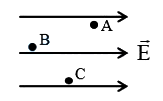
- Let \(\mathrm{A}, \mathrm{B}\) and \(\mathrm{C}\) be the three points in a uniform electric field \((\overrightarrow{\mathrm{E}})\) as shown. The electric potential is
 MHT CET 2021 Easy
 - A prism having refractive index \(\sqrt{2}\) and refracting angle \(30^{\circ}\) has one of the
refracting surfaces silvered. The beam of light incident on the other refracting
surface will retrace its path, if angle of incidence is \(\left[\sin \frac{\pi}{6}=0 \cdot 5\right]\)MHT CET 2020 Medium - Which among the following cations will form lowest stability complex if the ligand remains the same?MHT CET 2021 Easy
- Which from following solids exhibits isotropic properties?MHT CET 2024 Medium
- The wavelength of radiation emitted is ' \(\lambda_0\) ' when an electron jumps from the second excited state to the first excited state of hydrogen atom. If the electron jumps from the third excited state to the second orbit of the hydrogen atom, the wavelength of the radiation emitted will be \(\frac{20}{x} \lambda_0\). The value of \(x\) isMHT CET 2023 Medium