


MHT CET · Physics · Oscillations
A small wooden cube is placed on a plank. The plank performs a vertical S.H.M of frequency \(\frac{3}{\pi} \mathrm{Hz}\). The maximum amplitude of the plank so that the wooden block does not leave the plank is [take \(g=10 \mathrm{~m} / \mathrm{s}^2\) ]
- A \(\frac{7}{12} \mathrm{~m}\)
- B \(\frac{5}{2} m\)
- C \(\frac{5}{18} \mathrm{~m}\)
- D \(\frac{11}{18} \mathrm{~m}\)
Answer & Solution
Correct Answer
(C) \(\frac{5}{18} \mathrm{~m}\)
Step-by-step Solution
Detailed explanation
Concept: wooden cube can leave the plank at the top extreme location when the plank just begins to move towards the equilibrium position. See the figure below:
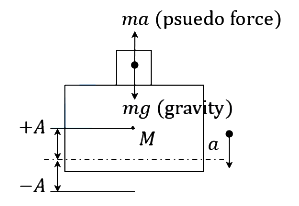
For cube not to leave plank the weight of the block should be more than the pseudo force on the cube:
\(\text { ma } \leq \mathrm{mg}\)
Therefore, \(\mathrm{a} \leq \mathrm{g}\).
\(|a|=\omega^2 x\) when, \(x=A\) the amplitude
\(\therefore \omega^2 \mathrm{~A} \leq \mathrm{g} \text { or } \mathrm{A} \leq \frac{\mathrm{g}}{\omega^2}\)
Given, \(\mathrm{f}=\frac{3}{\pi} \mathrm{Hz} \frac{\omega}{2 \pi}=\frac{1}{\mathrm{~T}}\)
\(\Rightarrow \omega=6 \mathrm{~Hz}\)
\(A \leq \frac{10}{6^2} \mathrm{~m}\)
\(\mathrm{A} \leq \frac{5}{18} \mathrm{~m}\)
For cube not to leave plank the weight of the block should be more than the pseudo force on the cube:
\(\text { ma } \leq \mathrm{mg}\)
Therefore, \(\mathrm{a} \leq \mathrm{g}\).
\(|a|=\omega^2 x\) when, \(x=A\) the amplitude
\(\therefore \omega^2 \mathrm{~A} \leq \mathrm{g} \text { or } \mathrm{A} \leq \frac{\mathrm{g}}{\omega^2}\)
Given, \(\mathrm{f}=\frac{3}{\pi} \mathrm{Hz} \frac{\omega}{2 \pi}=\frac{1}{\mathrm{~T}}\)
\(\Rightarrow \omega=6 \mathrm{~Hz}\)
\(A \leq \frac{10}{6^2} \mathrm{~m}\)
\(\mathrm{A} \leq \frac{5}{18} \mathrm{~m}\)
See the Complete Solution
Get step-by-step explanations for this and 2.5 Lakh+ more JEE, NEET & CET questions.
- Unlock all solutions
- Practice the full chapter
- Track accuracy across PYQs
4.8 rated on Google Play · 14,000+ reviews
More questions from Physics
- Activity of a radioactive sample decreases to \(\left(\frac{1}{3}\right)^{r d}\) of its original value in 3 days. Then in 9 days its activity reduces toMHT CET 2022 Easy
- A charged spherical conductor of radius ' \(R\) ' is connected momentarily to another uncharged spherical conductor of radius ' \(r\) ' by means of a thin conducting wire, then the ratio of the surface charge density of the first to the second conductor isMHT CET 2023 Medium
- A current ' \(I\) ' produces a magnetic flux ' \(\phi\) ' per turn in a coil of ' \(n\) ' turns. Self-inductance of the coil is ' \(L\) '. The relation between them isMHT CET 2021 Easy
- Two spherical conductors of radii \(4 \mathrm{~cm}\) and \(5 \mathrm{~cm}\) are charged to the same potential. If ' \(\sigma_1\) ' and ' \(\sigma_2\) ' be the respective value of the surface density of charge on the two conductors then the ratio \(\sigma_1: \sigma_2\) isMHT CET 2021 Hard
- An electromagnetic wave of wavelength ' \(\lambda\) ' is incident on a photosensitive surface of negligible work function. If the photoelectrons emitted from this surface have the de-Broglie wavelength ' \(\lambda_{1}{ }^{\prime}\) thenMHT CET 2020 Medium
- Two gases A and B having same initial state (P, V, n, T). Now gas A is compressed to \(\frac{\mathrm{V}}{8}\) by isothermal process and other gas \(B\) is compressed to \(\frac{V}{8}\) by adiabatic process. The ratio of final pressure of gas A and B is (Both gases are monoatomic, \(\gamma=5 / 3\) )MHT CET 2024 Medium
More PYQs from MHT CET
- Which among the following equations represents relation between cryoscopic constant, depression in freezing point and molality?MHT CET 2022 Medium
- If \(\bar{a}\) and \(\overline{\mathrm{b}}\) are unit vectors such that \(|\bar{a}+\overline{\mathrm{b}}|=\sqrt{3}\), then the angle between \(\bar{a}\) and \(\overline{\mathrm{b}}\) isMHT CET 2025 Easy
- Which from following monomers is used to obtain polymer represented asMHT CET 2024 Medium
- Which from following compounds is a trihydric alcohol?MHT CET 2024 Medium
- Diosgenin obtained from yam plant (Dioscorea) is used in the manufacturing of_________.MHT CET 2022 Medium
- Identify ' \(Y\) ' in the following reaction.
\(\mathrm{CH}_3 \mathrm{Br} \xrightarrow{\mathrm{KCN}} \mathrm{X} \xrightarrow{\mathrm{Na} / \mathrm{C}_2 \mathrm{H}_5 \mathrm{OH}} \mathrm{Y}\)MHT CET 2024 Medium