


MHT CET · Physics · Oscillations
A simple pendulum with bob of mas ' \(m\) ' and conducting wire of length ' \(L\) ' swings under gravity through an angle ' \(\theta\) '. The component of earth's magnetic field in the direction perpendicular to swing is ' \(\mathrm{B}\) '. Maximum e.m.f. induced across the pendulum is ( \(\mathrm{g}=\) acceleration due to gravity)
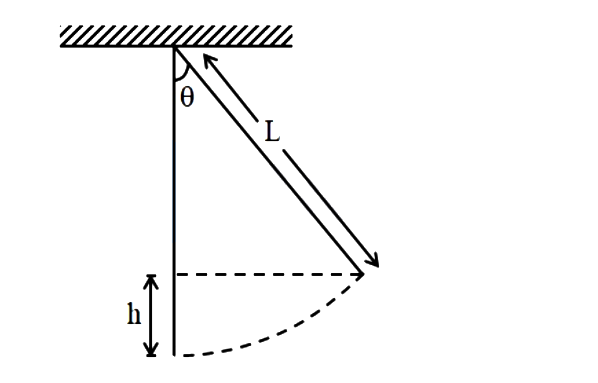
- A \(\mathrm{BL} \sin \left(\frac{\theta}{2}\right)(\mathrm{gL})\)
- B \(2 \mathrm{BL} \sin \left(\frac{\theta}{2}\right)(\mathrm{gL})^2\)
- C \(2 \mathrm{BL} \sin \left(\frac{\theta}{2}\right)(\mathrm{gL})^{3 / 2}\)
- D \(2 \mathrm{BL} \sin \left(\frac{\theta}{2}\right)(\mathrm{gL})^{1 / 2}\)
Answer & Solution
Correct Answer
(D) \(2 \mathrm{BL} \sin \left(\frac{\theta}{2}\right)(\mathrm{gL})^{1 / 2}\)
Step-by-step Solution
Detailed explanation
We have, \(\mathrm{h}=\mathrm{L}(1-\cos \theta)\)
Maximum velocity at equilibrium position is given by,
\(\begin{aligned} & \mathrm{v}^2=2 \mathrm{gh}=2 \mathrm{gL}(1-\cos \theta)=2 \mathrm{gL}\left(2 \sin ^2\left(\frac{\theta}{2}\right)\right) \\ & \mathrm{v}=2 \sin \left(\frac{\theta}{2}\right) \sqrt{\mathrm{gL}}\end{aligned}\)
Thus Maximum potential difference,
\(\mathrm{V}_{\max }=\mathrm{BvL}=2 \mathrm{BL} \sin \left(\frac{\theta}{2}\right) \sqrt{\mathrm{gL}}\)
Maximum velocity at equilibrium position is given by,
\(\begin{aligned} & \mathrm{v}^2=2 \mathrm{gh}=2 \mathrm{gL}(1-\cos \theta)=2 \mathrm{gL}\left(2 \sin ^2\left(\frac{\theta}{2}\right)\right) \\ & \mathrm{v}=2 \sin \left(\frac{\theta}{2}\right) \sqrt{\mathrm{gL}}\end{aligned}\)
Thus Maximum potential difference,
\(\mathrm{V}_{\max }=\mathrm{BvL}=2 \mathrm{BL} \sin \left(\frac{\theta}{2}\right) \sqrt{\mathrm{gL}}\)
See the Complete Solution
Get step-by-step explanations for this and 2.5 Lakh+ more JEE, NEET & CET questions.
- Unlock all solutions
- Practice the full chapter
- Track accuracy across PYQs
4.8 rated on Google Play · 14,000+ reviews
More questions from Physics
- The refraction of light ray takes place from air to water, water to glass and again
glass to air. The ray emerges parallel to incident ray. The correct relation is
\(\left[\mathrm{n}_{\mathrm{a}}, \mathrm{n}_{\mathrm{w}}, \mathrm{n}_{\mathrm{g}}\right.\) represent refractive indices of air, water and glass respectively.MHT CET 2020 Easy - Pressure inside two soap bubbles is \(1.01 \mathrm{~atm}\) and \(1.03 \mathrm{~atm}\). The ratio between their volumes is (Pressure outside the soap bubble is \(1 \mathrm{~atm}\) )MHT CET 2021 Medium
- Three identical metal spheres (of same surface area) have red, black and white colors and they are heated up to same temperature. They are allowed to cool. Arrange them from maximum rate of cooling to minimum rate of coolingMHT CET 2024 Medium
- An ideal refrigerator has freezer at a temperature of \(-13^{\circ} \mathrm{C}\). The coefficient of performance of the engine is 5 . The temperature of the air (to which heat is rejected) isMHT CET 2023 Medium
- A child is sitting on a swing which performs S.H.M. It has minimum and maximum heights from ground \(0.75 \mathrm{~cm}\) and \(2 \mathrm{~m}\) respectively. Its maximum speed will be \(\left[\mathrm{g}=10 \frac{\mathrm{m}}{\mathrm{s}^2}\right]\)MHT CET 2021 Easy
- What is the pressure of hydrogen in a cylinder of volume 10 litre if its total energy of translation is \(7.5 \times 10^3 \mathrm{~J}\) ?MHT CET 2024 Medium
More PYQs from MHT CET
- The equation of the plane passing through the point of intersection of the planes \(2 x-y+z-3=0\) and \(4 x-3 y+5 z+9=0\) and parallel to the lines \(\frac{x+1}{2}=\frac{y+3}{4}=\frac{z-3}{5}\) is \(\alpha x+\beta y+\gamma z+d=0\) Then \(\alpha+\beta+\gamma+\mathrm{d}=\)MHT CET 2025 Medium
- The effective atomic number of lron (Z = 26) in isMHT CET 2019 Hard
- Identify a mineral of zinc from following.MHT CET 2024 Easy
- If \(\mathrm{CP}\) and \(\mathrm{CD}\) is a pair of semi-conjugate diameters of the ellipse \(\frac{\mathrm{x}^{2}}{\mathrm{a}^{2}}+\frac{\mathrm{y}^{2}}{\mathrm{~b}^{2}}=1\), then
\(\mathrm{CP}^{2}+\mathrm{CD}^{2}=\)MHT CET 2020 Hard - If \(\mathrm{f}(\mathrm{x})=[\mathrm{x}]\), for \(\mathrm{x} \in(-1,2)\), then \(\mathrm{f}\) is discontinuous at (where \([\mathrm{x}]\) represents floor function)MHT CET 2021 Easy
- If cranial nerves: 12 pairs, then spinal nerves:MHT CET 2017 Hard