


MHT CET · Physics · Waves and Sound
A simple harmonic progressive wave is given by \(\mathrm{Y}=\mathrm{Y}_0 \sin 2 \pi\) \(\left(\mathrm{nt}-\frac{\mathrm{x}}{\lambda}\right)\). If the wave velocity is \(\left(\frac{1}{8}\right)^{\text {th }}\) the maximum particle velocity, then the wavelength is
- A \(\frac{\pi \mathrm{Y}_0}{2}\)
- B \(\frac{\pi \mathrm{Y}_0}{4}\)
- C \(\frac{\pi \mathrm{Y}_0}{8}\)
- D \(\frac{\pi \mathrm{Y}_0}{16}\)
Answer & Solution
Correct Answer
(B) \(\frac{\pi \mathrm{Y}_0}{4}\)
Step-by-step Solution
Detailed explanation
\(
\begin{aligned}
& \text { Maximum particle velocity }=\mathrm{Y}_0 \omega=2 \pi \mathrm{n} \mathrm{Y}_0 \\
& \text { Wave velocity }=\mathrm{n} \lambda \\
& \therefore \frac{2 \pi \mathrm{n} \mathrm{Y}_0}{8}=\mathrm{n} \lambda \\
& \therefore \lambda=\frac{\pi \mathrm{Y}_0}{4}
\end{aligned}
\)
\begin{aligned}
& \text { Maximum particle velocity }=\mathrm{Y}_0 \omega=2 \pi \mathrm{n} \mathrm{Y}_0 \\
& \text { Wave velocity }=\mathrm{n} \lambda \\
& \therefore \frac{2 \pi \mathrm{n} \mathrm{Y}_0}{8}=\mathrm{n} \lambda \\
& \therefore \lambda=\frac{\pi \mathrm{Y}_0}{4}
\end{aligned}
\)
See the Complete Solution
Get step-by-step explanations for this and 2.5 Lakh+ more JEE, NEET & CET questions.
- Unlock all solutions
- Practice the full chapter
- Track accuracy across PYQs
4.8 rated on Google Play · 14,000+ reviews
More questions from Physics
- In a given meter bridge, the current flowing through \(40 \Omega\) resistor is
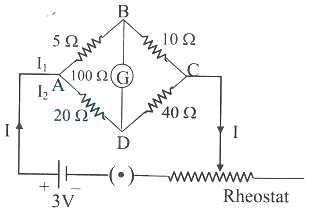 MHT CET 2023 Hard
 - A water film is formed between two parallel wires of 10 cm length. The distance of 0.5 cm between the wires is increased by 1 mm . The work done in the process is (surface tension of water \(=72 \mathrm{~N} / \mathrm{m}\) ).MHT CET 2024 Medium
- For a gas, \(\frac{\mathrm{R}}{\mathrm{C}_{\mathrm{v}}}=0.4\) where R is the universal gas constant and ' \(\mathrm{C}_{\mathrm{v}}\) ' is molar specific heat at constant volume. The gas is made up of molecules which areMHT CET 2024 Medium
- According to the kinetic theory of gases, when two molecules of a gas collide with each other thenMHT CET 2025 Easy
- Two conducting spheres of radii ' \(r_1\) ' and ' \(r_2\) ' are equally charged. The ratio of their potentials is (potential of \(r_1\) to potential \(r_2\) )MHT CET 2025 Easy
- A small spherical ball of radius ' \(r\) ' is rolling on a curved surface which is frictionless and has a radius of curvature ' R '. Its motion is simple harmonic. Then its time period of oscillation is proportional to ( \(\mathrm{g}=\) acceleration due to gravity)
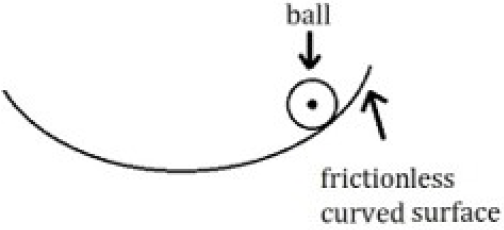 MHT CET 2025 Medium
More PYQs from MHT CET
- A signal of frequency \(3 \mathrm{kHz}\) is amplitude modulated on a carrier wave of frequency \(2 \cdot 5 \mathrm{MHz}\). The upper and lower sideband frequencies in the resultant signal areMHT CET 2020 Easy
- Water rises in a capillary tube of radius ' \(r\) ' upto a height ' \(h\) '. The mass of water in a capillary is ' \(m\) '. The mass of water that will rise in a capillary tube of radius \(\frac{\text { ' } r \text { ' }}{3}\) will beMHT CET 2023 Medium
- The natural rubber is the polymer ofMHT CET 2012 Easy
- Sodium salt of \(\propto\) - halogen carboxylic acid when heated with sodium nitrite and followed by hydrolysis formsMHT CET 2020 Medium
- In colloquial language, habitat is a postal address while niche is the _________ of the organism.MHT CET 2024 Medium
- If \(A=\left[\begin{array}{cc}\cos ^{2} \alpha & \cos \alpha \sin \alpha \\ \cos \alpha \sin \alpha & \sin ^{2} \alpha\end{array}\right]\)
and
\(B=\left[\begin{array}{cc}\cos ^{2} \beta & \cos \beta \sin \beta \\ \cos \beta \sin \beta & \sin ^{2} \beta\end{array}\right]\) are two matrices
such that the product \(A B\) is null matrix, then \(\alpha-\beta\) isMHT CET 2007 Medium