


MHT CET · Physics · Nuclear Physics
A shell of mass 'M' initially at rest suddenly explodes in three fragments. Two of
these fragments are of mass 'M \(/ 4\) ' each, which move with velocities \(3 \mathrm{~ms}^{-1}\) and
\(4 \mathrm{~ms}^{-1}\) respectively in mutually perpendicular directions. The magnitude of velocity of the third fragment is
- A \(3 \cdot 0 \mathrm{~ms}^{-1}\)
- B \(2 \cdot 5 \mathrm{~ms}^{-1}\)
- C \(1 \cdot 5 \mathrm{~ms}^{-1}\)
- D \(2 \cdot 0 \mathrm{~ms}^{-1}\)
Answer & Solution
Correct Answer
(B) \(2 \cdot 5 \mathrm{~ms}^{-1}\)
Step-by-step Solution
Detailed explanation
The mass \(M\) is initially at rest, hence its initial momentum is zero. By law or conservation of momentum, the net momentum of the three pieces should be zero. The moments of the two pieces are
\(\mathrm{p}_{1}=\frac{3 \mathrm{M}}{4} \text { and } \mathrm{p}_{2}=\frac{5 \mathrm{M}}{4}\)
Three are at right angles to each other.
Their resultant will be \(p=\sqrt{p_{1}^{2}+p_{2}^{2}}\)
\(\begin{array}{l}
=\sqrt{\left(\frac{3 M}{4}\right)^{2}+\left(\frac{4 M}{4}\right)^{2}} \\
=\frac{M}{4} \sqrt{(3)^{2}+(4)^{2}} \\
=\frac{M}{4} \sqrt{25}=\frac{5 M}{4}
\end{array}\)
The momentum of the third piece will be equal and opposite to this.
The mass of the third piece will be \(\frac{M}{2}\)
If its velocity is \(\mathrm{V}\), then
\(\begin{array}{l}
\frac{M}{2} \cdot V=\frac{5 M}{4} \\
\therefore V=2.5 \mathrm{~ms}^{-1}
\end{array}\)
\(\mathrm{p}_{1}=\frac{3 \mathrm{M}}{4} \text { and } \mathrm{p}_{2}=\frac{5 \mathrm{M}}{4}\)
Three are at right angles to each other.
Their resultant will be \(p=\sqrt{p_{1}^{2}+p_{2}^{2}}\)
\(\begin{array}{l}
=\sqrt{\left(\frac{3 M}{4}\right)^{2}+\left(\frac{4 M}{4}\right)^{2}} \\
=\frac{M}{4} \sqrt{(3)^{2}+(4)^{2}} \\
=\frac{M}{4} \sqrt{25}=\frac{5 M}{4}
\end{array}\)
The momentum of the third piece will be equal and opposite to this.
The mass of the third piece will be \(\frac{M}{2}\)
If its velocity is \(\mathrm{V}\), then
\(\begin{array}{l}
\frac{M}{2} \cdot V=\frac{5 M}{4} \\
\therefore V=2.5 \mathrm{~ms}^{-1}
\end{array}\)
See the Complete Solution
Get step-by-step explanations for this and 2.5 Lakh+ more JEE, NEET & CET questions.
- Unlock all solutions
- Practice the full chapter
- Track accuracy across PYQs
4.8 rated on Google Play · 14,000+ reviews
More questions from Physics
- A ring and a disc roll on horizontal surface without slipping with same linear velocity. If both have same mass and total kinetic energy of the ring is 6 J then total kinetic energy of the disc isMHT CET 2024 Medium
- A charged particle is moving along a magnetic field line. What is the magnetic force acting on the particle? \(\left(\sin 0^{\circ}=0, \sin \frac{\pi}{2}=1\right)\)MHT CET 2024 Easy
- The magnetic flux linked with the coil with time as \(\Phi=4 \mathrm{t}^2+3 \mathrm{t}+7\). The magnitude of the induced e.m.f at \(t=2 \mathrm{~s}\) isMHT CET 2022 Easy
- In capillary tube having area of cross-section ' \(A\) ', water rises to a height ' \(h\) '. If cross sectional area is reduced to \(\frac{A}{9}\), the rise of water in the capillary tube isMHT CET 2021 Medium
- A simple harmonic progressive wave is represented as \(Y=A \sin 2 \pi\left(n t-\frac{x}{\lambda}\right) \mathrm{cm}\). If the maximum particle velocity is four times the wave velocity, then the wavelength of the wave isMHT CET 2020 Medium
- For series LCR circuit, which one of the following is a CORRECT statement?MHT CET 2021 Hard
More PYQs from MHT CET
- Liquid drops are falling slowly one by one from vertical glass tube. The relation between the weight of a drop ' \(w\) ', the surface tension ' \(T\) ' and the radius ' \(r\) ' of the bore of the tube is (Angle of contact is zero)MHT CET 2024 Easy
- The molecular mass of a gas having r.m.s. speed four times as that of another gas having molecular mass 32 isMHT CET 2023 Medium
- The potential difference \(\left(V_A-V_B\right)\) between the points \(A\) and \(B\) in the given figure is
 MHT CET 2025 Easy
 - Mohan was writing a report of the benefits of biogas
i. It is cheap and safe
ii. Can be used for cooking
iii. Can be transported easily
iv. Causes pollution
Which one of the above statements has been reported incorrectly?MHT CET 2022 Hard - The logic gate represented by following logic circuit is
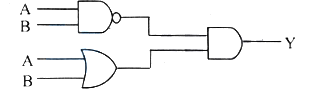 MHT CET 2024 Easy
 - Identify the use of glyptalMHT CET 2025 Easy