


MHT CET · Physics · Rotational Motion
A rubber ball is dropped from a height of \(5 \mathrm{~m}\) on a planet, where the acceleration due to gravity is not known. On bouncing it rises to \(1.8 \mathrm{~m}\). The ball loses its velocity on bouncing by a factor of
- A \(\frac{16}{25}\)
- B \(\frac{2}{5}\)
- C \(\frac{3}{5}\)
- D \(\frac{9}{25}\)
Answer & Solution
Correct Answer
(B) \(\frac{2}{5}\)
Step-by-step Solution
Detailed explanation
Key Idea According to conservation of energy, potential energy at height \(h=\) kinetic energy at
ground. Potential energy = Kinetic energy
ie,
\(m g h=\frac{1}{2} m v^{2}\)
\(\Rightarrow \quad v=\sqrt{2 g h}\)
If \(h_{1}\) and \(h_{2}\) are initial and final heights, then
\(v_{1}=\sqrt{2 g h_{1}}, \quad v_{2}=\sqrt{2 g h_{2}}\)
Loss in velocity
\(\Delta v=v_{1}-v_{2}=\sqrt{2 g h_{1}}-\sqrt{2 g h_{2}}\)
\(\therefore\) Fractional loss in velocity \(=\frac{\Delta v}{v_{1}}\)
\(\begin{array}{l}=\frac{\sqrt{2 g h_{1}}-\sqrt{2 g h_{2}}}{\sqrt{2 g h_{1}}} \\=1-\sqrt{\frac{h_{2}}{h_{1}}}\end{array}\)
Substituting the values, we have
\(\therefore\)
\(\frac{\Delta v}{v_{1}}=1-\sqrt{\frac{1.8}{5}}\)
\(\begin{array}{l}=1-\sqrt{0.36}=1-0.6 \\=0.4=\frac{2}{5}\end{array}\)
ground. Potential energy = Kinetic energy
ie,
\(m g h=\frac{1}{2} m v^{2}\)
\(\Rightarrow \quad v=\sqrt{2 g h}\)
If \(h_{1}\) and \(h_{2}\) are initial and final heights, then
\(v_{1}=\sqrt{2 g h_{1}}, \quad v_{2}=\sqrt{2 g h_{2}}\)
Loss in velocity
\(\Delta v=v_{1}-v_{2}=\sqrt{2 g h_{1}}-\sqrt{2 g h_{2}}\)
\(\therefore\) Fractional loss in velocity \(=\frac{\Delta v}{v_{1}}\)
\(\begin{array}{l}=\frac{\sqrt{2 g h_{1}}-\sqrt{2 g h_{2}}}{\sqrt{2 g h_{1}}} \\=1-\sqrt{\frac{h_{2}}{h_{1}}}\end{array}\)
Substituting the values, we have
\(\therefore\)
\(\frac{\Delta v}{v_{1}}=1-\sqrt{\frac{1.8}{5}}\)
\(\begin{array}{l}=1-\sqrt{0.36}=1-0.6 \\=0.4=\frac{2}{5}\end{array}\)
See the Complete Solution
Get step-by-step explanations for this and 2.5 Lakh+ more JEE, NEET & CET questions.
- Unlock all solutions
- Practice the full chapter
- Track accuracy across PYQs
4.8 rated on Google Play · 14,000+ reviews
More questions from Physics
- A big water drop is divided into 8 equal droplets. \(\Delta \mathrm{P}_{\mathrm{S}}\) and \(\Delta \mathrm{P}_{\mathrm{B}}\) be the excess pressure inside a smaller and bigger drop respectively. The relation between \(\Delta \mathrm{P}_{\mathrm{S}}\) and \(\Delta \mathrm{P}_{\mathrm{B}}\) isMHT CET 2021 Medium
- Two discs of same mass ąnd same thickness (t) are made from two different materials of densities ' \(\mathrm{d}_1\) ' and ' \(\mathrm{d}_2\) ' respectively. The ratio of the moment of inertia \(\mathrm{I}_1\) to \(\mathrm{I}_2\) of two discs about an axis passing through the centre and perpendicular to the plane of disc isMHT CET 2023 Medium
- Identify the 'INCORRECT' statement from the following.MHT CET 2020 Easy
- A concave mirror of focal length 'f \(_{1}\) ' is placed at a distance 'd' from a convex lens of focal length 'f 2 '. A parallel beam of light coming from infinity parallel to principal axis falls on the convex lens and then after refraction falls on the concave mirror. If it is to retrace the path, the distance 'd' should beMHT CET 2020 Medium
- The magnetic field intensity ' \(\mathrm{H}\) ' at the centre of a long solenoid having ' \(n\) ' turns per unit length and carrying a current I', when no material is kept in it, isMHT CET 2021 Easy
- A thin uniform rod of mass ' m ' and length ' L ' is pivoted at one end so that it can rotate in a vertical plane. The free end is held vertically above pivot and then released. The angular acceleration of the rod when it makes an angle ' \(\theta\) ' with the vertical is [consider negligible friction at the pivot] ( \(\mathrm{g}=\) acceleration due to gravity)
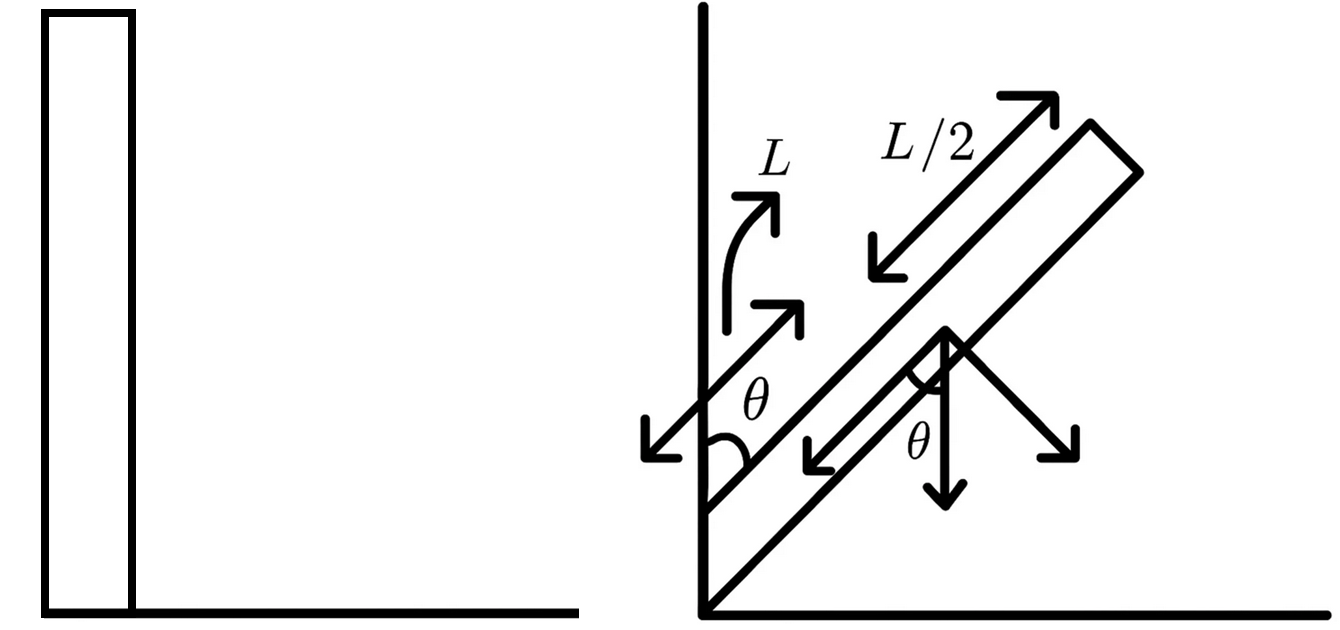 MHT CET 2025 Medium
More PYQs from MHT CET
- On placing a thin film of mica of thickness \(12 \times 10^{-5} \mathrm{~cm}\) in the path of one of the interfering waves in Young's double slit experiment using monochromatic light, the fringe pattern shifts through a distance equal to width of a bright fringe. If wavelength used is \(\lambda=6 \times 10^{-5} \mathrm{~cm}\), the refractive index of mica isMHT CET 2022 Hard
- The proposition \((\sim p) \vee(p \wedge \sim q)\) is equivalent toMHT CET 2024 Easy
- Which of the following salt contain interstitial water molecule in it?MHT CET 2020 Easy
- Which of the following statement/s is/are correct with respect to generation and conduction of nerve impulse?
i. The resting potential difference is -70mvs
ii. The voltage gated \(Na ^{+}\) and \(K^{+}\) channels operate together and are self closing.
iii. At the peak of action potential, the potential difference rises to +30 to +60mvs
iv. In medullated nerve fibre, the action potential is conducted wave as of membrane depolarization.
v. The resting potential is maintained by especially closure of gated channels of \(Na ^{+}\) and \(K^{+}\)MHT CET 2023 Easy - A liquid having coefficient of cubical expansion ' \(\gamma\) ' is kept in a copper vessel having coefficient of linear expansion \(\frac{\gamma}{3}\). If heat is supplied to the vessel, the original level of the liquid in the vessel willMHT CET 2025 Medium
- If \(Z=\frac{-2}{1+\sqrt{3}}, i=\sqrt{-1}\), then the value of \(\arg Z\) isMHT CET 2024 Medium