


MHT CET · Physics · Ray Optics
A ray of light is incident on one face of an equilateral glass prism having refractive index \(\sqrt{2}\). It produces the emergent ray which just grazes along the adjacent face. The value of angle of incidence is
- A \(\sin ^{-1}\left(\frac{1}{\sqrt{2}} \sin 15^{\circ}\right)\)
- B \(\sin ^{-1}\left(\sqrt{2} \sin 30^{\circ}\right)\)
- C \(\sin ^{-1}\left(\frac{1}{\sqrt{2}} \sin 45^{\circ}\right)\)
- D \(\sin ^{-1}\left(\sqrt{2} \sin 15^{\circ}\right)\)
Answer & Solution
Correct Answer
(D) \(\sin ^{-1}\left(\sqrt{2} \sin 15^{\circ}\right)\)
Step-by-step Solution
Detailed explanation
The emergent ray just grazes the second face.
Hence angle of emergence, \(\mathrm{e}=90^{\circ}\)
\(\begin{aligned} & \mu=\frac{\sin \mathrm{e}}{\sin r_2}=\frac{\sin 90^{\circ}}{\sin r_2}=\frac{1}{\sin r_2} \\ & \therefore \frac{1}{\sin r_2}=\sqrt{2} \text { or } \sin r_2=\frac{1}{\sqrt{2}}\end{aligned}\)
\(\begin{aligned} & \therefore \mathrm{r}_2=45^{\circ} ; \mathrm{A}=\mathrm{r}_1+\mathrm{r}_2 \\ & \therefore \mathrm{r}_1=\mathrm{A}-\mathrm{r}_2=60-45=15^{\circ}\end{aligned}\)
Also, \(\frac{\sin i}{\sin r_1}=\mu\)
\(\begin{aligned} & \therefore \sin \mathrm{i}=\mu \sin \mathrm{r}_1=\sqrt{2} \sin 15^{\circ} \\ & \therefore \mathrm{i}=\sin ^{-1}\left(\sqrt{2} \sin 15^{\circ}\right)\end{aligned}\)
Hence angle of emergence, \(\mathrm{e}=90^{\circ}\)
\(\begin{aligned} & \mu=\frac{\sin \mathrm{e}}{\sin r_2}=\frac{\sin 90^{\circ}}{\sin r_2}=\frac{1}{\sin r_2} \\ & \therefore \frac{1}{\sin r_2}=\sqrt{2} \text { or } \sin r_2=\frac{1}{\sqrt{2}}\end{aligned}\)
\(\begin{aligned} & \therefore \mathrm{r}_2=45^{\circ} ; \mathrm{A}=\mathrm{r}_1+\mathrm{r}_2 \\ & \therefore \mathrm{r}_1=\mathrm{A}-\mathrm{r}_2=60-45=15^{\circ}\end{aligned}\)
Also, \(\frac{\sin i}{\sin r_1}=\mu\)
\(\begin{aligned} & \therefore \sin \mathrm{i}=\mu \sin \mathrm{r}_1=\sqrt{2} \sin 15^{\circ} \\ & \therefore \mathrm{i}=\sin ^{-1}\left(\sqrt{2} \sin 15^{\circ}\right)\end{aligned}\)
See the Complete Solution
Get step-by-step explanations for this and 2.5 Lakh+ more JEE, NEET & CET questions.
- Unlock all solutions
- Practice the full chapter
- Track accuracy across PYQs
4.8 rated on Google Play · 14,000+ reviews
More questions from Physics
- When two light waves each of amplitude 'A' and having a phase difference of \(\frac{\pi}{2}\) superimposed then the amplitude of resultant wave isMHT CET 2023 Easy
- The period of a simple pendulum gets doubled whenMHT CET 2024 Easy
- When a mercury drop of radius ' \(R\) ' splits up into 1000 droplets of radius ' \(r\) ', the change in surface energy is ( \(T=\) surface tension of mercury)MHT CET 2024 Easy
- A particle of mass is moving in SHM with a path length of and frequency of . The maximum force in newton, acting on the particle isMHT CET 2016 Easy
- If the magnet is cut into four equal parts such that their lengths and breadths are equal. Pole strength of each part isMHT CET 2010 Easy
- A photoelectric surface is illuminated successively by monochromatic light of 'wavelength ' \(\lambda\) ' and \(\left(\frac{\lambda}{2}\right)\). If the maximum kinetic energy of the emitted photoelectrons in the first case is one-fourth that in the second case, the work function of the surface of the material is ( \(\mathrm{c}=\) speed of light, \(\mathrm{h}=\) Planck's constant \()\)MHT CET 2024 Medium
More PYQs from MHT CET
- The acceleration (a) - time (T) graph for the body starting from rest is given below. The maximum speed of the body is
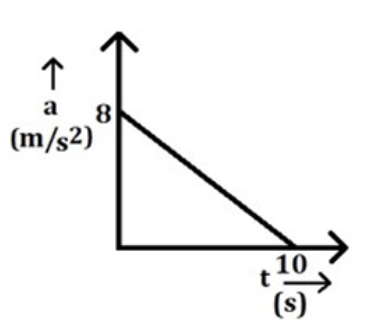 MHT CET 2025 Medium
 - The voltage between the plates of a parallel plate capacitor of capacity \(1 \mu \mathrm{~F}\) is changing at the rate of \(4 \mathrm{~V} / \mathrm{s}\). the displacement current in the capacitor isMHT CET 2025 Medium
- What is half life time of a first order reaction if initial conc. of reactant is \(0.01 \mathrm{~mol} \mathrm{~L}^{-1}\) and rate of reaction is \(0.00352 \mathrm{~mol} \mathrm{~L}^{-1}\) minute \({ }^{-1}\) ?MHT CET 2023 Medium
- What is the void volume in the crystal lattice formed by bcc unit cell?MHT CET 2022 Medium
- Identify tetrasaccharide from following.MHT CET 2023 Easy
- The differential equation satisfied by \(y=X \sin (6 t+5)+Y \cos (6 t+5)\) is (where \(X\) and \(Y\) are constants)MHT CET 2025 Medium