


MHT CET · Physics · Nuclear Physics
A radioactive nucleus emits \(4 \alpha\) particles and \(7 \beta\) particles in succession. The ratio of number of neutrons to that of protons is \([\mathrm{A}=\) mass number, \(\mathrm{Z}=\) atomic number \(]\)
- A \(\frac{\mathrm{A}-\mathrm{Z}-13}{\mathrm{Z}-2}\)
- B \(\frac{A-Z-13}{Z-1}\)
- C \(\frac{A-Z-15}{Z-1}\)
- D \(\frac{A-Z-11}{Z-2}\)
Answer & Solution
Correct Answer
(C) \(\frac{A-Z-15}{Z-1}\)
Step-by-step Solution
Detailed explanation
Let us assume, a particle \(X\) having atomic number \(Z\) and mass number \(A\).
When an a-particle is emitted by a nucleus, then its atomic number decreases by 2 and mass number decreases by 4 . So, for given case, \(\mathrm{Z} \mathrm{X}^{\mathrm{A}} \stackrel{4 \text { a-particle }}{\longrightarrow} \mathrm{Z}_{-\mathrm{a}} \mathrm{Y}^{\mathrm{A}-16}\)
When a \(\beta\)-particle is emitted by a nucleus its atomic number increases by one and mass number remains unchanged. So, for given case,
\(\mathrm{Z}-8 \mathrm{Y}^{\mathrm{A}-16} \stackrel{7 \beta-p a r t i c l e}{\longrightarrow} \mathrm{Z}-1 \mathrm{Z}^{\mathrm{A}-16}\)
When an a-particle is emitted by a nucleus, then its atomic number decreases by 2 and mass number decreases by 4 . So, for given case, \(\mathrm{Z} \mathrm{X}^{\mathrm{A}} \stackrel{4 \text { a-particle }}{\longrightarrow} \mathrm{Z}_{-\mathrm{a}} \mathrm{Y}^{\mathrm{A}-16}\)
When a \(\beta\)-particle is emitted by a nucleus its atomic number increases by one and mass number remains unchanged. So, for given case,
\(\mathrm{Z}-8 \mathrm{Y}^{\mathrm{A}-16} \stackrel{7 \beta-p a r t i c l e}{\longrightarrow} \mathrm{Z}-1 \mathrm{Z}^{\mathrm{A}-16}\)
See the Complete Solution
Get step-by-step explanations for this and 2.5 Lakh+ more JEE, NEET & CET questions.
- Unlock all solutions
- Practice the full chapter
- Track accuracy across PYQs
4.8 rated on Google Play · 14,000+ reviews
More questions from Physics
- A mass \(0.4 \mathrm{~kg}\) performs S.H.M. with a frequency \(\frac{16}{\pi} \mathrm{Hz}\). At a certain displacement it has kinetic energy \(2 \mathrm{~J}\) and potential energy \(1.2 \mathrm{~J}\). The amplitude of oscillation isMHT CET 2021 Hard
- Potential difference between the points \(P\) and Q is nearly
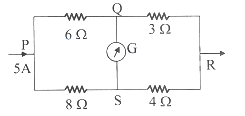 MHT CET 2023 Hard
 - An element \(\overrightarrow{\Delta \ell}=\Delta \mathrm{x} \hat{\mathrm{i}}\) is placed at the origin and carries a current of 10A. The magnitude of magnetic field on the Y axis at a distance of 0.5 m if \(\Delta \mathrm{x}=1 \mathrm{~cm}\) is \(\left(\frac{\mu_0}{4 \pi}=10^{-7}\right.\) SI unit \()\left(\sin 90^{\circ}=1\right)\)MHT CET 2025 Easy
- A body is thrown from the surface of the earth with velocity . The maximum height in meter above the surface of the earth up to which it will reach is (radius of the earth, acceleration due to gravity)MHT CET 2018 Easy
- A calorimeter contains 10 g of water at \(20^{\circ} \mathrm{C}\). The temperature fall to \(15^{\circ} \mathrm{C}\) in 10 min . When calorimeter contains 20 g of water at \(20^{\circ} \mathrm{C}\), it takes 15 min . for the temperature to become \(15^{\circ} \mathrm{C}\). The water equivalent at the calorimeter isMHT CET 2025 Medium
- The de-Broglie wavelength of an electron moving in the \(n^{\text {th }}\) Bohr orbit of radius \(r\) isMHT CET 2022 Medium
More PYQs from MHT CET
- Identify 'A' in the following reaction
 MHT CET 2020 Medium
 - In fundamental mode, the time required for the sound wave to reach up to closed end of a pipe filled with air is 't' second. The frequency of vibration of air column is (Neglect end correction)MHT CET 2025 Medium
- How long should aqueous NaCl be electrolysed by passing 100 ampere current, so that 0.5 mol chlorine is released at anode?MHT CET 2025 Medium
- Which from following elements is NOT regarded as transition element?MHT CET 2025 Easy
- Figure shows the combination of inductances and capacitances. Resonant frequency of the L - C circuit is
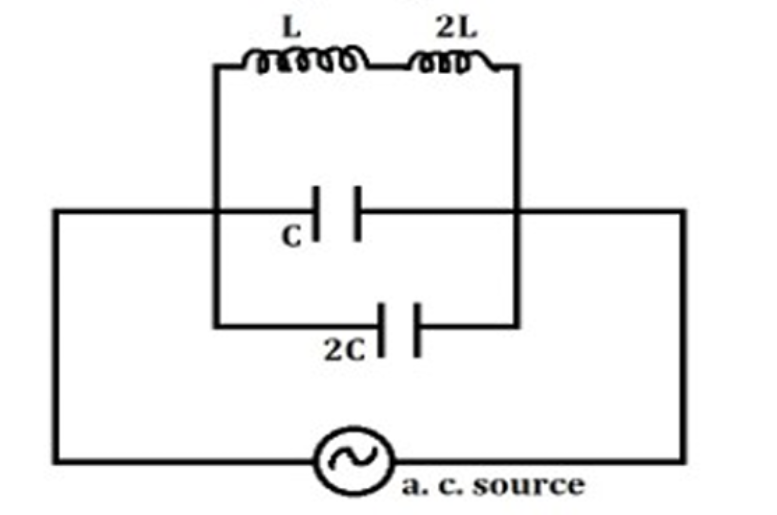 MHT CET 2025 Medium
 - Let \(\mathrm{z} \in \mathrm{C}\) with \(\operatorname{Im}(\mathrm{z})=10\) and it satisfies \(\frac{2 \mathrm{z}-\mathrm{n}}{2 \mathrm{z}+\mathrm{n}}=2 \mathrm{i}-1, \mathrm{i}=\sqrt{-1}\) for some natural number \(\mathrm{n}\), thenMHT CET 2023 Medium