


MHT CET · Physics · Electrostatics
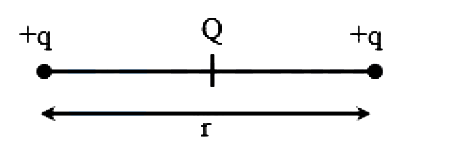
A point charge \(Q\) is placed at the center of the line joining two equal point charges \(+q\) and \(+q\). The value of \(Q\) if the system of the charges is equilibrium, is
- A \(\frac{-q}{2}\)
- B \(-\frac{\mathrm{q}}{4}\)
- C \(\frac{+\mathrm{q}}{4}\)
- D \(\frac{+\mathrm{q}}{2}\)
Answer & Solution
Correct Answer
(B) \(-\frac{\mathrm{q}}{4}\)
Step-by-step Solution
Detailed explanation
The forces on charge \(Q\) due to the other two charges will be equal and opposite and hence it will be in equilibrium. Force on \(+\mathrm{q}\) due to the other two charges should also be equal and opposite. Their magnitudes will be equal if
\(
\begin{aligned}
& \frac{1}{4 \pi \varepsilon_0} \cdot \frac{\mathrm{q}^2}{\mathrm{r}^2}=\frac{1}{4 \pi \varepsilon_0} \cdot \frac{\mathrm{qQ}}{\left(\frac{\mathrm{r}}{2}\right)^2}=\frac{1}{4 \pi \varepsilon_0} \cdot \frac{4 \mathrm{qQ}}{\mathrm{r}^2} \\
& \therefore \mathrm{q}=4 \mathrm{Q} \text { or } \mathrm{Q}=\frac{\mathrm{q}}{4}
\end{aligned}
\)
\(\mathrm{Q}\) must be negative, hence \(\mathrm{Q}=-\frac{\mathrm{q}}{4}\)
\(
\begin{aligned}
& \frac{1}{4 \pi \varepsilon_0} \cdot \frac{\mathrm{q}^2}{\mathrm{r}^2}=\frac{1}{4 \pi \varepsilon_0} \cdot \frac{\mathrm{qQ}}{\left(\frac{\mathrm{r}}{2}\right)^2}=\frac{1}{4 \pi \varepsilon_0} \cdot \frac{4 \mathrm{qQ}}{\mathrm{r}^2} \\
& \therefore \mathrm{q}=4 \mathrm{Q} \text { or } \mathrm{Q}=\frac{\mathrm{q}}{4}
\end{aligned}
\)
\(\mathrm{Q}\) must be negative, hence \(\mathrm{Q}=-\frac{\mathrm{q}}{4}\)
See the Complete Solution
Get step-by-step explanations for this and 2.5 Lakh+ more JEE, NEET & CET questions.
- Unlock all solutions
- Practice the full chapter
- Track accuracy across PYQs
4.8 rated on Google Play · 14,000+ reviews
More questions from Physics
- Half-lives of two radioactive elements \(A\) and \(B\) are 30 minute and 60 minute respectively. Initially the samples have equal number of nuclei. After 120 minute the ratio of decayed numbers of nuclei of \(B\) to that of \(A\) will beMHT CET 2024 Medium
- A current of \(5 \mathrm{~A}\) is flowing at \(220 \mathrm{~V}\) in the primary coil of transformer. If the voltage produced in the secondary coil is \(2200 \mathrm{~V}\) and \(50 \%\) of power is lost, then the current in secondary will beMHT CET 2022 Easy
- Two satellites P and Q go round a planet in circular orbits having radii ' \(3 R\) ' and ' \(R\) ' respectively. If the speed of satellite \(P\) is ' \(2 V\) ', the speed of the satellite Q will beMHT CET 2025 Medium
- The moment of inertia of a uniform square plate about an axis perpendicular to its plane and passing through the centre is \(\frac{\mathrm{Ma}^2}{6}\), where ' \(\mathrm{M}\) ' is the mass and ' \(a\) ' is the side of square plate. Moment of inertia of this plate about an axis perpendicular to its plane and passing through one of its corners isMHT CET 2023 Medium
- An iron rod is placed parallel to magnetic field of intensity . The magnetic flux through the rod is and its cross-sectional area is . The magnetic permeability of the rod in isMHT CET 2016 Medium
- The scale of a galvanometer is divided into 160 equal divisions. The galvanometer shows full scale deflection of 16 mA and maximum voltage is 80 mV . Now the range is changed so that galvanometer reads 160 V . The required resistance to be connected isMHT CET 2025 Medium
More PYQs from MHT CET
- Let C be a curve given by \(y(x)=1+\sqrt{4 x-3}\), \(x\gt\frac{3}{4}\). If P is a point on C , such that the tangent at P has slope \(\frac{2}{3}\), then a point through which the normal at P passes, isMHT CET 2024 Medium
- Identify the reaction taking place at anode during electrolysis of molten \(\mathrm{NaCl}\) ?MHT CET 2022 Medium
- \(\alpha\) -hydroxy propanoic acid has .......... asymmetric carbon atoms.MHT CET 2010 Hard
- Which of the following alkenes, on oxidation by \(\mathrm{KMnO}_4\) in dil. \(\mathrm{H}_2 \mathrm{SO}_4\) forms adipic acid?MHT CET 2025 Medium
- The tangent to the circle \(x^2+y^2=5\) at \((1,-2)\) also touches the circle \(x^2+y^2-8 x+6 y+20=0\) then the co-ordinates of the corresponding point of contact isMHT CET 2024 Easy
- Let \(\bar{a}=\hat{i}+\hat{\mathrm{j}}-\hat{\mathrm{k}}\) and \(\bar{c}=5 \hat{i}-3 \hat{\mathrm{j}}+2 \hat{\mathrm{k}}\) and if \(\overline{\mathrm{b}} \times \overline{\mathrm{c}}=\bar{a}\) then \(|\overline{\mathrm{b}}|=\)MHT CET 2025 Medium