


MHT CET · Physics · Waves and Sound
A pipe \(\mathrm{P}_{\mathrm{C}}\) closed at one end and pipe \(\mathrm{P}_{\mathrm{O}}\) open at both ends are vibrating in second overtone. They are in resonance with a given tuning fork. The ratio of the length of pipe \(\mathrm{P}_{\mathrm{C}}\) vs \(\mathrm{P}_{\mathrm{O}}\) is (Neglect end correction)
- A \(\frac{4}{5}\)
- B \(\frac{5}{6}\)
- C \(\frac{2}{3}\)
- D \(\frac{3}{5}\)
Answer & Solution
Correct Answer
(B) \(\frac{5}{6}\)
Step-by-step Solution
Detailed explanation
For second overtone:
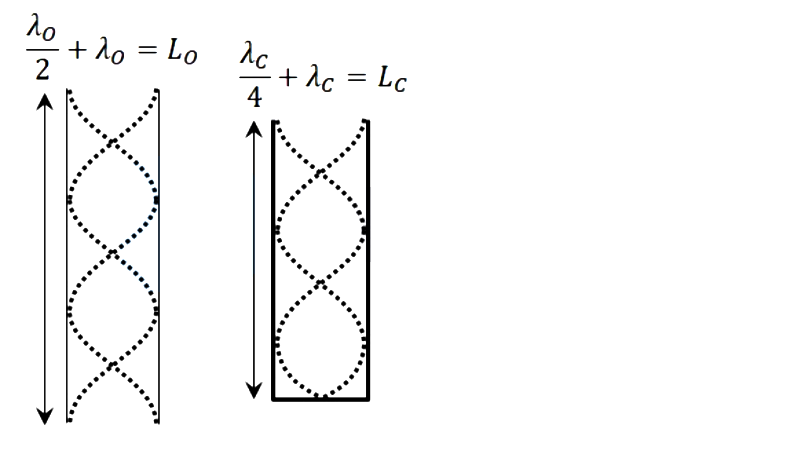
If they are in the resonance with the same tuning fork, using:
\(\lambda \mathrm{f}=\mathrm{v}\)
\(f\) and \(v\) are the same, so
\(\begin{aligned} & \lambda_C=\lambda_0 \\ & \therefore\left(\frac{4}{5} L_C\right)=\frac{2}{3} L_0 \\ & \Rightarrow \frac{L_C}{L_0}=\frac{5}{6}\end{aligned}\)
If they are in the resonance with the same tuning fork, using:
\(\lambda \mathrm{f}=\mathrm{v}\)
\(f\) and \(v\) are the same, so
\(\begin{aligned} & \lambda_C=\lambda_0 \\ & \therefore\left(\frac{4}{5} L_C\right)=\frac{2}{3} L_0 \\ & \Rightarrow \frac{L_C}{L_0}=\frac{5}{6}\end{aligned}\)
See the Complete Solution
Get step-by-step explanations for this and 2.5 Lakh+ more JEE, NEET & CET questions.
- Unlock all solutions
- Practice the full chapter
- Track accuracy across PYQs
4.8 rated on Google Play · 14,000+ reviews
More questions from Physics
- Periodic time of a satellite revolving above the earth's surface at a height equal to radius of the earth ' \(R\) ' is [ \(g=\) acceleration due to gravity]MHT CET 2023 Medium
- The ratio of intensities of two waves producing interference is \(9: 4\), then the ratio
of the resultant maximum and minimum intensities will be \(\left(\cos \frac{\pi}{3}=\frac{1}{2}\right)\)MHT CET 2020 Easy - On a photosensitive surface, if the intensity of incident radiation is increased, the stopping potentialMHT CET 2021 Easy
- A glass rod of radius ' \(r\) ' ' is inserted symmetrically into a vertical capillary tube of radius ' \(\mathrm{r}_2\) ' \(\left(\mathrm{r}_1 < \mathrm{r}_2\right)\) such that their lower ends are at same level. The arrangement is dipped in water. The height to which water will rise into the tube will be ( \(\rho=\) density of water, \(\mathrm{T}=\) surface tension in water, \(\mathrm{g}\) = acceleration due to gravity)MHT CET 2021 Hard
- A coil of ' \(n\) ' turns and resistance \(R \Omega\) is connected in series with a resistance \(\frac{R}{2}\). The combination is moved for time 't' second through magnetic flux \(\Phi_1\) to \(\Phi_2\). The induced current in the circuit isMHT CET 2025 Medium
- An electron is moving in an orbit around the nucleus in an atom. Let \(m\), b orbital magnetic moment and \(L\) be angular momentum of the electron, thenMHT CET 2022 Hard
More PYQs from MHT CET
- A uniformly charged semicircular arc of radius ' \(r\) ' has linear charge density \((\lambda)\). What is the electric field at its centre?
( \(\epsilon_0=\) permittivity of free space)MHT CET 2021 Medium - The root mean square velocity of molecules of a gas is \(200 \mathrm{~m} / \mathrm{s}\). What will be the
root mean square velocity of the molecules, if the molecular weight is doubled and
the absolute temperature is halved?MHT CET 2020 Easy - \(\int \frac{\sin 2 x \cos 2 x}{\sqrt{4-\cos ^4 2 x}} \mathrm{~d} x=\)MHT CET 2025 Medium
- \(\vec{a}=\hat{i}+\hat{j}+\hat{k}\), and \(\vec{b}=\hat{i}-\hat{j}+\widehat{k}\) and \(\vec{c}=\hat{i}-\hat{j}-\hat{k}\) are three vectors then vector \(\overline{\mathrm{r}}\) in the plane of \(\overline{\mathrm{a}}\) and \(\overline{\mathrm{b}}\), whose projection on \(\overline{\mathrm{c}}\) is \(\frac{1}{\sqrt{3}}\), is given byMHT CET 2022 Medium
- If a plane meets the axes \(\mathrm{X}, \mathrm{Y}, \mathrm{Z}\) in \(\mathrm{A}, \mathrm{B}, \mathrm{C}\) respectively such that centroid of \(\triangle \mathrm{ABC}\) is \((1,2,3)\), then the equation of the plane isMHT CET 2021 Medium
- Which of the following statement pattern is a tautology?
\(\mathrm{S}_{1} \equiv \sim \mathrm{p} \rightarrow(\mathrm{q} \leftrightarrow \mathrm{p})\)
\(\mathrm{S}_{2} \equiv \sim \mathrm{p} \mathrm{V} \sim \mathrm{q}\)
\(\mathrm{S}_{3} \equiv(\mathrm{p} \rightarrow \mathrm{q}) \wedge(\mathrm{q} \rightarrow \mathrm{p})\)
\(\mathrm{S}_{4} \equiv(\mathrm{q} \rightarrow \mathrm{p}) \vee(\sim \mathrm{p} \leftrightarrow \mathrm{q})\)MHT CET 2020 Medium