


MHT CET · Physics · Gravitation
A pendulum is oscillating with frequency ' \(n\) ' on the surface of earth. If it is taken to a depth \(\frac{R}{4}\) below the surface of earth, new frequency of oscillation of depth \(\frac{R}{4}\) is ( \(R=\) radius of earth)
- A \(\frac{2}{\sqrt{3} n}\)
- B \(\frac{\sqrt{3} n}{2}\)
- C \(\frac{2 \mathrm{n}}{\sqrt{3}}\)
- D \(\frac{\mathrm{n}}{4}\)
Answer & Solution
Correct Answer
(B) \(\frac{\sqrt{3} n}{2}\)
Step-by-step Solution
Detailed explanation
The frequency of the pendulum at the surface is given as \(\mathrm{f}=\frac{1}{2 \pi} \sqrt{\frac{\mathrm{~g}}{l}}\)
At depth the formula for gravitational acceleration is \(\mathrm{g}_{\mathrm{eff}}=\mathrm{g}\left(1-\frac{\mathrm{d}}{\mathrm{R}}\right)\)
For \(\mathrm{d}=\frac{\mathrm{R}}{4}, \mathrm{~g}_{\text {eff }}=\mathrm{g}\left(1-\frac{1}{4}\right)=\frac{3}{4} g\)
The frequency at depth \(\mathrm{d}=\frac{\mathrm{R}}{4}\)
\(\mathrm{f}_{\mathrm{d}}=\frac{1}{2 \pi} \sqrt{\frac{\frac{3}{4} \mathrm{~g}}{l}}=\frac{1}{2 \pi} \sqrt{\frac{3 \mathrm{~g}}{4 l}}\)
Take the ratio of both frequencies
\(\begin{aligned}
& \frac{f_d}{f}=\frac{\sqrt{3}}{2} \\
& f_d=\frac{\sqrt{3}}{2} f=\frac{\sqrt{3} n}{2} \quad \ldots(\because f=n)
\end{aligned}\)
At depth the formula for gravitational acceleration is \(\mathrm{g}_{\mathrm{eff}}=\mathrm{g}\left(1-\frac{\mathrm{d}}{\mathrm{R}}\right)\)
For \(\mathrm{d}=\frac{\mathrm{R}}{4}, \mathrm{~g}_{\text {eff }}=\mathrm{g}\left(1-\frac{1}{4}\right)=\frac{3}{4} g\)
The frequency at depth \(\mathrm{d}=\frac{\mathrm{R}}{4}\)
\(\mathrm{f}_{\mathrm{d}}=\frac{1}{2 \pi} \sqrt{\frac{\frac{3}{4} \mathrm{~g}}{l}}=\frac{1}{2 \pi} \sqrt{\frac{3 \mathrm{~g}}{4 l}}\)
Take the ratio of both frequencies
\(\begin{aligned}
& \frac{f_d}{f}=\frac{\sqrt{3}}{2} \\
& f_d=\frac{\sqrt{3}}{2} f=\frac{\sqrt{3} n}{2} \quad \ldots(\because f=n)
\end{aligned}\)
See the Complete Solution
Get step-by-step explanations for this and 2.5 Lakh+ more JEE, NEET & CET questions.
- Unlock all solutions
- Practice the full chapter
- Track accuracy across PYQs
4.8 rated on Google Play · 14,000+ reviews
More questions from Physics
- Two spherical black bodies have radii \(r 1\) and \(r_2\). Their surface temperatures are \(T 1\) and \(T_2\). If they radiate same power then \(\frac{r_2}{r_1}\) isMHT CET 2017 Medium
- The de-Broglie wavelength \((\lambda)\) of a particle is related to its kinetic energy \((\mathrm{E})\) asMHT CET 2023 Easy
- In Young's double slit experiment, the fifth maximum with wavelength ' \(\lambda_1\) ' is at a distance ' \(\mathrm{y}_1\) ' and the same maximum with wavelength ' \(\lambda_2\) ' is at a distance ' \(y_2\) ' measured from the central bright band. Then \(\frac{y_1}{y_2}\) is equal to [D and \(d\) are constant]MHT CET 2023 Medium
- Using Bohr's quantization condition, the rotational kinetic energy in the third orbit for a diatomic molecule is ( \(h=\) Planck's constant, \(I=\) moment of inertia of diatomic molecule)MHT CET 2025 Medium
- In the circuit shown, the potential difference across the \(4.5 \mu \mathrm{F}\) capacitor is
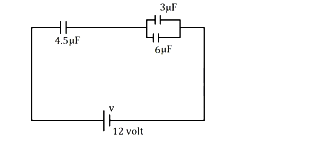 MHT CET 2020 Medium
 - A rod of length ' \(l\) ' is rotated with angular velocity ' \(\omega\) ' about its one end, perpendicular to a magnetic field of induction 'B'. The e.m.f. induced in the rod isMHT CET 2024 Easy
More PYQs from MHT CET
- Two identical photocathodes receive light of frequencies ' \(\mathrm{n}_1\) ' and ' \(\mathrm{n}_2\) '. If the velocities of the emitted photoelectrons of mass ' \(m\) ' are ' \(V_1\) ' and ' \(\mathrm{V}_2\) ' respectively, then ( \(\mathrm{h}=\) Planck's constant )MHT CET 2024 Hard
- In the process of space communication, use of modem is necessary.
In which one of the following modes modem acts as a modulator and a demodulator respectively?MHT CET 2020 Easy - Which from following reactions performs zero work?MHT CET 2025 Medium
- What is the temperature at which the ethers can be prepared from alcohols by the action of concentrated \(\mathrm{H}_2 \mathrm{SO}_4\) ?MHT CET 2022 Medium
- The electric potential at a point on the axis of an electric dipole is proportional to \([\mathrm{r}=\) distance between centre of the electric dipole and the point]MHT CET 2024 Easy
- Let \(P \equiv(-3,0), Q \equiv(0,0)\) and \(R \equiv(3,3 \sqrt{3})\) be three points. Then the equation of the bisector of the angle \(\mathrm{PQR}\) isMHT CET 2023 Medium