


MHT CET · Physics · Oscillations
A pendulum has length of \(0.4 \mathrm{~m}\) and maximum speed \(4 \mathrm{~m} / \mathrm{s}\). When the length makes
an angle \(30^{\circ}\) with the horizontal, its speed will be
\(\left[\sin \frac{\pi}{6}=\cos \frac{\pi}{3}=0 \cdot 5\right.\) and \(\left.\mathrm{g}=10 \mathrm{~m} / \mathrm{s}^{2}\right]\)
- A \(2 \sqrt{2} \mathrm{~m} / \mathrm{s}\)
- B \(\sqrt{3} \mathrm{~m} / \mathrm{s}\)
- C \(2 \sqrt{5} \mathrm{~m} / \mathrm{s}\)
- D \(2 \sqrt{3} \mathrm{~m} / \mathrm{s}\)
Answer & Solution
Correct Answer
(D) \(2 \sqrt{3} \mathrm{~m} / \mathrm{s}\)
Step-by-step Solution
Detailed explanation
A pendulum has length of \(0.4 \mathrm{~m}\) and maximum speed \(4 \mathrm{~m} / \mathrm{s}\). When the length makes an angle \(30^{\circ}\) with the horizontal, its speed will be \(2 \sqrt{3} \mathrm{~m} / \mathrm{s}\).
Explanation:
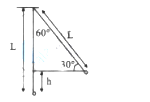
\(h=L-L \cos 0=L(1-\cos \theta)\)
\(=0.4\left(1-\cos 60^{\circ}\right)\)
\(=0.4\left(1-\frac{1}{2}\right)\)
\(=0.4 \times \frac{1}{2}\)
\(=0.2\)
\(\frac{1}{2} m v_{1}^{2}=\frac{1}{2} m v_{2}^{2}+m g h\)
\(v_{1}^{2}=v_{2}^{2}+2 g h\)
\(\therefore v_{2}^{2}=v_{1}^{2}-2 g h\)
\(=(4)^{2}-2 \times 10 \times 0.2\)
\(=16-4=12\)
\(\therefore v_{2}=\sqrt{12}=2 \sqrt{3} m / s\)
Explanation:
\(h=L-L \cos 0=L(1-\cos \theta)\)
\(=0.4\left(1-\cos 60^{\circ}\right)\)
\(=0.4\left(1-\frac{1}{2}\right)\)
\(=0.4 \times \frac{1}{2}\)
\(=0.2\)
\(\frac{1}{2} m v_{1}^{2}=\frac{1}{2} m v_{2}^{2}+m g h\)
\(v_{1}^{2}=v_{2}^{2}+2 g h\)
\(\therefore v_{2}^{2}=v_{1}^{2}-2 g h\)
\(=(4)^{2}-2 \times 10 \times 0.2\)
\(=16-4=12\)
\(\therefore v_{2}=\sqrt{12}=2 \sqrt{3} m / s\)
See the Complete Solution
Get step-by-step explanations for this and 2.5 Lakh+ more JEE, NEET & CET questions.
- Unlock all solutions
- Practice the full chapter
- Track accuracy across PYQs
4.8 rated on Google Play · 14,000+ reviews
More questions from Physics
- A piece of semiconductor is connected in series in an electric circuit. On increasing the temperature, the current in the circuit willMHT CET 2025 Easy
- A charged spherical conductor has radius ' \(r\) '. The potential difference between its surface and a point at a distance ' \(3 r\) ' from the center is ' \(\mathrm{V}\) ' The electric intensity at a distance ' \(3 \mathrm{r}\) ' from the centre of the conductor isMHT CET 2021 Medium
- The length of the compound microscope is 15 cm . The magnifying power for relaxed eye is 25 . If the focal length of eye lens is 6 cm then the object distance for objective lens will beMHT CET 2025 Medium
- A carrier wave of peak voltage 16 volt is used to transmit a signal. If the
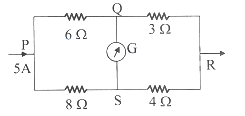
modulation index is \(75 \%\), the peak voltage of the modulating signal isMHT CET 2020 Easy - Potential difference between the points \(P\) and Q is nearly
 MHT CET 2023 Hard
 - In LCR series circuit, when ' \(L\) ' is removed from the circuit, the phase difference between voltage and current in the circuit is \(\frac{\pi}{3}\). If ' \(C\) ' is removed from the circuit instead of \(L\) then phase difference is again \(\frac{\pi}{3}\). The power factor of the circuit is \(\left(\tan 60^{\circ}=\sqrt{3}\right)\)MHT CET 2025 Medium
More PYQs from MHT CET
- A machine gun fires bullets of mass \(30 \mathrm{~g}\) with velocity of \(1000 \mathrm{~m} / \mathrm{s}\). The man holding the gun can exert a maximum force of \(300 \mathrm{~N}\) on it. How many bullets can he fire per second at most?MHT CET 2023 Easy
- Calculate the number of atoms present in 1 g of an element if it forms fcc unit cell structure. [ \(\varrho \times \mathrm{a}^3=6.8 \times 10^{-22} \mathrm{~g}\) ]MHT CET 2025 Medium
- If \(e^{-y} \cdot y=x\), then \(\frac{d y}{d x}\) isMHT CET 2021 Medium
- Magnetic induction produced at the centre of a circular loop of radius ' R ' carrying a current is ' \(B\) '. The magnetic moment of the loop is ( \(\mu_0=\) permeability of free space)MHT CET 2024 Medium
- Which gives \(+7\) oxidation state?MHT CET 2010 Medium
- Monosilane on coming in contact with air burns with a luminous flame producing vortex rings. These rings are ofMHT CET 2007 Medium