


MHT CET · Physics · Oscillations
A particle performs S.H.M. with amplitude 'A'. Its speed is tripled at the instant
when it is at a distance of \(\frac{2 \mathrm{~A}}{3}\) from the mean position. The new amplitude of the
motion is
- A \(\frac{5 \mathrm{~A}}{3}\)
- B \(\frac{7 \mathrm{~A}}{3}\)
- C \(\frac{2 \mathrm{~A}}{3}\)
- D \(\frac{\mathrm{A}}{3}\)
Answer & Solution
Correct Answer
(B) \(\frac{7 \mathrm{~A}}{3}\)
Step-by-step Solution
Detailed explanation
Kinetic energy of a particle performing S.H.M. is given by
\(
k=\frac{1}{2} m \omega^{2}\left(A^{2}-x^{2}\right)
\)
When \(x=\frac{2}{3} A\),
\(
\mathrm{k}=\frac{1}{2} \mathrm{~m} \omega^{2}\left(\mathrm{~A}^{2}-\frac{4}{9} \mathrm{~A}^{2}\right)=\frac{1}{2} \mathrm{~m} \omega^{2} \mathrm{~A}^{2} \times \frac{5}{9}
\)
If the velocity is tripled, its kinetic energy will become 9 times. The new kinetic energy will be \(k^{\prime}=\frac{1}{2} m \omega^{2} A^{2} \times 5\)
The potential energy \(p=\frac{1}{2} m \omega^{2}\left(\frac{2}{3} A\right)^{2}=\frac{1}{2} m \omega^{2} A^{2} \cdot \frac{4}{9}\)
If \(A^{\prime}\) is the new amplitude then the total energy e is given by
\(E=\frac{1}{2} m \omega^{2} A^{\prime 2}\)
Also, \(E=P+k^{\prime}\)
\(\therefore \frac{1}{2} m \omega^{2} A^{\prime 2}=\frac{1}{2} m \omega^{2} A^{2} \cdot \frac{4}{9}+\frac{1}{2} m \omega^{2} A^{2} \cdot 5\)
\(\therefore A^{\prime 2}=\left(\frac{4}{9}+5\right) A^{2}\)
\(\therefore A^{\prime}=\frac{7}{3} A\)
\(
k=\frac{1}{2} m \omega^{2}\left(A^{2}-x^{2}\right)
\)
When \(x=\frac{2}{3} A\),
\(
\mathrm{k}=\frac{1}{2} \mathrm{~m} \omega^{2}\left(\mathrm{~A}^{2}-\frac{4}{9} \mathrm{~A}^{2}\right)=\frac{1}{2} \mathrm{~m} \omega^{2} \mathrm{~A}^{2} \times \frac{5}{9}
\)
If the velocity is tripled, its kinetic energy will become 9 times. The new kinetic energy will be \(k^{\prime}=\frac{1}{2} m \omega^{2} A^{2} \times 5\)
The potential energy \(p=\frac{1}{2} m \omega^{2}\left(\frac{2}{3} A\right)^{2}=\frac{1}{2} m \omega^{2} A^{2} \cdot \frac{4}{9}\)
If \(A^{\prime}\) is the new amplitude then the total energy e is given by
\(E=\frac{1}{2} m \omega^{2} A^{\prime 2}\)
Also, \(E=P+k^{\prime}\)
\(\therefore \frac{1}{2} m \omega^{2} A^{\prime 2}=\frac{1}{2} m \omega^{2} A^{2} \cdot \frac{4}{9}+\frac{1}{2} m \omega^{2} A^{2} \cdot 5\)
\(\therefore A^{\prime 2}=\left(\frac{4}{9}+5\right) A^{2}\)
\(\therefore A^{\prime}=\frac{7}{3} A\)
See the Complete Solution
Get step-by-step explanations for this and 2.5 Lakh+ more JEE, NEET & CET questions.
- Unlock all solutions
- Practice the full chapter
- Track accuracy across PYQs
4.8 rated on Google Play · 14,000+ reviews
More questions from Physics
- The fundamental frequency of an air column in a pipe closed at one end is . If the same pipe is open at both the ends, the frequencies produced in areMHT CET 2017 Medium
- Two identical coaxial circular loops carry current 'i' each circulating in the clockwise direction. If the loops are approaching each other, thenMHT CET 2025 Medium
- A potentiometer wire has length of \(5 \mathrm{~m}\) and resistance of \(16 \Omega\). The driving cell has an e.m.f. of \(5 \mathrm{~V}\) and an internal resistance of \(4 \Omega\). When the two cells of e.m.f.s \(1.3 \mathrm{~V}\) and \(1.1 \mathrm{~V}\) are connected so as to assist each other and then oppose each other, the balancing lengths are respectivelyMHT CET 2023 Hard
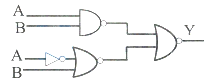
- In the following digital logic circuit, the output Y will be ' 1 ' for inputs
 MHT CET 2023 Easy
 - A bar of iron having magnetic moment \(2 \cdot 4 \mathrm{Am}^2\) weighs 66 g . If the density of the material of the bar is \(7700 \mathrm{~kg} / \mathrm{m}^3\), the intensity of magnetisation in \(\mathrm{Am}^{-1}\) isMHT CET 2025 Medium
- Two simple harmonic motions are represented as \(y_1=10 \sin \omega t\) and \(y_2=10 \sin \omega t+5 \cos \omega t\). The ratio of the amplitudes of \(y_1\) and \(y_2\) isMHT CET 2022 Medium
More PYQs from MHT CET
- Identify the correct decreasing order of stability of complexes formed by divalent metal ions with same ligand.MHT CET 2025 Medium
- Find the rate of formation of \(\mathrm{NO}_{2(\mathrm{~g})}\) in the following reaction.
\(2 \mathrm{~N}_2 \mathrm{O}_{5(\mathrm{~g})} \rightarrow 4 \mathrm{NO}_{2(\mathrm{~g})}+\mathrm{O}_{2(\mathrm{~g})}\) \(\ {\left[\frac{-\mathrm{d}\left[\mathrm{N}_2 \mathrm{O}_5\right]}{\mathrm{dt}}=0.02 \mathrm{~mol} \mathrm{dm}^{-3}\right]}\)MHT CET 2023 Easy - Two electrons occupying the same orbital are distinguished byMHT CET 2021 Easy
- Which among following compounds possesses highest number of \(\mathrm{N}\) atoms in it?MHT CET 2022 Easy
- Given below are two statements.
Statement I - Most of the blood proteins are acidic proteins.
Statement II - Derived proteins are not found in nature.
In the light of above statements, Select the correct option given below:MHT CET 2025 Easy - If 1 is added to first 10 natural numbers, then variance of the numbers so obtained isMHT CET 2021 Easy