


MHT CET · Physics · Oscillations
A particle performs linear S.H.M. At a particular instant, velocity of the particle is ' \(u\) ' and acceleration is ' \(\alpha\) ' while at another instant,
velocity is ' \(v\) ' and acceleration is ' \(\beta\) ' \((0 \lt \alpha \lt \beta)\). The distance between the two positions is
- A \(\frac{u^2-v^2}{\alpha+\beta}\)
- B \(\frac{u^2+v^2}{\alpha+\beta}\)
- C \(\frac{u^2-v^2}{\alpha-\beta}\)
- D \(\frac{u^2+v^2}{\alpha-\beta}\)
Answer & Solution
Correct Answer
(A) \(\frac{u^2-v^2}{\alpha+\beta}\)
Step-by-step Solution
Detailed explanation
When velocity is \(u\) and acceleration is \(\alpha\), let the position of particle be \(\mathrm{x}_1\).
When velocity is v and acceleration is \(\beta\), let the position of particle be \(x_2\).
If \(\omega\) is the angular frequency then, \(\alpha=\omega^2 x_1\)
and \(\beta=\omega^2 x_2\)
\(\therefore \quad \alpha+\beta=\omega^2\left(\mathrm{x}_1+\mathrm{x}_2\right)\)...(i)
Also, velocity of particle at particular instant can be given as,
\(\begin{aligned}
& u^2=\omega^2 A^2-\omega^2 x_1^2 \\
& \text { and } v^2=\omega^2 A^2-\omega^2 x_2^2 \\
& \text { i.e., } v^2-u^2=\omega^2\left(x_1^2-x_2^2\right) \\
& v^2-u^2=\omega^2\left(x_1-x_2\right)\left(x_1+x_2\right)...(ii)
\end{aligned}\)
from equation (i) we get
\(\begin{aligned}
& \quad v^2-u^2=\left(x_1-x_2\right)(\alpha+\beta) \\
& \therefore \quad x_1-x_2=\frac{v^2-u^2}{\alpha+\beta} \\
& \quad \text { or } x_2-x_1=\frac{u^2-v^2}{\alpha+\beta}
\end{aligned}\)
When velocity is v and acceleration is \(\beta\), let the position of particle be \(x_2\).
If \(\omega\) is the angular frequency then, \(\alpha=\omega^2 x_1\)
and \(\beta=\omega^2 x_2\)
\(\therefore \quad \alpha+\beta=\omega^2\left(\mathrm{x}_1+\mathrm{x}_2\right)\)...(i)
Also, velocity of particle at particular instant can be given as,
\(\begin{aligned}
& u^2=\omega^2 A^2-\omega^2 x_1^2 \\
& \text { and } v^2=\omega^2 A^2-\omega^2 x_2^2 \\
& \text { i.e., } v^2-u^2=\omega^2\left(x_1^2-x_2^2\right) \\
& v^2-u^2=\omega^2\left(x_1-x_2\right)\left(x_1+x_2\right)...(ii)
\end{aligned}\)
from equation (i) we get
\(\begin{aligned}
& \quad v^2-u^2=\left(x_1-x_2\right)(\alpha+\beta) \\
& \therefore \quad x_1-x_2=\frac{v^2-u^2}{\alpha+\beta} \\
& \quad \text { or } x_2-x_1=\frac{u^2-v^2}{\alpha+\beta}
\end{aligned}\)
See the Complete Solution
Get step-by-step explanations for this and 2.5 Lakh+ more JEE, NEET & CET questions.
- Unlock all solutions
- Practice the full chapter
- Track accuracy across PYQs
4.8 rated on Google Play · 14,000+ reviews
More questions from Physics
- A simple microscope is used to see the object first in blue light and then in red
light. Due to the change from blue to red light, what is the effect on its magnifying
power?MHT CET 2020 Easy - In potentiometer experiment, null point is obtained at a particular point for a cell on potentiometer wire ' \(x\) ' \(\mathrm{cm}\) long. If length of potentiometer wire is increased by few centimeters without changing the cell, the balancing length will [Driving source is not changed]MHT CET 2021 Easy
- Two capacitors \(\mathrm{C}_1=3 \mu \mathrm{F}\) and \(\mathrm{C}_2=2 \mu \mathrm{F}\) are connected in series across d.c. source of \(100 \mathrm{~V}\). The ratio of the potential across \(C_2\) to \(C_1\) isMHT CET 2023 Medium
- A graph of magnetic flux \((\phi)\) versus current (I) is plotted for four inductors A, B, C, D. Larger value of self inductance is for inductor
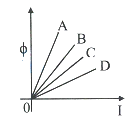 MHT CET 2023 Easy
 - A simple pendulum of length \(2 \mathrm{~m}\) is given a horizontal push through angular displacement of \(60^{\circ}\). If the mass of bob is 200 gram, the angular velocity of the bob will be (Take Acceleration due to gravity \(=10 \mathrm{~m} / \mathrm{s}^2\) ) \(\left(\sin 30^{\circ}=\cos 60^{\circ}=0.5, \cos 30^{\circ}=\sin 60^{\circ}=\sqrt{3} / 2\right)\)MHT CET 2023 Hard
- Graph shows the variation of de-Broglie wavelength \(\lambda\) versus \(\frac{1}{\sqrt{V}}\) where \(V\) is the accelerating potential for four particles, P, Q, R, S carrying same charge but of mass \(m_1, m_2, m_3, m_4\). Which one represents a particle of smaller mass?
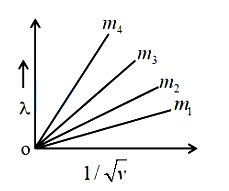 MHT CET 2022 Hard
More PYQs from MHT CET
- An ideal gas of molar mass ' \(\mathrm{M}_0\) ' has r.m.s. velocity ' \(\mathrm{V}\) ' at temperature ' \(\mathrm{T}\) '. ThenMHT CET 2021 Easy
- If the magnitude of intensity of electric field at a distance ' \(\mathrm{r}_1\) ' on an axial line and at a distance ' \(r_2\) ' on an equatorial line due to a given short dipole are equal, then \(r_1: r_2\), isMHT CET 2023 Medium
- The maximum wavelength of radiation emitted by a star is 289.8 nm. Then intensity of radiation for the star is (Given : Stefan’s constant = , Wien’s constant,MHT CET 2019 Medium
- The acute angle between the lines \(x=-y, z=0\) and \(x=0, z=0\) isMHT CET 2022 Easy
- Given below are the two statements regarding photoreceptor cells of human eye.
Statement I: The three types of cone cells have their own characteristic photopigments that respond to red, green and blue lights.
Statement II: Sensation of white light is produced due to simultaneous equal stimulation of all three types of cone cells.
In the light of above statements, choose the correct answer from the options given below:MHT CET 2024 Medium - If \(\alpha=3 \sin ^{-1} \frac{6}{11}\) and \(\beta=3 \cos ^{-1}\left(\frac{4}{9}\right)\), where the inverse trigonometric functions take only the principal values, then the incorrect option isMHT CET 2023 Medium