


MHT CET · Physics · Oscillations
A particle performing S.H.M. with maximum velocity ' \(V\) '. If the amplitude double and periodic time is made, \(\left(\frac{1}{3}\right)^{\text {rd }}\) then the maximum velocity is
- A \(\frac{\mathrm{V}}{2}\)
- B \(\frac{\mathrm{V}}{3}\)
- C 6V
- D \(\frac{2 \mathrm{~V}}{3}\)
Answer & Solution
Correct Answer
(C) 6V
Step-by-step Solution
Detailed explanation
Given:
- The amplitude doubles \(\left(A^{\prime}=2 A\right)\).
- The period becomes one-third \(\left(T^{\prime}=\frac{1}{3} T\right)\).
Formula for Maximum Velocity:
\(V_{\max }=A \omega\)
where \(\omega=\frac{2 \pi}{T}\).
Step 1: New Angular Velocity:
\(\omega^{\prime}=\frac{2 \pi}{T^{\prime}}=\frac{2 \pi}{\frac{1}{3} T}=6 \pi / T=3 \omega\)
Step 2: New Maximum Velocity:
\(V_{\max }^{\prime}=A^{\prime} \omega^{\prime}=(2 A)(3 \omega)=6 A \omega\)
Since the original \(V_{\max }=A \omega\) :
\(V_{\max }^{\prime}=6 V\)
- The amplitude doubles \(\left(A^{\prime}=2 A\right)\).
- The period becomes one-third \(\left(T^{\prime}=\frac{1}{3} T\right)\).
Formula for Maximum Velocity:
\(V_{\max }=A \omega\)
where \(\omega=\frac{2 \pi}{T}\).
Step 1: New Angular Velocity:
\(\omega^{\prime}=\frac{2 \pi}{T^{\prime}}=\frac{2 \pi}{\frac{1}{3} T}=6 \pi / T=3 \omega\)
Step 2: New Maximum Velocity:
\(V_{\max }^{\prime}=A^{\prime} \omega^{\prime}=(2 A)(3 \omega)=6 A \omega\)
Since the original \(V_{\max }=A \omega\) :
\(V_{\max }^{\prime}=6 V\)
See the Complete Solution
Get step-by-step explanations for this and 2.5 Lakh+ more JEE, NEET & CET questions.
- Unlock all solutions
- Practice the full chapter
- Track accuracy across PYQs
4.8 rated on Google Play · 14,000+ reviews
More questions from Physics
- A parallel plate air capacitor has a uniform electric field \(E\) in the space between the plates. Area of each plate is \(A\) and the distance between the plates is \(d\). The energy stored in the capacitor is \(\left[\varepsilon_0=\right.\) permittivity of free space \(]\)MHT CET 2022 Easy
- A body moves along a circular path of radius 15 cm . It starts from a point on the circular path and reaches the end of diameter in 3 second. The angular speed of the body in rad \(/ \mathrm{s}\) isMHT CET 2024 Easy
- The angular momentum of the electron in the third Bohr orbit of hydrogen atom is ' \(l\) '. Its angular momentum in the fourth Bohr orbit isMHT CET 2024 Easy
- The ratio of radii of gyration of a circular ring and circular disc of the same mass and radius, about an axis passing through their centres and perpendicular to their planes isMHT CET 2021 Easy
- The ratio of the velocity of sound in hydrogen gas \(\left(\gamma=\frac{7}{5}\right)\) to that in helium gas \(\left(\gamma=\frac{5}{3}\right)\) at the same temperature isMHT CET 2024 Easy
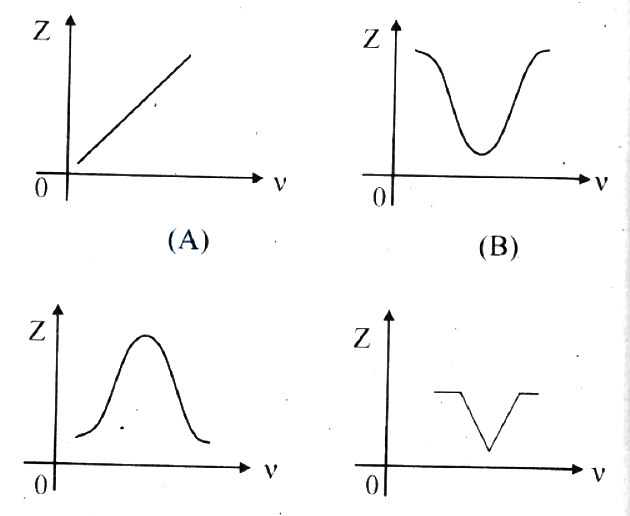
- Which one of the following graph represent correctly the variation of impedance (Z) of a series LCR circuit with the frequency ( \(v\) ) of applied a.c.?
 MHT CET 2024 Medium
More PYQs from MHT CET
- If \(\mathrm{f}: \mathrm{R} \rightarrow \mathrm{R}\), such that \(f(x)=\frac{e^{x}+e^{-x}}{e^{x}-e^{-x}}\), then \(\mathrm{f}\) isMHT CET 2020 Easy
- White light consists of wavelengths range from \(480 \mathrm{~nm}\) to \(672 \mathrm{~nm}\). What will be the wavelength range when white light is passed through glass of refractive index 1.6?MHT CET 2021 Easy
- Five letters are placed at random in five addressed envelopes. The probability that all the letters are not dispatched in the respective right envelopes isMHT CET 2022 Easy
- What is oxidation state of \(\mathrm{Cl}\) in \(\mathrm{KClO}_3\)MHT CET 2022 Easy
- Molarity is:MHT CET 2018 Easy
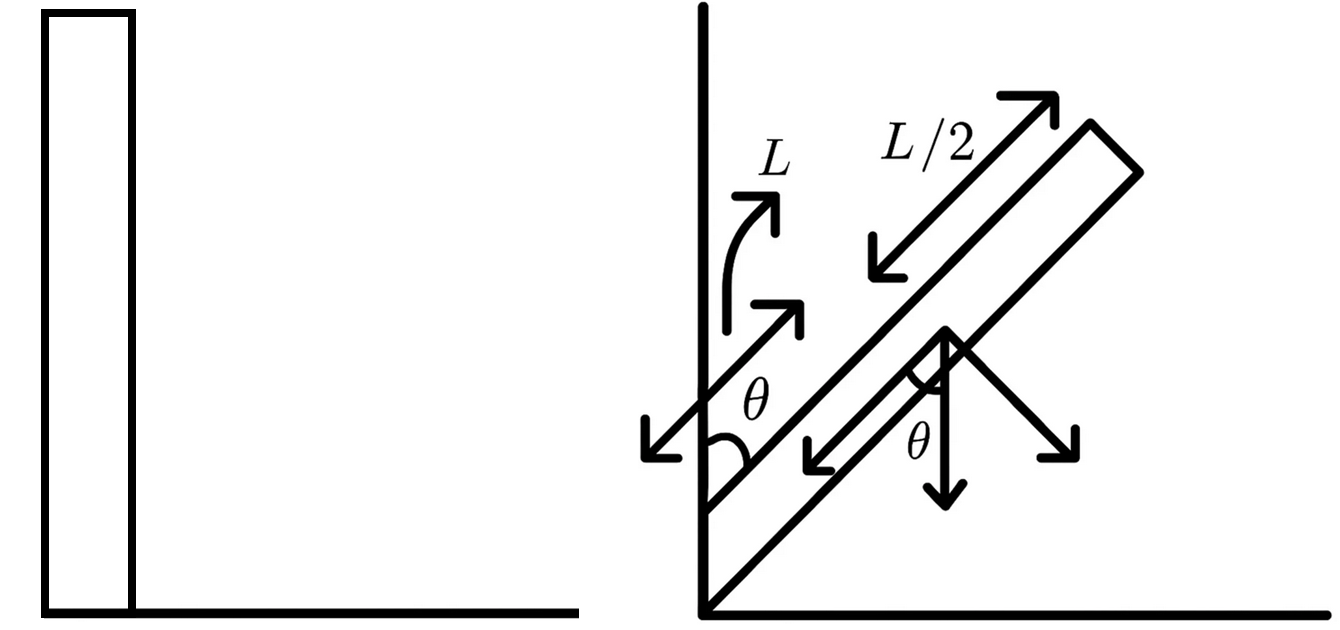
- A thin uniform rod of mass ' m ' and length ' L ' is pivoted at one end so that it can rotate in a vertical plane. The free end is held vertically above pivot and then released. The angular acceleration of the rod when it makes an angle ' \(\theta\) ' with the vertical is [consider negligible friction at the pivot] ( \(\mathrm{g}=\) acceleration due to gravity)
 MHT CET 2025 Medium