


MHT CET · Physics · Motion In Two Dimensions
A particle of mass ' \(m\) ' performs uniform circular motion of radius ' \(r\) ' with linear speed ' \(v\) ' under the application of force ' \(F\) '. If \(\mathrm{m}, \mathrm{v}\) and \(\mathrm{r}\) are all increased by \(50 \%\), the necessary change in force required to maintain the particle in uniform circular motion is
- A \(125 \%\)
- B \(150 \%\)
- C \(100 \%\)
- D \(225 \%\)
Answer & Solution
Correct Answer
(A) \(125 \%\)
Step-by-step Solution
Detailed explanation
Given that, Mass \(=\mathrm{m}\), Velocity \(=\mathrm{v}\), Radius \(=\mathrm{r}\)
We know that, The force is
\(\text F =\frac{\text{ mv} ^2}{\text r }\quad\ldots(1)\)
Now, the increment is \(50 \%\) in mass, velocity and radius
\(\text m=\text m+\frac{\text m}{2},\text v=\text v+\frac{\text v}{2}\) and \(\text r=\text r+\frac{\text r}{2}\).
Now, new force is
\(F^{\prime}=\frac{\left(m+\frac{m}{2}\right)\left(v+\frac{v}{2}\right)^2}{\left(r+\frac{r}{2}\right)}=\frac{\frac{3}{2} m \times \frac{9}{4} v^2}{\frac{3}{2} r}=F \times \frac{9}{4}\)
Now, the \% change in force
\(\frac{F^{\prime}-F}{F} \times 100=\left(\frac{9}{4}-1\right) \times 100=125 \%\)
We know that, The force is
\(\text F =\frac{\text{ mv} ^2}{\text r }\quad\ldots(1)\)
Now, the increment is \(50 \%\) in mass, velocity and radius
\(\text m=\text m+\frac{\text m}{2},\text v=\text v+\frac{\text v}{2}\) and \(\text r=\text r+\frac{\text r}{2}\).
Now, new force is
\(F^{\prime}=\frac{\left(m+\frac{m}{2}\right)\left(v+\frac{v}{2}\right)^2}{\left(r+\frac{r}{2}\right)}=\frac{\frac{3}{2} m \times \frac{9}{4} v^2}{\frac{3}{2} r}=F \times \frac{9}{4}\)
Now, the \% change in force
\(\frac{F^{\prime}-F}{F} \times 100=\left(\frac{9}{4}-1\right) \times 100=125 \%\)
See the Complete Solution
Get step-by-step explanations for this and 2.5 Lakh+ more JEE, NEET & CET questions.
- Unlock all solutions
- Practice the full chapter
- Track accuracy across PYQs
4.8 rated on Google Play · 14,000+ reviews
More questions from Physics
- A capacitor, an inductor and an electric bulb are connected in series to an a.c. supply of variable frequency. As the frequency of the supply is increased gradually, then the electric bulb is found toMHT CET 2023 Easy
- Given that ' \(x\) ' joule of heat is incident on a body. Out of that, total heat reflected and transmitted is ' \(y\) ' joule. The absorption coefficient of body is-MHT CET 2024 Easy
- The frequency of the third overtone of a pipe of length ' \(L_c\) ', closed at one end is same as the frequency of the sixth overtone of a pipe of length ' \(L_0\) ', open at both ends. Then the ratio \(\mathrm{L}_{\mathrm{c}}: \mathrm{L}_0\) isMHT CET 2024 Medium
- Water is flowing through a horizontal pipe in stream line flow. At the narrowest part of the pipeMHT CET 2023 Easy
- An a.c. source of angular frequency ' \(\omega\) ' is fed across a resistor ' \(\mathrm{R}\) ' and a capacitor ' \(\mathrm{C}\) ' in series. The current registered is I. If now the frequency of source is changed to \(\frac{\omega}{3}\) (but maintaining the same voltage), the current in the circuit is found to be halved. The ratio of reactance to resistance at the original frequency ' \(\omega\) ' will beMHT CET 2021 Hard
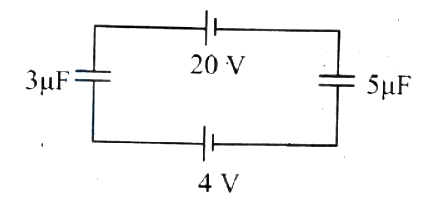
- In the circuit shown in the following figure, the potential difference cross \(3 \mu \mathrm{~F}\) capacitor is
 MHT CET 2024 Easy
More PYQs from MHT CET
- In the common emitter mode of a transistor when the collector emitter voltage is changed by \(0.4 \mathrm{~V}\), the collector current changes by \(0.04 \mathrm{~mA}\). The output resistance isMHT CET 2022 Easy
- Which among the following alkenes is most stable?MHT CET 2023 Easy
- The conductivity of 0.02 M KCl , solution is \(0.00250 \mathrm{ohm}^{-1} \mathrm{~cm}^{-1}\). What is its molar conductivity?MHT CET 2024 Easy
- Calculate the pH of 0.01 M sulphuric acid.MHT CET 2024 Hard
- In Lyman series, series limit of wavelength is \(\lambda_1\). The wavelength of first line of Lyman series is \(\lambda_2\) and in Balmer series, the series limit of wavelength is \(\lambda_3\). Then the relation between \(\lambda_1\), \(\lambda_2\) and \(\lambda_3\) isMHT CET 2023 Easy
- In \(\mathrm{M}_{\mathrm{O}}\) is the mass of an oxygen isotope \({ }_8 \mathrm{O}^{17}\) and \(M_p\) and \(M_N\) are the mass of proton and mass of neutron respectively, then the nucleus binding energy of the isotope isMHT CET 2024 Easy