


MHT CET · Physics · Oscillations
A particle executing linear S.H.M has period 3 second and amplitude \(6 \mathrm{~cm}\). The time required by it to travel a distance of \(3 \mathrm{~cm}\) from positive extreme position is
\(\left[\sin 30^{\circ}=\cos 60^{\circ}=\frac{1}{2}, \sin 60^{\circ}=\cos 30^{\circ}=\frac{\sqrt{3}}{2}\right]\)
- A 2s
- B 3s
- C 4s
- D 0.5s
Answer & Solution
Correct Answer
(D) 0.5s
Step-by-step Solution
Detailed explanation
Lets take simplest equation of SHM,
\(y=A \sin (\omega t)\)
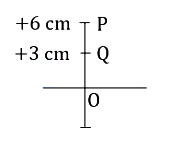
Given, \(A=6 \mathrm{~cm}, \mathrm{~T}=3 \mathrm{sec}\)
\(\therefore \omega=\frac{2 \pi}{T}=\frac{2 \pi}{3} \sec ^{-1} .\)
Time when particle reaches extreme position \(\mathrm{P}\) is \(1.5 \mathrm{sec}\).
Let time to reach \(\mathrm{Q}\) is \(\delta\).
\(\begin{aligned}
& \Rightarrow \mathrm{y}=3 \mathrm{~cm}=6 \mathrm{~cm} \sin \left(\frac{\pi}{2}+\omega \delta\right) \\
& \Rightarrow \sin \left(\frac{\pi}{2}+\omega \delta\right)=\frac{1}{2} \\
& \Rightarrow \cos (\omega \delta)=\frac{1}{2} \\
& \Rightarrow \delta=\frac{\pi}{3 \omega}=\frac{\pi(3)}{3(2 \pi)}=0.5 \mathrm{~s}
\end{aligned}\)
\(y=A \sin (\omega t)\)
Given, \(A=6 \mathrm{~cm}, \mathrm{~T}=3 \mathrm{sec}\)
\(\therefore \omega=\frac{2 \pi}{T}=\frac{2 \pi}{3} \sec ^{-1} .\)
Time when particle reaches extreme position \(\mathrm{P}\) is \(1.5 \mathrm{sec}\).
Let time to reach \(\mathrm{Q}\) is \(\delta\).
\(\begin{aligned}
& \Rightarrow \mathrm{y}=3 \mathrm{~cm}=6 \mathrm{~cm} \sin \left(\frac{\pi}{2}+\omega \delta\right) \\
& \Rightarrow \sin \left(\frac{\pi}{2}+\omega \delta\right)=\frac{1}{2} \\
& \Rightarrow \cos (\omega \delta)=\frac{1}{2} \\
& \Rightarrow \delta=\frac{\pi}{3 \omega}=\frac{\pi(3)}{3(2 \pi)}=0.5 \mathrm{~s}
\end{aligned}\)
See the Complete Solution
Get step-by-step explanations for this and 2.5 Lakh+ more JEE, NEET & CET questions.
- Unlock all solutions
- Practice the full chapter
- Track accuracy across PYQs
4.8 rated on Google Play · 14,000+ reviews
More questions from Physics
- A thin uniform rod has mass 'M' and length 'L'. The moment of inertia about an axis perpendicular to it and passing through the point at a distance \(\frac{\mathrm{L}}{3}\) from one of its ends, will beMHT CET 2020 Easy
- Kirchhoff's current law and voltage law respectively are based on the law of conservation ofMHT CET 2020 Easy
- The existence of electromagnetic waves were experimentally confirmed byMHT CET 2012 Easy
- Three black discs \(x, y, z\) have radii \(1 \mathrm{~m}, 2 \mathrm{~m}\) and \(3 \mathrm{~m}\) respectively. The wavelength corresponding to maximum intensity are \(200 \mathrm{~nm}\), \(300 \mathrm{~nm}\) and \(400 \mathrm{~nm}\) respectively. The relation between emissive power \(E_x, E_y\) and \(E_z\) isMHT CET 2022 Hard
- A force acting on a particle causes a displacement in its own direction. If the work done is 14 J, then the value of ‘a’ isMHT CET 2019 Medium
- Which of the following statements is NOT true?MHT CET 2024 Easy
More PYQs from MHT CET
- The solution of the equation \(\tan ^{-1}(1+x)+\tan ^{-1}(1-x)=\frac{\pi}{2}\) isMHT CET 2023 Easy
- For non-zero vectors \(\bar{a}, \bar{b}, \bar{c},|(\bar{a} \times \bar{b}) \cdot \bar{c}|=|\bar{a}||\bar{b}||\bar{c}|\) holds and only ifMHT CET 2022 Medium
- What is the number of oxygen atoms bonded to chlorine in its strongest oxoacid?MHT CET 2025 Easy
- Calculate the number of moles of nonvolatile solute dissolved in 0.5 kg solvent if molal elevation constant for solvent is \(2 \mathrm{~kg} \mathrm{~K} \mathrm{~mol}^{-1}\) \(\left[\Delta \mathrm{T}_{\mathrm{b}}=0.8 \mathrm{~K}\right]\)MHT CET 2025 Easy
- Cyclotron is used toMHT CET 2024 Easy
- The critical angle for light going from medium ‘x’ to medium ‘y’ is . The speed of light in medium ‘x’ is . The speed of light in medium ‘y’ isMHT CET 2019 Medium