


MHT CET · Physics · Oscillations
A particle connected to the end of a spring executes S.H.M. with period ' \(\mathrm{T}_1\) '. While the corresponding period for another spring is ' \(T_2\) '. If the period of oscillation with two springs in series is ' \(T\) ', then
- A \(\mathrm{T}=\sqrt{\mathrm{T}_1^2+\mathrm{T}_2^2}\)
- B \(\mathrm{T}=\sqrt{\mathrm{T}_2^2-\mathrm{T}_1^2}\)
- C \(\mathrm{T}=\mathrm{T}_1+\mathrm{T}_2\)
- D \(\mathrm{T}=\mathrm{T}_1-\mathrm{T}_2\)
Answer & Solution
Correct Answer
(A) \(\mathrm{T}=\sqrt{\mathrm{T}_1^2+\mathrm{T}_2^2}\)
Step-by-step Solution
Detailed explanation
\(
\mathrm{T}_1=2 \pi \sqrt{\frac{\mathrm{m}}{\mathrm{k}_1}} \quad \mathrm{~T}_2=2 \pi \sqrt{\frac{\mathrm{m}}{\mathrm{k}_2}}
\)
When the two springs are connected in series, the effective spring constant is given by \(\mathrm{T}=2 \pi \sqrt{\frac{\mathrm{m}}{\mathrm{k}}}\)
\(
\begin{aligned}
& \therefore \mathrm{T}^2=4 \pi^2 \frac{\mathrm{m}}{\mathrm{k}}=4 \pi^2 \mathrm{~m}\left[\frac{1}{\mathrm{k}_1}+\frac{1}{\mathrm{k}_2}\right]=4 \pi^2 \frac{\mathrm{m}}{\mathrm{k}_1}+4 \pi^2 \frac{\mathrm{m}}{\mathrm{k}_2} \\
& =\mathrm{T}_1^2+\mathrm{T}_2^2 \\
& \therefore \mathrm{T}=\sqrt{\mathrm{T}_1^2+\mathrm{T}_2^2}
\end{aligned}
\)
\mathrm{T}_1=2 \pi \sqrt{\frac{\mathrm{m}}{\mathrm{k}_1}} \quad \mathrm{~T}_2=2 \pi \sqrt{\frac{\mathrm{m}}{\mathrm{k}_2}}
\)
When the two springs are connected in series, the effective spring constant is given by \(\mathrm{T}=2 \pi \sqrt{\frac{\mathrm{m}}{\mathrm{k}}}\)
\(
\begin{aligned}
& \therefore \mathrm{T}^2=4 \pi^2 \frac{\mathrm{m}}{\mathrm{k}}=4 \pi^2 \mathrm{~m}\left[\frac{1}{\mathrm{k}_1}+\frac{1}{\mathrm{k}_2}\right]=4 \pi^2 \frac{\mathrm{m}}{\mathrm{k}_1}+4 \pi^2 \frac{\mathrm{m}}{\mathrm{k}_2} \\
& =\mathrm{T}_1^2+\mathrm{T}_2^2 \\
& \therefore \mathrm{T}=\sqrt{\mathrm{T}_1^2+\mathrm{T}_2^2}
\end{aligned}
\)
See the Complete Solution
Get step-by-step explanations for this and 2.5 Lakh+ more JEE, NEET & CET questions.
- Unlock all solutions
- Practice the full chapter
- Track accuracy across PYQs
4.8 rated on Google Play · 14,000+ reviews
More questions from Physics
- For a body performing simple harmonic motion, its potential energy is \(E_x\) at displacement \(x\) and \(\mathrm{E}_{\mathrm{y}}\) at displacement y from mean position. The potential energy \(\mathrm{E}_0\) at displacement \((\mathrm{x}+\mathrm{y})\) isMHT CET 2024 Medium
- In an equilateral prism the ray undergoes minimum deviation when it is incident at an angle of \(50^{\circ}\). The angle of minimum deviation isMHT CET 2024 Easy
- A pendulum clock is running fast. To correct its time, we shouldMHT CET 2021 Easy
- A galvanometer of resistance \(50 \Omega\) is connected to a battery of \(3 \mathrm{~V}\) along with a resistance of \(2950 \Omega\) in series. A full scale deflection of 30 divisions is obtained in the galvanometer. In order to reduce this deflection to 20 divisions, the resistance in series should beMHT CET 2008 Hard
- Two wires carrying current \(5 \mathrm{~A}\) and \(2 \mathrm{~A}\) are enclosed in a circular loop as shown in the figure. Another wire carrying a current of \(3 \mathrm{~A}\) is situated outside the loop. The value of \(f \overrightarrow{\mathrm{B}} \overrightarrow{\mathrm{dl}}\) around the loop is ( \(\mu_0=\) permeability of free space, \(\overrightarrow{\mathrm{dl}}\) is the length of the Amperion loop)
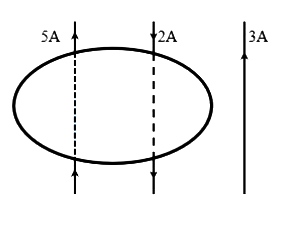 MHT CET 2021 Easy
 - Two positively charged identical spheres separated by a distance 'd' exert some force (F) on each other when they are kept in air. If both the spheres are immersed in a liquid of dielectric constant 5 , the force experienced by each is (All other parameters are unchanged.)MHT CET 2023 Hard
More PYQs from MHT CET
- Which among the following is an example of emulsion?MHT CET 2024 Medium
- Which of the following equations represents integrated rate law for zero order reaction?MHT CET 2021 Medium
- At what speed should a source of sound move so that the observer finds the apparent frequency equal to half the original frequency?MHT CET 2025 Medium
- A disc of mass \(25 \mathrm{~kg}\) and radius \(0.2 \mathrm{~m}\) is rotating at 240 r.p.m. A retarding torque brings it to rest in \(20 \mathrm{~s}\). If the torque is due to a force applied tangentially on the rim of the disc, then the magnitude of the force in newton isMHT CET 2022 Hard
- Calculate the molality of the solution containing nonvolatile solute if boiling point elevation of solution is 0.39 K .
\(\left[\mathrm{K}_{\mathrm{b}} \text { of water }=0.52 \mathrm{~K} \mathrm{~kg} \mathrm{~mol}^{-1}\right]\)MHT CET 2025 Easy - The optical path difference between two identical light waves arriving at a point is \(31.5 \lambda\), where \(\lambda\) is the wavelength of light used. The point is [Given: Two light sources are coherent]MHT CET 2022 Easy