


MHT CET · Physics · Work Power Energy
A particle at rest starts moving with a constant angular acceleration of \(4 \mathrm{rad} / \mathrm{s}^2\) in a circular path. The time at which magnitudes of its centripetal acceleration and tangential acceleration will be equal, is (in second)
- A \(\frac{1}{4}\)
- B \(\frac{1}{3}\)
- C \(\frac{1}{2}\)
- D \(\frac{2}{3}\)
Answer & Solution
Correct Answer
(C) \(\frac{1}{2}\)
Step-by-step Solution
Detailed explanation
Given that, \(\alpha=4 \mathrm{rad} / \mathrm{s}^2\)
Centripetal (radial) acceleration, \(\mathrm{a}_{\mathrm{r}}=\mathrm{r} \omega^2\)
Tangential acceleration, \(a_t=r \alpha\)
If \(a_r=a_t\), then \(r \omega^2=r \alpha\)
\(\begin{array}{ll} \therefore & \omega^2=\alpha=4 \\ \therefore & \omega=\sqrt{4}=2 \mathrm{rad} / \mathrm{s} \\ \therefore & \text { But, } \omega=\omega_0+\alpha \mathrm{t}=0+\alpha \mathrm{t}=\alpha \mathrm{t} \\ \therefore & 2=4 \mathrm{t} \\ \therefore & \mathrm{t}=\frac{1}{2} \mathrm{~s} \end{array}\)
Centripetal (radial) acceleration, \(\mathrm{a}_{\mathrm{r}}=\mathrm{r} \omega^2\)
Tangential acceleration, \(a_t=r \alpha\)
If \(a_r=a_t\), then \(r \omega^2=r \alpha\)
\(\begin{array}{ll} \therefore & \omega^2=\alpha=4 \\ \therefore & \omega=\sqrt{4}=2 \mathrm{rad} / \mathrm{s} \\ \therefore & \text { But, } \omega=\omega_0+\alpha \mathrm{t}=0+\alpha \mathrm{t}=\alpha \mathrm{t} \\ \therefore & 2=4 \mathrm{t} \\ \therefore & \mathrm{t}=\frac{1}{2} \mathrm{~s} \end{array}\)
See the Complete Solution
Get step-by-step explanations for this and 2.5 Lakh+ more JEE, NEET & CET questions.
- Unlock all solutions
- Practice the full chapter
- Track accuracy across PYQs
4.8 rated on Google Play · 14,000+ reviews
More questions from Physics
- The electric potential at a point on the axis of an electric dipole is proportional to \([\mathrm{r}=\) distance between centre of the electric dipole and the point]MHT CET 2024 Easy
- The frequency for which a \(5 \mu \mathrm{F}\) capacitor has a reactance of \(\frac{1}{1000} \Omega\) is given byMHT CET 2022 Medium
- The velocity of 4 gas molecules are given by \(1 \mathrm{~km} / \mathrm{s}, 3 \mathrm{~km} / \mathrm{s}, 5 \mathrm{~km} / \mathrm{s}\) and \(7 \mathrm{~km} / \mathrm{s}\). Calculate the difference between average and RMS velocity.MHT CET 2010 Medium
- Two point charges +8 q and -2 q are located at \(\mathrm{X}=0\) (origin) and \(\mathrm{X}=\mathrm{L}\) respectively. The net electric field due to these two charges is zero at point P on X -axis. The location of point P from the origin isMHT CET 2024 Easy
- Light of wavelength ' \(\lambda\) ' is incident on a slit of width 'd'. The resulting diffraction pattern is observed on a screen at a distance 'D'. The linear width of the principal maximum is then equal to the width of the slit if \(D\) equalsMHT CET 2023 Medium
- In a step-down transformer, the number of turns inMHT CET 2012 Easy
More PYQs from MHT CET
- The law of electromagnetic induction have been used in the construction ofMHT CET 2012 Easy
- A point mass ' \(m\) ' attached at one end of a massless, inextensible string of length ' \(\ell\) ' performs a vertical circular motion and the string rotates in vertical plane, as shown in the diagram. The increase in the centripetal acceleration of the point mass when it moves from point \(A\) to point C is
[ \(\mathrm{g}=\) acceleration due to gravity.]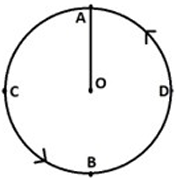 MHT CET 2025 Medium
 - If \(\bar{a}, \bar{b}, \bar{c}\) are three vectors such that \(\overline{|a|}=3, \overline{|b|}=5, \overline{|c|}=7\) then \(|\bar{a}-\bar{b}|^2+|\bar{b}-\bar{c}|^2+|\bar{c}-\bar{a}|^2\) does not exceedMHT CET 2025 Medium
- To manufacture a solenoid of length \(1 \mathrm{~m}\) and inductance \(1 \mathrm{mH}\), the length of thin wire required is
(cross - sectional diameter of a solenoid is considerably less than the length)MHT CET 2023 Medium - The size of the real image produced by a convex lens of focal length \(\mathrm{F}\) is ' \(\mathrm{m}\) ' times the size of the object. The image distance from the lens isMHT CET 2023 Medium
- A nucleosome along with linker DNA consists ofMHT CET 2016 Hard