


MHT CET · Physics · Capacitance
A parallel plate capacitor has plate area ' \(\mathrm{A}\) ' and separation between plates is 'd'. It is charged to a potential difference of \(V_0\) volt. The charging battery is then disconnected and plates are pulled apart three times the initial distance. The work done to increase the distance between the plates is \(\left(\varepsilon_0=\right.\) permittivity of free space \()\)
- A \(\frac{3 \varepsilon_0 \mathrm{AV}_0{ }^2}{\mathrm{~d}}\)
- B \(\frac{\varepsilon_0 \mathrm{AV}_0{ }^2}{2 \mathrm{~d}}\)
- C \(\frac{\varepsilon_0 \mathrm{AV}_0{ }^2}{3 \mathrm{~d}}\)
- D \(\frac{\varepsilon_0 \mathrm{AV}_0{ }^2}{\mathrm{~d}}\)
Answer & Solution
Correct Answer
(D) \(\frac{\varepsilon_0 \mathrm{AV}_0{ }^2}{\mathrm{~d}}\)
Step-by-step Solution
Detailed explanation
Let the initial capacitance be \(\mathrm{C}_0=\frac{\varepsilon_0 \mathrm{~A}}{\mathrm{~d}}\)
Let the charge on the capacitor be \(\mathrm{Q}_{\text {initial }}=\mathrm{C}_0 \mathrm{~V}_0\) Plate separation is increased by 3 times i.e., \(\mathrm{d}^{\prime}=3 \mathrm{~d}\)
\(C_{\text {final }}=\frac{\varepsilon_0 A}{3 d}=\frac{1}{3}\left(\frac{\varepsilon_0 A}{d}\right)=\frac{C_0}{3}\)
Let \(\mathrm{Q}_{\text {final }}\) be the final charge on the capacitor and \(V_{\text {final }}\) be the final potential on the capacitor.
\(\therefore \quad \mathrm{Q}_{\text {final }}=\mathrm{C}_{\text {fiñal }} \mathrm{V}_{\text {final }}=\frac{1}{3} \mathrm{C}_0 \mathrm{~V}_{\text {fial }}\)
As the capacitor is isolated,
\(\mathrm{Q}_{\text {final }}=\mathrm{Q}_{\text {initial, }} \)
\( \mathrm{C}_0 \mathrm{~V}_0 =\frac{1}{3} \mathrm{C}_0 \mathrm{~V}_{\text {fial }} \)
\( \therefore \mathrm{V}_{\text {final }}=3 \mathrm{~V}_0 \)
\( \text { Work done } =\text { Final P.E }- \text { Initial P.E } \)
\( =\frac{1}{2} \mathrm{C}_{\text {finu }}\left(\mathrm{V}_{\text {final }}\right)^2-\frac{1}{2} \mathrm{C}_0\left(\mathrm{~V}_0\right)^2 \)
\( =\frac{1}{2} \frac{\mathrm{C}_0}{3} 9 \mathrm{~V}_0^2-\frac{1}{2} \mathrm{C}_0 \mathrm{~V}_0^2 \)
\( =\mathrm{C}_0 \mathrm{~V}_0^2\left(\frac{3}{2}-\frac{1}{2}\right) \)
\( =\mathrm{C}_0 \mathrm{~V}_0^2 \)
\( =\frac{\varepsilon_0 \mathrm{~A} \mathrm{~V}_0^2}{\mathrm{~d}} \ldots\left(\because \mathrm{C}_0=\frac{\varepsilon_0 \mathrm{~A}}{\mathrm{~d}}\right)\)
Let the charge on the capacitor be \(\mathrm{Q}_{\text {initial }}=\mathrm{C}_0 \mathrm{~V}_0\) Plate separation is increased by 3 times i.e., \(\mathrm{d}^{\prime}=3 \mathrm{~d}\)
\(C_{\text {final }}=\frac{\varepsilon_0 A}{3 d}=\frac{1}{3}\left(\frac{\varepsilon_0 A}{d}\right)=\frac{C_0}{3}\)
Let \(\mathrm{Q}_{\text {final }}\) be the final charge on the capacitor and \(V_{\text {final }}\) be the final potential on the capacitor.
\(\therefore \quad \mathrm{Q}_{\text {final }}=\mathrm{C}_{\text {fiñal }} \mathrm{V}_{\text {final }}=\frac{1}{3} \mathrm{C}_0 \mathrm{~V}_{\text {fial }}\)
As the capacitor is isolated,
\(\mathrm{Q}_{\text {final }}=\mathrm{Q}_{\text {initial, }} \)
\( \mathrm{C}_0 \mathrm{~V}_0 =\frac{1}{3} \mathrm{C}_0 \mathrm{~V}_{\text {fial }} \)
\( \therefore \mathrm{V}_{\text {final }}=3 \mathrm{~V}_0 \)
\( \text { Work done } =\text { Final P.E }- \text { Initial P.E } \)
\( =\frac{1}{2} \mathrm{C}_{\text {finu }}\left(\mathrm{V}_{\text {final }}\right)^2-\frac{1}{2} \mathrm{C}_0\left(\mathrm{~V}_0\right)^2 \)
\( =\frac{1}{2} \frac{\mathrm{C}_0}{3} 9 \mathrm{~V}_0^2-\frac{1}{2} \mathrm{C}_0 \mathrm{~V}_0^2 \)
\( =\mathrm{C}_0 \mathrm{~V}_0^2\left(\frac{3}{2}-\frac{1}{2}\right) \)
\( =\mathrm{C}_0 \mathrm{~V}_0^2 \)
\( =\frac{\varepsilon_0 \mathrm{~A} \mathrm{~V}_0^2}{\mathrm{~d}} \ldots\left(\because \mathrm{C}_0=\frac{\varepsilon_0 \mathrm{~A}}{\mathrm{~d}}\right)\)
See the Complete Solution
Get step-by-step explanations for this and 2.5 Lakh+ more JEE, NEET & CET questions.
- Unlock all solutions
- Practice the full chapter
- Track accuracy across PYQs
4.8 rated on Google Play · 14,000+ reviews
More questions from Physics
- Two parallel plates separated by ' \(\mathrm{d}\) ' \(\mathrm{mm}\) are kept at potential difference of ' \(V\) ' volt. A particle of mass ' \(m\) ' and charge ' \(q\) ' enters in it with some velocity. The acceleration of the particle will beMHT CET 2022 Medium
- When the heat is given to a gas in an Isothermal process, then there will beMHT CET 2025 Easy
- A sonometer wire resonates with a given tuning fork forming standing wave with 5 antinodes between two bridges when mass of \(9 \mathrm{~kg}\) is suspended from the wire. When mass 'm' is suspended from the wire, with same fork and same length between two bridges 3 antinodes are formed. Mass \(\mathrm{M}\) isMHT CET 2020 Medium
- The magnitude of gravitational potential energy of a body at a distance ' \(R\) ' from the centre of the earth is ' \(E\) '. Its weight at a distance ' \(1.5 R\) ' from the centre of the earth isMHT CET 2025 Medium
- Two loops \(P\) and \(Q\) of radii \(R_1\) and \(R_2\) are made from uniform metal wire of same material. \(\mathrm{I}_{\mathrm{P}}\) and \(\mathrm{I}_{\mathrm{Q}}\) be the moment of inertia of loop P and Q respectively then ratio \(R_1 / R_2\) is \(\left(\right.\) Given \(\left.I_P / I_Q=27\right)\)MHT CET 2024 Medium
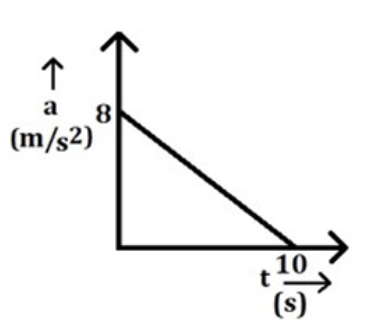
- The acceleration (a) - time (T) graph for the body starting from rest is given below. The maximum speed of the body is
 MHT CET 2025 Medium
More PYQs from MHT CET
- Identify the element having smallest ionic size in +3 state from following.MHT CET 2024 Medium
- Two parallel air capacitors have their plate areas \(100 \mathrm{~cm}^2\) and \(500 \mathrm{~cm}^2\), respectively. They have the same charge and potential. If the distance between the plates of the first capacitor is \(0.5 \mathrm{~mm}\), the distance between the plates of the second capacitor isMHT CET 2022 Easy
- The differential equation whose solution is \(y=c^2+\frac{c}{x}\), where \(c\) is constant, isMHT CET 2022 Easy
- What is the number of node in 2 s orbital?MHT CET 2025 Easy
- If the lines \(x^2-4 x y+y^2=0\) make angles \(\alpha\) and \(\beta\) with positive direction of X-axis, then \(\cot ^2 \alpha+\cot ^2 \beta=\)MHT CET 2021 Medium
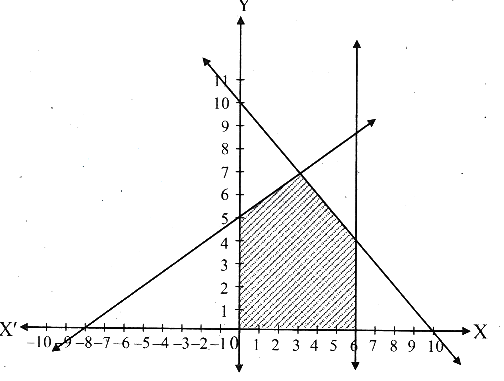
- The shaded area in the given figure is a solution set for some system of inequalities. The maximum value of the function \(z=4 x+3 y\) subject to linear constraints given by the system is
 MHT CET 2024 Easy