


MHT CET · Physics · Mechanical Properties of Fluids
A metal wire of density ' \(e\) ' floats on water surface horizontally. If it is NOT to sink in water, then maximum radius of wire is ( \(\mathrm{T}\) = surface tension of water, \(\mathrm{g}\) = gravitational acceleration)
- A \(\frac{\pi \mathrm{eg}}{\mathrm{T}}\)
- B \(\frac{\mathrm{T}}{\pi \mathrm{eg}}\)
- C \(\sqrt{\frac{2 \mathrm{~T}}{\pi \mathrm{eg}}}\)
- D \(\sqrt{\frac{\pi e g}{T}}\)
Answer & Solution
Correct Answer
(C) \(\sqrt{\frac{2 \mathrm{~T}}{\pi \mathrm{eg}}}\)
Step-by-step Solution
Detailed explanation
The correct option is (C).
There are two free surfaces as shown in the figure:
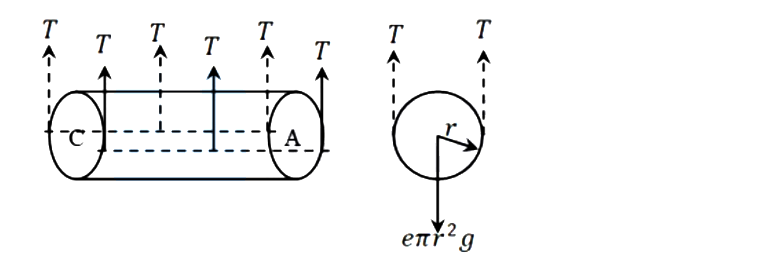
Consider the force balance per unit length as shown in the diagram above:
\(2 \mathrm{~T}=\mathrm{e} \pi \mathrm{r}^2 \mathrm{~g}\)
Therefore, \(r=\sqrt{\frac{2 \mathrm{~T}}{\pi \mathrm{eg}}}\).
We neglect buoyancy force as it is negligible as compared to surface tension force!
There are two free surfaces as shown in the figure:
Consider the force balance per unit length as shown in the diagram above:
\(2 \mathrm{~T}=\mathrm{e} \pi \mathrm{r}^2 \mathrm{~g}\)
Therefore, \(r=\sqrt{\frac{2 \mathrm{~T}}{\pi \mathrm{eg}}}\).
We neglect buoyancy force as it is negligible as compared to surface tension force!
See the Complete Solution
Get step-by-step explanations for this and 2.5 Lakh+ more JEE, NEET & CET questions.
- Unlock all solutions
- Practice the full chapter
- Track accuracy across PYQs
4.8 rated on Google Play · 14,000+ reviews
More questions from Physics
- The depletion layer in \(\mathrm{p}-\mathrm{n}\) junction region is caused byMHT CET 2024 Easy
- A charge is uniformly distributed on the surface of a spherical rubber balloon. As it is blown up, the total electric flux coming out of the surfaceMHT CET 2025 Easy
- An e.m.f. \(\mathrm{E}=\mathrm{E}_{0} \sin \omega \mathrm{t}\) is applied to a circuit containing 'L' and 'R' in series. If \(X_{L}=R\), then the power dissipated in the circuit isMHT CET 2020 Easy
- Water is flowing steadily in a river. A and B are the two layers of water at heights 40 cm and 90 cm from the bottom. The velocity of the layer A is \(12 \mathrm{~cm} / \mathrm{s}\). The velocity of the layer B isMHT CET 2025 Medium
- A black body has maximum wavelength ' \(\lambda_{\mathrm{m}}\) ' at temperature 2000 K . Its maximum wavelength at 3000 K will beMHT CET 2025 Easy
- A glass cube of length 21 cm has a small air bubble trapped inside. When viewed normally from one face, its apparent distance is 8 cm. When viewed normally from the opposite face, its apparent distance is 6 cm.
The refractive index of the glass and the actual distance of the air bubble from the first surface respectively are:MHT CET 2025 Medium
More PYQs from MHT CET
- Select the correct statement.MHT CET 2020 Hard
- Calculate the new volume of a gas at constant pressure when temperature is increased to \(546 \mathrm{~K}\) [Initial volume of a gas at \(273 \mathrm{~K}\) is \(4 \mathrm{dm}^3\) ]MHT CET 2022 Medium
- If the function
\(f(x)= \begin{cases}3 a x+b, \text { for } x < 1 \ 11, \text { for } x=1 \end{cases}\) \(\text { is continuous at } \ 5 a x\) \(-2 b,\text { for } x>1\) \(x=1\). Then, the values of \(a\) and \(b\) areMHT CET 2021 Medium - The money invested in a company is compounded continuously. ₹ 400 invested today becomes ₹ \(800\) in 6 years, then at the end of 33 years, it will become \(_{-}(\sqrt{2} = 1 \cdot 4142)\)MHT CET 2025 Medium
- Which one of the following is an example of cane sugar?MHT CET 2022 Easy
- Find the value of \(-197^{\circ} \mathrm{C}\) temperature in Kelvin.MHT CET 2021 Easy