


MHT CET · Physics · Electromagnetic Induction
A metal rod of length ' 1 ' rotates about one of its ends in a plane perpendicular to a magnetic field of induction ' \(B\) '. If the e.m.f. induced between the ends of the rod is ' \(\mathrm{e}\) ' then the number of revolutions made by the rod per second is
- A \(\frac{\pi \ell^2}{\mathrm{eB}}\)
- B \(\frac{\mathrm{e}}{\mathrm{B} \pi \ell^2}\)
- C \(\frac{\mathrm{e}}{\mathrm{B} \pi^2 l}\)
- D \(\frac{\mathrm{B}^2}{\mathrm{e} \pi \ell}\)
Answer & Solution
Correct Answer
(B) \(\frac{\mathrm{e}}{\mathrm{B} \pi \ell^2}\)
Step-by-step Solution
Detailed explanation
The induced emf e \(=\frac{\mathrm{d} \phi}{\mathrm{dt}}=\frac{\mathrm{d}}{\mathrm{dt}}(\mathrm{AB})=\mathrm{B} \frac{\mathrm{dA}}{\mathrm{dt}}\)
In one rotation the rod traces out a circle of radius 1 or an area \(\mathrm{A}=\pi \mathrm{l}^2\)
So, in \(n\) rotations it will trace out an area of \(n \pi l^2\)
\(\therefore \mathrm{e}=\mathrm{B} \frac{\Delta \mathrm{A}}{\Delta \mathrm{t}}=\mathrm{B} \cdot \frac{\mathrm{n} \pi \mathrm{l}^2}{\Delta \mathrm{t}} \)
\( \text {But } \frac{\mathrm{n}}{\Delta \mathrm{t}}=\frac{\text {No.of rev.performed }}{\text { time }}=\) \(\text { frequency } \mathrm{f} \)
\( \therefore \mathrm{e}=\mathrm{Bf} \pi \mathrm{l}^2=\text { Bf.A } \)
\( \therefore \mathrm{f}=\frac{\mathrm{e}}{\mathrm{B} \pi \mathrm{l}^2}\)
In one rotation the rod traces out a circle of radius 1 or an area \(\mathrm{A}=\pi \mathrm{l}^2\)
So, in \(n\) rotations it will trace out an area of \(n \pi l^2\)
\(\therefore \mathrm{e}=\mathrm{B} \frac{\Delta \mathrm{A}}{\Delta \mathrm{t}}=\mathrm{B} \cdot \frac{\mathrm{n} \pi \mathrm{l}^2}{\Delta \mathrm{t}} \)
\( \text {But } \frac{\mathrm{n}}{\Delta \mathrm{t}}=\frac{\text {No.of rev.performed }}{\text { time }}=\) \(\text { frequency } \mathrm{f} \)
\( \therefore \mathrm{e}=\mathrm{Bf} \pi \mathrm{l}^2=\text { Bf.A } \)
\( \therefore \mathrm{f}=\frac{\mathrm{e}}{\mathrm{B} \pi \mathrm{l}^2}\)
See the Complete Solution
Get step-by-step explanations for this and 2.5 Lakh+ more JEE, NEET & CET questions.
- Unlock all solutions
- Practice the full chapter
- Track accuracy across PYQs
4.8 rated on Google Play · 14,000+ reviews
More questions from Physics
- The ratio of work done by an ideal rigid diatomic gas to the heat supplied by the gas in an isobaric process isMHT CET 2024 Easy
- A parallel monochromatic beam of light is incident normally on a narrow slit. A diffraction pattern is formed on a screen placed perpendicular to the direction of the incident beam. At the first maximum of the diffraction pattern, the phase difference between the rays coming from the edges of the slit isMHT CET 2022 Medium
- In the network shown cell of emf E has internal resistance r and the galvanometer shows zero deflection. If the cell is replaced by a new cell of emf 2E and internal resistance 3r keeping everything else identical then
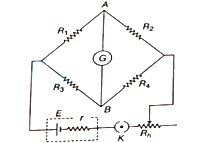 MHT CET 2019 Medium
 - \(\mathrm{I}_1\) is the moment of inertia of a circular disc about an axis passing through its centre and perpendicular to the plane of disc. \(I_2\) is its moment of inertia about an axis AB perpendicular to plane and parallel to axis \(\mathrm{CM}\) at a distance \(\frac{2 R}{3}\) from centre. The ratio of \(I_2\) and \(I_1\) is \(x= 9\). The value of ' \(x\) ' is ( \(\mathrm{R}=\) radius of the disc)
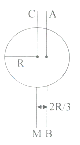 MHT CET 2023 Hard
 - The difference in length between two rods \(\mathrm{A}\) and \(\mathrm{B}\) is \(60 \mathrm{~cm}\) at all temperatures. If \(\alpha_{\mathrm{A}}=18 \times 10^{-6} /{ }^{\circ} \mathrm{C}\) and \(\beta_{\mathrm{B}}=27 \times 10^{-6} /{ }^{\circ} \mathrm{C}\), the lengths of the two rods areMHT CET 2023 Medium
- In the experiment to determine the internal resistance of a cell (E1) using potentiometer, the resistance drawn from the resistance box is \({ }^{\prime} \mathrm{R}^{\prime}\). The potential difference across the balancing length of the wire is equal to the terminal potential difference (V) of the cell. The value of internal resistance (r) of the cell isMHT CET 2020 Easy
More PYQs from MHT CET
- Given below are two statements.
Statement I - The isolated DNA of donor organism is cleaved by suitable restriction endonuclease to form DNA fragments with cohesive staggered or blunt ends.
Statement II - The foreign DNA or passenger DNA can also be obtained directly from genomic or cDNA library.
In the light of above statements, select the correct option given below:MHT CET 2025 Medium - Concave and convex lenses are placed touching each other. The ratio of magnitudes of their power is \(2: 3\). The focal length of the system is 30 cm . The focal lengths of individual lens areMHT CET 2024 Hard
- Which of the following is obtained as major product when excess of methane is treated with limited chlorine in presence of UV light?MHT CET 2025 Easy
- The value of \(\tan \left(2 \tan ^{-1}\left(\frac{\sqrt{5}-1}{2}\right)\right)\) isMHT CET 2024 Medium
- Which among the following has lowest boiling point?MHT CET 2024 Easy
- What is percent dissociation of \(\mathrm{NH}_4 \mathrm{OH}\) if molar conductance at zero concentration for \(\mathrm{NH}_4 \mathrm{Cl}, \mathrm{NaCl}\) and NaOH are 130,109 and \(213 \mathrm{~S} \mathrm{~cm}^2 \mathrm{~mol}^{-1}\) respectively and molar conductivity of \(0.01 \mathrm{M} \mathrm{NH}_4 \mathrm{OH}\) is \(9.0 \mathrm{~S} \mathrm{~cm}^2 \mathrm{~mol}^{-1}\) ?MHT CET 2025 Medium