


MHT CET · Physics · Electromagnetic Induction
A metal disc of radius ' \(\mathrm{R}\) ' rotates with an angular velocity ' \(\omega\) ' about an axis perpendicular to its plane passing through its centre in a magnetic field of induction ' \(\mathrm{B}\) ' acting perpendicular to the plane of the disc. The induced e.m.f. between the rim and axis of the disc is (magnitude only)
- A \(\frac{R \omega^2 R^2}{2}\)
- B \(\frac{\mathrm{R} \omega \mathrm{R}}{2}\)
- C \(\frac{B \omega^2 R}{2}\)
- D \(\frac{\mathrm{B} \omega \mathrm{R}^2}{2}\)
Answer & Solution
Correct Answer
(D) \(\frac{\mathrm{B} \omega \mathrm{R}^2}{2}\)
Step-by-step Solution
Detailed explanation
The correct option is (D).
We can imagine the disc to be a collection of thin rods connected in parallel between the center of the disc and the rim. So if we calculate the induced emf on a thin rod rotating about its axis then this should be equal to that of the disc.
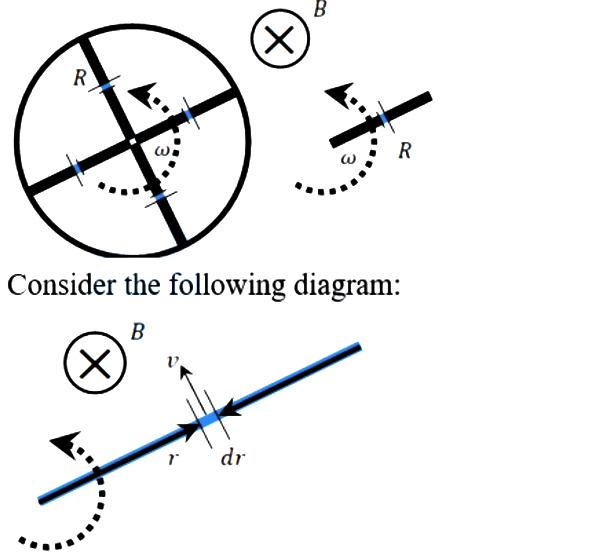
The tiny motional emf developed across the element dr can be written as:
\(\mathrm{dE}=\mathrm{Bvdr}\)
Taking the velocity \(\mathrm{v}=\omega \mathrm{r}\),
\(\mathrm{dE}=\mathrm{B} \omega \mathrm{rdr}\)
On integrating across the rod,
\(\left.\mathrm{E}=\int_0^{\mathrm{R}} \mathrm{B} \omega \mathrm{rdr}=\frac{\mathrm{B} \omega \mathrm{r}^2}{2}\right]_0^{\mathrm{R}}=\frac{\mathrm{B} \omega \mathrm{R}^2}{2}\)
We can imagine the disc to be a collection of thin rods connected in parallel between the center of the disc and the rim. So if we calculate the induced emf on a thin rod rotating about its axis then this should be equal to that of the disc.
The tiny motional emf developed across the element dr can be written as:
\(\mathrm{dE}=\mathrm{Bvdr}\)
Taking the velocity \(\mathrm{v}=\omega \mathrm{r}\),
\(\mathrm{dE}=\mathrm{B} \omega \mathrm{rdr}\)
On integrating across the rod,
\(\left.\mathrm{E}=\int_0^{\mathrm{R}} \mathrm{B} \omega \mathrm{rdr}=\frac{\mathrm{B} \omega \mathrm{r}^2}{2}\right]_0^{\mathrm{R}}=\frac{\mathrm{B} \omega \mathrm{R}^2}{2}\)
See the Complete Solution
Get step-by-step explanations for this and 2.5 Lakh+ more JEE, NEET & CET questions.
- Unlock all solutions
- Practice the full chapter
- Track accuracy across PYQs
4.8 rated on Google Play · 14,000+ reviews
More questions from Physics
- A uniform wire \(20 \mathrm{~m}\) long and weighing \(50 \mathrm{~N}\) hangs vertically. The speed of the wave at mid point of the wire is (acceleration due to gravity \(=\mathrm{g}=10 \mathrm{~ms}^{-2}\) )MHT CET 2023 Medium
- An ideal gas at \(27^{\circ} \mathrm{C}\) is compressed adiabatically to (8/27) of its original volume. If ratio of specific heats, \(\gamma=5 / 3\) then the rise in temperature of the gas isMHT CET 2021 Medium
- When 100 V d.c. is applied across a solenoid, a current of 1 A flows in it. When 100 a.c. is applied across it, the current drops to 0.5 A . If the frequency is 50 Hz , the impedance and inductance isMHT CET 2024 Hard
- A diatomic gas \(\left(\gamma=\frac{7}{5}\right)\) is compressed adiabatically to volume \(\frac{\mathrm{v}_0}{32}\), where \(V_0\) is its initial volume. The initial temperature of the gas is \(T_i\) in kelvin and the final temperature is \(\mathrm{xT}_{\mathrm{i}}\) in kelvin. The value of x isMHT CET 2025 Medium
- Railway track is made of steel segments separated by small gaps to allow for linear expansion. The segment of track is 10 m long when laid at temperature \(17^{\circ} \mathrm{C}\). The maximum temperature that can be reached is \(45^{\circ} \mathrm{C}\). Increase in length of the segment of railway track is ' \(x\) ' \(\times 10^{-5} \mathrm{~m}\). The value of ' \(x\) ' is \(\left(\alpha_{\text{steel }}=\right.\) \(\left.1.2 \times 10^{-5} /{ }^{\circ} \mathrm{C}\right)\)MHT CET 2024 Medium
- A sonometer wire resonates with a given tuning fork forming standing waves with five antinodes between the two bridges when a mass of \(9 \mathrm{~kg}\) is suspended from the wire. When this mass is replaced by a mass \(\mathrm{M}\), the wire resonates with the same tuning fork forming three antinodes for the same positions of the bridges. The value of ' \(M\) ' isMHT CET 2021 Medium
More PYQs from MHT CET
- Two cards are drawn successively with replacement from a well shuffled pack of 52 cards. Let X denote the random variable of number of jacks obtained in the two drawn cards. Then \(\mathrm{P}(\mathrm{X}=1)+\mathrm{P}(\mathrm{X}=2)\) equalsMHT CET 2024 Hard
- In an a.c. circuit with pure capacitance 'C' and a.c. source \(\mathrm{E}=\mathrm{E}_0 \sin \omega \mathrm{t}\), the equation of instantaneous current is given byMHT CET 2025 Easy
- If \(x^{2} y^{2}=\sin ^{-1} \sqrt{x^{2}+y^{2}}+\cos ^{-1} \sqrt{x^{2}+y^{2}}\), then \(\frac{d y}{d x}=\)MHT CET 2020 Easy
- What type of following forces is present in ethylene glycol?MHT CET 2024 Medium
- Which one of the following statements is 'NOT' True about the angle of contact of a liquid?MHT CET 2022 Easy
- Which element from following exhibits common oxidation state +2 only?MHT CET 2022 Easy